We Need to Protect Our Forest Preserves. We Also Need to Go Beyond Them
Forest preserves and national forests are some of our greatest remaining treasures in the U.S. But ‘nature’ doesn’t, and shouldn’t, stop at their borders.
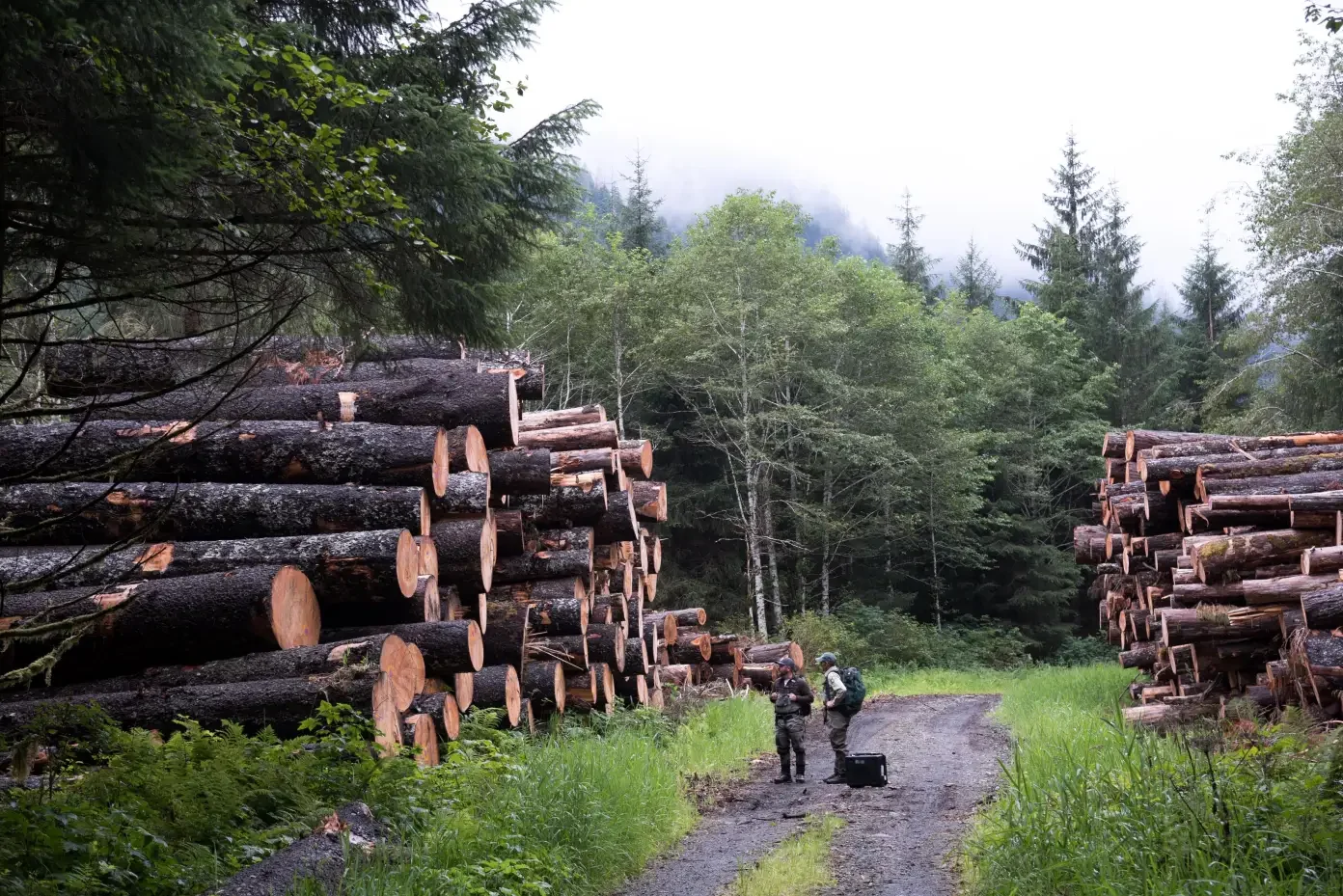
Photo courtesy of Brandon Hill, Trout Unlimited
The Trump administration’s systematic dismantling of the U.S. Forest Service, what More Than Just Parks describes as “the most devastating attack on the U.S. Forest Service in its 121-year history,” is underway with grave consequences for national parks and national forests across the nation.
The administration made a press release detailing the changes on March 31st without the usual aplomb and self-aggrandizement, perhaps due to how wildly unpopular such a move would likely be across party lines.
The desperate-sounding announcement, which as of the time of writing can’t even be fully accessed either via USDA or the U.S. Forest Service’s website, spins the disintegration as the prioritization of “common sense forest management,” as a ‘sweeping restructuring’ rather than a grotesque attack on an easily affordable, essential public service.
It should come as no surprise. It would seem ‘common sense’ for a rapacious billionaire capitalist deeply in service to oligarchic power to move the U.S. Forest Service’s headquarters to Salt Lake City where mining and logging interests dominate, where priceless national forests are too often treated as commodities with no thought to the long-term damage, where destroying some of the last acres of public natural beauty on a continent that was once a figurative Eden is considered ‘good business’ for the extractive, lizard-brained impulses of a system that can never have enough.
In other words, like a patient diagnosed with a terminal illness, the U.S. Forestry Service has been moved there to wither and die. It’s a common tactic for oligarchic power to undermine, underfund, and ultimately cripple public services and institutions before rendering them all but inert, unresponsive to the spirit of their original mission, a form of corruption known as ‘regulatory capture.’
Like so much of what has happened to public services and institutions in the neoliberal era of hyper-financialized, amoral, suicidal profit maximization, it calls upon those who have retained their humanity to gather and fight.
It’s the fight to defend our forest preserves, national forests, national parks and public lands, to hold as sacred whatever has not yet been despoiled by the ravages of extractive economic forces which would ‘cut the last tree’ if there was no one to stop them, forces so spiritually bankrupt as to do something as insane and destructive as divert Lake Tahoe’s major energy source to power an AI datacenter.
Why the Fight for Conservation Transcends National Forest Lines
However, we must also appreciate that part of what has helped us get to such a dismal point is a broader cultural failure to appreciate nature as something which does not occur merely within predetermined borders.
While we should work to protect and maintain those public institutions we do have, it is ultimately insufficient and even shortsighted to suppose that underfunded regulatory agencies alone can do that work in a culture that operates under the assumptions of capital, a culture that continues to so frequently and fundamentally overlook the deep importance of sustainable ecology in nearly every facet of its day-to-day economy.
Perhaps no one alive in America today has more incisively and eloquently written on the failings of American capital and consumer culture to grasp the deep importance of natural systems than Wendell Berry. A widely celebrated novelist, poet, essayist and environmental advocate (and, perhaps most importantly, a farmer), Berry’s sharp wit has produced myriad polemics of American culture that characterize it as profoundly dissociated from the natural world.
Forthright and clear, it is not difficult to connect with Berry through his passionate writing as a staunch defender of the land, with publications such as his 1973 poem “Manifesto: The Mad Farmer Liberation Front.” Ever focused on developing an intimacy with one’s sense of place in the world (and as such, inevitably one’s sense of place within nature), Berry advocated for an understanding of progress not measured by the industrial, the mechanized, and the digitized, but rather a deepening relationship between the land and humans, to be an essential part of it as a working whole.
With respect to wilderness ‘preservation,’ Berry has naturally supported such efforts on their face: of course we should wish to fight for what natural beauty is left in a nation so runover by the machine with no love for the land, the miner with no thought for the rivers, or logger with no care for the forest.
Yet, he recognized those preservation efforts as not only insufficient, but a product of a strategy and culture that has essentially segmented nature, locking it away as a thing that happens ‘out there’ in pre-approved spaces rather than all around us.
Writes Sarah Leonard, Associate Editor for Dissent Magazine, Berry effectively opposed “the national-parks model of conservation: purity on this side, despoliation on the other.”
In her interview with Berry, he describes industrial meat production as a system that “confines animals closely in one place and grows their food in another place, usually distant. This breaks the fertility cycle and violates all the principles of nature on which sustainable agriculture and a dependable food supply depend,” working to illustrate that the relationship between the productive capacity of a land and its sustainability within natural systems is not whatsoever separable, and that to pursue the former without the latter is to court the very process we are undergoing today: collapse.
Writes Berry himself in ‘A Forest Conversation,’ (most easily found in Wendell Berry: Essays 1993-2017, Library of America, 2019)
“At present, too ignorant to know how ignorant we are, we believe that we are free to impose our will upon the land with the utmost power and speed to gain the largest profit in the shortest time, and we believe that there are no penalties for this.”
Continuing, “The issue of land use is not on the agenda of most conservation organizations, which have been primarily concerned throughout their history with the preservation of wilderness and wildlife habit, even thought most land is being used, and used badly, and though no wilderness or wildlife can survived the prolonged abuse of economic landscapes.” (pg. 584)
In other words, Berry critiques conservation organizations for failing to carry forward a vision of ecology and ‘conservation’ that contains within it not just lands previously delineated for the purposes of conservation, e.g. forest preserves, but all land (here referred to as ‘economic landscapes’) which is to say most of the actual square mileage in the United States.
For if overwhelming majority of the ‘productive’ land in use in America today is used for unsustainable industrial production (agriculture, minerals, timber, so on), then that is to conclude that the overwhelming majority of the land in America today is at risk of or already undergoing ecological collapse.
That this could be overlooked so often by modern conservation efforts is perhaps less a symptom of ignorance on the part of today’s admirable naturalists and more a reflection of powerlessness in the face of capitalist realism, in the face of systems that struggle to understand the value of the natural world whatsoever.
Without a culture that sees sustainability as an issue of the utmost importance, without children who have as well-developed a relationship to the natural world as they do LCDs, that battle has been ever uphill.
Yet, walling off those areas worthy of legal protection and reducing conservation efforts to ‘natural’ holding pens in the context of an industrial society is to effectively admit defeat from the starting line.
Writes Berry in The New Agrarianism: Land, Culture, and the Community of Life (Princeton University Press, 2012), “…the most significant weakness of the conservation movement is its failure to produce or espouse an economic idea capable of correcting the economic idea of the industrialists,” arguing that to make nature merely a subject of “contemplation or art” ignores its inevitable economic dimension, thereby forfeiting the ground to industrialists entirely.
Berry identifies the origins of this sanctified, contained, ‘cathedral’ attitude toward national parks and forest preserves as traceable to Romantic poets such as Wordsworth. Notes National Parks Traveler in a piece on Berry, he argues in A Small Porch (Penguin, 2017) that Wordsworth put forward this model of “industrial-age conservation” which seeks to preserve ‘wilderness’ in “certain favorited places,” yet all in an implicit effort to exculpate ourselves from the raping of the natural world in every other corner machines could reach.
Like the failure that has been recycling in whatsoever sufficiently addressing industrial society’s impact on the natural world, reducing conservation to a handful of designated parks is thereby akin to a palliative upon the psyche of a nation whose relationship to the natural world has been, in fact, all but severed.
In the late hour of 2026, it is hard to argue with the failures of this model: underfunded and ever on the backfoot, the devastation of the U.S. Forestry Service is another demonstration of how existing preservation efforts simply cannot deter the growing stranglehold that oligarchic capital interests have on national policy.
As such, those efforts cannot ultimately protect public lands into the future.
Berry offers the frank admission that too little has been done, and too late, because ever-lacking from the discussion is an understanding for how land both preserved andused for economic output simply must be managed carefully and sustainably to prevent total ecological collapse.
In brief, the logger must log because human activity continues to require logging, but how should that logging be done? (Note, this comprises the subject of the remainder of ‘A Forest Conversation’). Moreover, how should humans understand their relationship to the natural world no matter its ‘preservation’ status?
Toward a New Culture to Protect All Lands
Writes Berry in “Preserving Wildness” (Wyoming Outdoor Council,1986), “…it is more important than ever that we should have cultures capable of making us into humans-creatures capable of prudence, justice, fortitude, temperance, and the other virtues.” (pg. 526)“
Ultimately, change must start at home, in local communities, and in a deeper relationship to ones local environment as Berry so often advocated. While that doesn’t mean one has to do it alone, it does mean one has to start.
Writes Berry in his 2017 ‘Think Little,’“If you are concerned about the proliferation of trash, then by all means start an organization in your community to do something about it. But before – and while you organize, pick up some cans and bottles yourself. That way, at least, you will assure yourself and others that you mean what you say.”
Continuing, Berry extends this example to any who might worry over the pollution in the air or water that they ought do what they can collectively, but not at the expense of a relationship to nature that sustains and reinforces those beliefs locally and even individually. In logic is simple: the impassioned wilderness defender has a passionate relationship to the wilderness.
To those unversed in Berry’s writing, this might seem like an attempt to shift the burden of (e.g.) CO2 emissions to the individual when industry is responsible for the vast majority of carbon emissions today; reports InfluenceMap’s Carbon Majors Database, some 80% of global CO2 emissions come from just 57 companies.
In fact, it’s become popular to point out that individual actions are in no way a sufficient response to the climate crisis without a systemic transformation of the industrial systems which devastate the planet.
While that’s true, it is wrong-spirited if used as an argument to absolve the individual of local action and personal accountability toward whatever they do have control over. And that local, individual level is, as ever, where we must begin, not because our local actions can impact global trends individually, but because together with others and local communities we can foster a culture that will impact those global trends and policies.
Berry reminds us to do what we can at home not because he is whatsoever ignorant of the scope of industrial society’s impact; indeed, that is the backbone of his contention with the national parks system.
Rather, he reminds us to step up because if we do not do so as a collective culture that at last profoundly understands, respects, and defends the intelligible and sustainable use of natural systems, then ours is a culture that won’t survive.
No matter what it is, no matter how we start, we must do it. Whether that’s start a home garden (even if you feel like you might not have the space to do so), propagate native plants, or even become a forest warden who works to remove invasive species, we can’t confine our understanding of nature to a park any more than we can reduce our relationship to nature to nonprofit donations while we continue to purchase single-use plastics.
Without this essential shift, we haven’t got a shot in hell going forward into a 21st century where the tab is already past due. But we can do it, and even on the local scale, the benefits to our health and our communities are immediate and lasting.
Take Action
Organizations readers can support
Readers looking to support public lands, wildlife protection and conservation advocacy can start with the organizations below.