
The ‘Trillion Dollar’ Man: SpaceX and the Great Passive Wealth Transfer
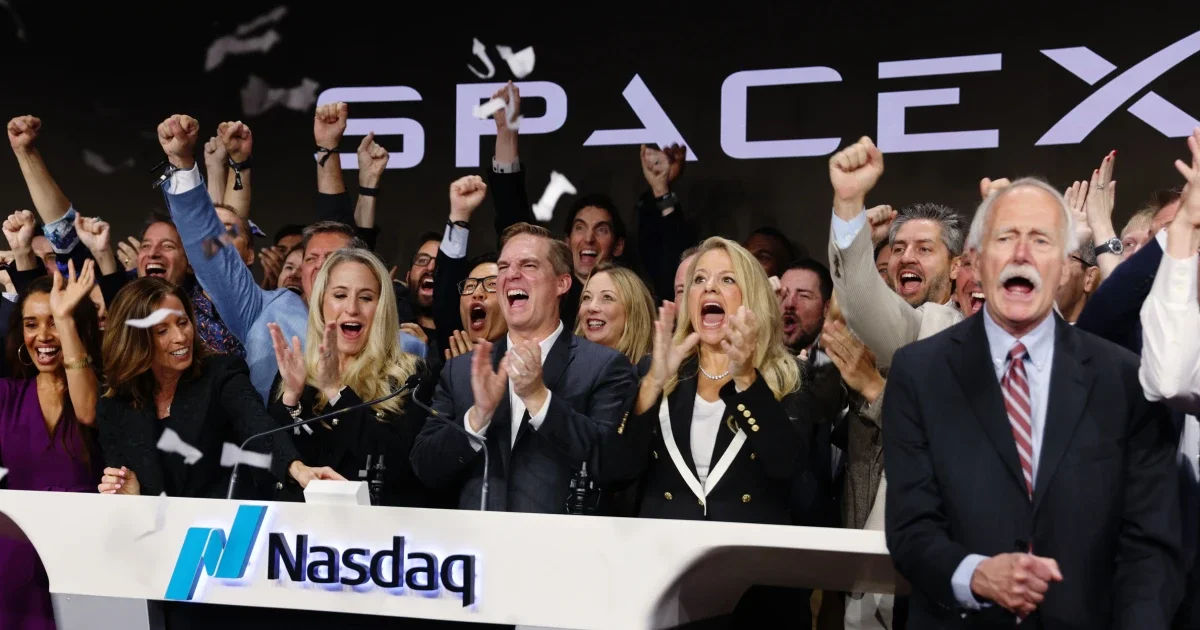
Image courtesy of NBC
The Trillion Dollar Man
The Trillion Dollar Man is a reported systems essay series about the rules, defaults and financial structures that turn workers’ retirement savings into capital for companies they may never choose, understand or meaningfully influence.
This first installment examines SpaceX’s recent public listing as a case study in how retirement defaults, index rules and founder-controlled governance can place ordinary workers’ savings inside companies they may never choose or meaningfully influence. It begins with a composite teacher, built from public commentary by retirement savers and the common mechanics of workplace retirement plans. She is not one person or one account, but rather represents the millions of workers whose paychecks enter target-date funds by default.
She is twenty-five, a year into teaching and she has never bought a stock in her life. On the day she signed her employment paperwork, a box was already checked. Five percent of every paycheck would route into the retirement plan her district offered, and because she did nothing, that money landed in the plan's default, a target-date fund built around the year she turns sixty-five.
She has never looked at what it holds. Almost no one her age does. That dollar moves on its own now, every two weeks, into a machine she will never see.
The system changed this year, and it changed for one company. When SpaceX listed its shares, the dollar that leaves her paycheck started buying a slice of it automatically, at the price the market set on the way in, in whatever volume the index demanded. She was never asked.
By design, she could not be. That is what a passive default means. It removes the human from the purchase, which is exactly the feature that makes it efficient, and exactly the feature that makes it useful to someone who wants a buyer that cannot say no.
The evidence that follows shows how the system works and who benefits from it. Index inclusion was sold to the public as a mirror. A neutral rule decides which companies are large enough to belong in the benchmark, and the funds that track the benchmark simply reflect what is already there.
In 2026, the mirror began directing money according to rules set by institutions other than the savers whose contributions followed it. Faster inclusion rules opened a path for a listing whose governance structure concentrates voting control in a single founder. The teacher’s contribution buys shares, while the authority attached to those shares remains concentrated elsewhere. Her retirement account supplies the capital while the system assigns the power.
This story runs now because the rule changed. Nasdaq’s revised methodology took effect on May 1, 2026, creating a faster path into the index for qualifying new listings. Within weeks, SpaceX had filed to go public, Morningstar had valued the company far below its reported listing target, and retirement savers were beginning to take notice.
On one personal-finance forum, a worker asked the question the whole system is built to keep her from asking: if her plan holds the wrong funds, will they be "forced to buy SpaceX stock, which apparently is super duper over valued," and is there "anything we can do to not lose our 401k money?" The structure underneath her question is the story, and it is older and colder than any one listing.
The alarm has reached Washington in an adjacent form. Senator Elizabeth Warren has publicly pressed the SEC's chair, Paul Atkins, warning that workers could "lose big" as the administration moves to let crypto into 401(k) plans. The mechanism in this story is different but the worry is the same: retirement money steered into assets the saver never chose.
Picture the moment she might look: one day, when the balance is finally large enough to feel real, she clicks past the number to the page almost no one opens, the holdings. There is a list of tickers she never chose and mostly cannot name. The design of her plan is precisely that no single person ever had to decide. That is the part worth sitting with. The one buyer at the center of this story is the one buyer who never agreed to buy. Her statement shows her a balance, while the voting power attached to those shares remains concentrated elsewhere.
A widely shared post on the Bogleheads subreddit forum put the fear in plain words, worrying that this was "private investors, like venture capitalists, Elon Musk, and his inner circle," able to dump "their overpriced money losing company on regular investors like us," with the rule change meaning "all of us automatically buying SpaceX shares at a high price."
“ The default removes the human from the purchase. That is what makes it efficient, and what makes it useful to someone who wants a buyer that cannot say no."
The Rulebook That Moved
Start with the rule, because the rule is where the choice was made. For years, a newly public company had to wait before a major index would admit it.
The Nasdaq-100 required months of seasoning, a window meant to let a stock trade, settle, and show a real price before the benchmark forced billions of passive dollars to buy it.
Effective May 1, 2026, after a public consultation, Nasdaq introduced a faster path: inclusion "will normally be effective after the 15th day of trading" for a qualifying new listing, where the old rule made it wait far longer.
The seasoning window did not shrink for every company, but it did shrink for the largest arrivals, the ones big enough to move the whole index when they enter.
The same season, FTSE Russell opened a parallel door. Its IPO Fast Entry change, approved and implemented in late May 2026, lets an IPO large enough to clear the Russell Top 500 enter "after the close of the fifth day of trading following the initial listing".
A companion update to FTSE's global Ground Rules, new Rule 8.1.1 dated May 26, 2026, goes further in a direction that matters here, letting "a security with a free float and/or voting rights of 5% or less" qualify for fast entry under defined conditions. A rule written to admit companies that float almost nothing to the public is a rule built for exactly the kind of listing this story is about.
A five-day window can also place inclusion within the stretch just after an offering when underwriters are still permitted to support the price under the SEC's stabilization rules. Forced buyers may arrive while the sellers' own bankers are holding the price up.
| Index Provider | Previous Rule | 2026 Change | Decision |
|---|---|---|---|
| Nasdaq-100 | Months of seasoning | Inclusion normally follows the 15th day of trading. Effective May 1, 2026 | Loosened |
| FTSE Russell | Longer seasoning period | Entry after the fifth trading day; low-float fast entry under Rule 8.1.1. May 2026 | Loosened |
| S&P Dow Jones | 12 months + profitability screen | No changes to seasoning, financial-viability or minimum-float requirements. June 4, 2026 | Held the line |
Index Provider
Previous Rule
Months of seasoning
2026 Change
Inclusion normally follows the 15th day of trading.
Effective May 1, 2026Index Provider
Previous Rule
Longer seasoning period
2026 Change
Entry after the fifth trading day; low-float fast entry under Rule 8.1.1.
May 2026Index Provider
Previous Rule
12 months + profitability screen
2026 Change
No changes to seasoning, financial-viability or minimum-float requirements.
June 4, 2026Set against this, one index company said no. On June 4, 2026, after its own consultation, S&P Dow Jones Indices announced that "no changes will be made to the eligibility criteria including financial viability screens, seasoning period, or minimum IWF, for the S&P 500, S&P MidCap 400, or S&P SmallCap 600 as a result of the S&P Dow Jones Indices consultation on the treatment of MegaCap companies".
Its existing twelve-month seasoning and profitability screens stayed in force. That refusal is the control case for this whole investigation, and the series will return to it.
The index providers argue that faster entry keeps benchmarks aligned with the investable market when a giant company begins trading outside them. That is a coherent argument, but it is also worth knowing who is making it.
Nasdaq is a for-profit company that earns fees from listings and from licensing its indexes, and FTSE Russell is owned by the London Stock Exchange Group, another for-profit exchange.
The body writing the rule that admits a company is paid, in part, by the business of admitting companies, is a structural conflict worth examining further.
The Lock
What the forced dollar buys is not an ordinary share, but rather an economic stake with limited voting power.
According to SpaceX's S-1, the company is listed with a dual-class structure: the shares sold to the public carry one vote each, and the shares held by the founder and insiders carry ten.
The filing leaves Elon Musk with overwhelming voting control, a large majority of the vote resting on a minority of the company's economics through his hold on the super-voting Class B.
One investor in the ValueInvesting subreddit compressed the whole structure into a sentence on a value-investing forum: "Each Class B share carries 10 votes. Musk controls all shareholder outcomes.” A minority of the company's economics commands a supermajority of its votes, in perpetuity.
The charter, again per the company's S-1, hardens that gap. The structure makes removing the chief executive a practical impossibility without his own consent, pushes shareholder disputes into mandatory arbitration, and uses a Texas incorporation that raises the bar for the derivative lawsuits that are usually the last tool a diluted investor holds.
Lucian Bebchuk and Kobi Kastiel, two Harvard corporate-governance scholars, also placed the gap between Musk's votes and his economics at the extreme end, even by the standards of other founder-controlled tech companies.
The honest counter is that none of this is hidden, and none of it is new. The dual-class structure is fully disclosed and familiar across major technology companies. Alphabet and Meta both have them, and Snap sold shares with no vote at all.
An investor who reads the filing can weigh those terms before deciding whether to buy. In a default retirement plan, the worker supplies the capital, while the structure determines where it goes, without their input.
As one investor wrote, every index fund on earth, "your Vanguard three-fund portfolio, your target-date retirement account, your 401k you've never looked at, is contractually required to buy SpaceX shares proportional to its index weight with no vote, no opt-out.”
The teacher may never have read the filing because her retirement plan was designed to make investing automatic. Once a company enters the relevant benchmark, funds designed to track it generally purchase the company according to its methodology.
“ Disclosure protects the investor who chooses. It does nothing to protect the workers who were defaulted in.
The One-Dollar Trace
American workers hold roughly ten trillion dollars in 401(k) accounts, and a large share of new contributions no longer lands where the worker directs it, because the worker directs nothing.
Instead, the majority of participants enter target-date funds by default. The Pension Protection Act of 2006 created a safe-harbor framework for automatic enrollment, and the Labor Department’s 2007 rules allowed plan sponsors to place workers into qualified default investment alternatives, including target-date funds.
Here is the path. The teacher is auto-enrolled at five percent. That money buys her target-date fund, the one keyed to roughly 2065. That fund holds a large sleeve of stocks, and most of that sleeve sits in a broad total-market index fund.
The index fund owns the market in proportion to the rulebook, so the day SpaceX is admitted, every future contribution she makes buys SpaceX in proportion to its index weight, automatically, at whatever price the market is charging that day.
This is a representative trace of how a default contribution reaches an index constituent, not a claim about one named fund, and the exact share of her dollar that reaches SpaceX depends on each provider's target-date equity breakdown and the company's final index weight.
Scale that single dollar across millions of auto-enrolled workers and the abstraction becomes a wall of forced demand.
One investor described it as "hundreds of billions in forced passive buying from vehicles that exist specifically to remove human judgment from capital allocation." Savers reached the same conclusion in fewer words. "We're Elon's exit liquidity."
When Tesla joined the S&P 500 in 2020, analysts at the time estimated tens of billions of dollars of mechanical index buying to track the change.
The SpaceX figure depends on the assets tracking each affected index, the company's float-adjusted weight and the caps, and it is not estimated here.
The direction is what matters. A price-insensitive buyer is being manufactured at scale, and it is pointed at one company at the same moment in which that company is in the greatest need of someone who will pay any price.
“ We are Elon's exit liquidity"
Valuation analysis alone cannot answer the question that follows: what happens when a large pool of automatic retirement contributions eventually shifts from net buying to net withdrawals? Auto-enrollment runs in one direction for now: every two weeks, money in, no seller on the other side who has to be convinced.
But the same demographic wave that filled these plans will one day drain them, when the workers who were defaulted in stop contributing and start withdrawing, and the buyer that could not say no becomes a seller that cannot wait.
What happens to a price held up by forced demand on the day the demand reverses, into a company whose control was locked away long before the selling starts?
The Price No One Is Allowed To Question
The forced buyer does not negotiate, which raises the obvious question of what the buyer is being made to pay.
On June 2, 2026, Morningstar initiated coverage of SpaceX at a fair-value estimate of seven hundred and eighty billion dollars, around fifty-five percent below the roughly $1.75 to $1.8 trillion the listing was aiming for, with equity analyst Nicolas Owens putting the company at "$780 billion."Morningstar's estimate comes from a major financial-research firm and sits far below the company's proposed listing range. A member on the Value Investing forum did the same math from the other end: less than seven percent of the $1.75 trillion target, he noted, is backed by current profit.
The fair counter is that a high multiple alone does not establish that a company is in a bubble. Morningstar, even while flagging the gap, still assigns the company a $780 billion fair value, a number that reflects genuine dominance in commercial launch and a fast-growing satellite-internet business in Starlink.
A company that is actually compounding can grow into a steep price. That case is real, and it is also beside the central point. The central concern here is not that the price is high, but rather that the rulebook was changed so the forced buyer arrives before the price has been tested, inside the window when the sellers' bankers are still holding it up, with no mechanism by which the buyer can decline.
“ A high price freely paid is a bet. A high price paid by a defaulted worker who never saw it is something else entirely."
A freely chosen investment reflects an investor's own assessment of risk. Default retirement investing operates through a different structure, where many workers may gain exposure without actively reviewing the company or its price.
The Foundation
The last thing to establish in Part One is what sits under the valuation, because the forced dollar is buying the foundation too.
A meaningful share of SpaceX's business rests on the public. Federal contract tracking puts the company's cumulative government awards from NASA, the Defense Department, and the Space Force into the tens of billions of dollars since 2003.
According to the company's S-1, a substantial share of its revenue comes from government contracts, and it is posting losses in the billions even as revenue grows. The company that the index is racing to buy at a record multiple is, in a meaningful part, financed by the same taxpayers whose retirement dollars are now buying its shares.
One thread runs hotter than the rest, and it is handled with care. According to its S-1, the company's recent losses stem in part from folding Musk's artificial-intelligence operations into the structure, which places a loss-making AI business inside the company the index is now buying.
The relationship between Musk's companies, their transactions, and any potential transfer of value requires separate reporting from related-party disclosures and corporate filings.
There is one more actor worth naming, because it shows the trade is understood by the people closest to it.
In May 2026 an asset manager launched an exchange-traded fund built specifically to buy companies just before index inclusion forces everyone else to, holding them into the event and selling as the passive money arrives. Front-running that automatic bid is now a product you can buy. The teacher's fund is the thing it front-runs.
When the Mirror Becomes the Mechanism
Step back and the structure comes into focus. A mirror reflects whatever stands in front of it. That was the promise of passive investing: an index would track the market as it existed, and the funds built around it would follow that reflection according to a set of rules rather than an individual manager’s judgment.
The teacher’s default fund was presented as part of that system—a broad, neutral way to own a share of the market without having to choose each company herself.
What changed in 2026 is that someone reached into the glass. The rule that decides what the mirror shows was loosened for one company. The shares that company sold concentrate control in one man.
And the reflection, the forced flow of retirement dollars, now drives toward that company on a schedule the savers do not set and cannot stop. A mirror cannot steer. This one was given a wheel, and the hand on the wheel is not the saver's.
Leah Hadley, a financial writer watching the same listing, echoed this sentiment when she wrote “index funds are not neutral. They reflect choices, and right now, some of those choices are being made for you."
The teacher will retire in forty years. Long before then, the people who sold into the demand her dollar helped create will have what they came for, the control locked in and the cash taken out. What she will hold is the share. What they will hold is the company, and the money.
Keep your eye on the keyhole a moment longer. Once you have seen a rule rewritten for one arrival, a vote severed from the dollar that paid for it, and a price-insensitive buyer manufactured to stand under a price no one could test, you cannot unsee it in the next listing, or the one after that.
This was never really about one man or one rocket company. They are the keyhole. Part Two opens the door and names the people standing on the other side of it.
Part Two, The Machine, opens the keyhole into the full room: the for-profit index providers and the fee incentives behind the rule change, S&P's refusal as the control case, the template waiting for the next mega-unicorns, and the moment the forced buyers turn into sellers.