
Iran War Spending Could Have Funded Child Care, Housing and Food—Instead, We Bombed Schoolchildren
What else could the money spent on the Iran War have been used for to benefit the American public? And why does no one in power seem to even be asking?
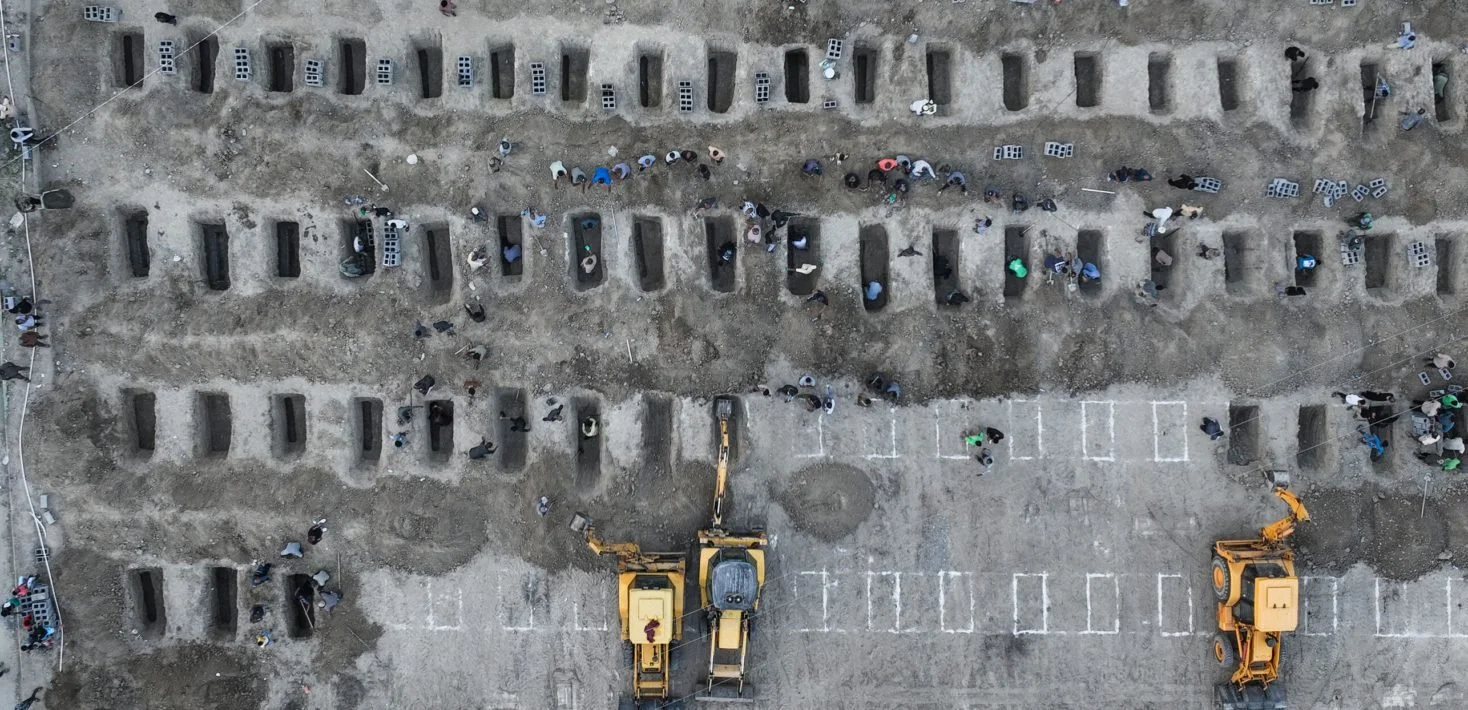
Graves dug for children killed in deadly strike on a school in Minab | Photo Courtesy of Amnesty International
On May 12, the Pentagon put the cost of the Iran war at ‘only’ $29 billion. Fortune has since then reported that the “real cost is closer to $200 billion”—and rising.
That figure is based on estimates derived from already-released data and statements, such as the U.S. Department of Defense’s report that the first six days of the war cost an estimated $11.3 billion. Early Center for Strategic and International Studies (CSIS) estimates concluded that the war was costing somewhere north of a billion per day.
And what’s worse? It’s likely all a major underestimate. Quoting Harvard Kennedy School senior policy lecturer and federal budget expert Linda Bilmes, Fortune’s report argues that the Defense Department’s recent $29 billion figure is underestimating the total costs by calculating the cost of current munitions rather than the cost to replace them:
“…the Tomahawk missiles used in Iran cost between $1 million and $2 million to make, but now it costs between $3 million to $6 million to replace” based on newly signed defense contracts.
Those are contracts that need to be signed because the U.S. was so ill-prepared to fight the war in Iran that it quickly ran out of munitions.
Writes the CSIS in another report, “Once Operation Epic Fury ends, the naval assets sent to the Middle East will return to the Pacific. Munitions inventories will start to recover, but restoring depleted stockpiles and then achieving the desired inventory levels will take many years.”
In what constitutes an open admission of at least some level of crisis in the U.S.’s ability to arm itself for modern missile warfare, as of June 22nd Trump has had to summon Pentagon officials and defense contractors (note how they go hand-in-hand) for ‘crunch talks’ about replacing depleted stockpiles.
Predictably, as of June 25th it has been reported that Lockheed Martin was awarded a contract worth as much as $35 billion by the Pentagon.
The disastrous, illegal Iran war is a profound demonstration of just how little the U.S. government is concerned with the interests of its own people during a cost-of-living crisis—let alone the lives of civilians in Iran.
It’s just another example of the kind of open corruption, the palm-and-glove relationship between the highest security functions of the United States and private, for-profit business interests that has helped to define the neoliberal era.
In fact, it is in spite of all the taxpayer money that has already been burned in this pointless war that the Pentagon is now asking for another $80 billion, largely to cover the costs of the war.
Iran War Spending: A Trillion Dollars’ Worth of Shooting Yourself in the Foot
That request follows Trump’s April request for a $1.5 trillion dollar budget for defense spending in 2027, a staggering 44% increase in funding for the Pentagon and the world’s most expensive military, three-and-a-half times more expensive than its nearest competitor.
Of course, the war’s costs extend well beyond the sticker price, whichever estimates you go with. Domestically, fuel costs have long been one of the headlines; reports the Institute on Taxation and Economic Policy, the total extra fuel cost to Americans to date as a result of the Iran War is over $55 billion (with additional costs of nearly $40 billion the summer).
Writes the Institute, the war’s estimated cost to average Americans by the end of the year if prices don’t fall is an additional $806 in fuel at a time when Americans are struggling to afford any housing, and that estimate doesn’t factor in the myriad knock-on economic effects from higher fuel prices which impact nearly every corner of the economy.
What’s more, reports CNN, the war has resulted in the world losing 1.15 billion barrels of oil supply, inflation has seen the Consumer Price Index rise to 4.2%, consumer confidence remains at historic lows, mortgage rates began going up again, and U.S. bonds are being sold off.
Adding insult-to-injury for Americans (78% of whom were recently found to want an immediate end to the conflict), the “Memorandum of Understanding” signed by Trump includes a $300 billion “Reconstruction and Development Fund” to Iran; more than half of this ‘fund’ has already been committed, reports Reuters.
While spun up as a Gulf State backed ‘investment fund’ excluding any ‘government money or grants,’ this reads like an obvious attempt to save face within the agreement language. Let’s be plain: the proposed $300 billion is a financial agreement to cover damages made during war negotiations in a war the United States has lost.
By the time all is said and done, Harvard’s Linda Bilmes argues, the cost will far exceed the figures being discussed today: I am certain we will reach one trillion dollars for the Iran war.”
Notes Harvard Kennedy School, it’s key to remember that George W. Bush’s later-fired economic advisor, Larry Lindsey, predicted the Iraq War “might cost $200 billion” when it ultimately cost $5 trillion.
What Else Could the Iran War Funding Have Been Spent On?
A trillion dollars. A trillion dollars. A trillion dollars to be spent on a needless war that was none whatsoever in the interest of the American people, that only one in four Americans believes was worth the cost.
A trillion dollars to be spent on a war that Benjamin Netenyahu has been lobbying U.S. presidents to get involved in for 40 years, and that no president until Trump was foolish (or compromised) enough to actually launch.
A trillion dollars to be spent on a war where over 165 civilians, most of them young girls and boys, were horrifically killed in a strike on a girls’ school assisted by AI-targeting systems that have proven themselves not remotely ready to provide data for life-and-death decisions…or to win wars. (Trump’s most recent response? To essentially dismiss it.)
If we calculate with the comparatively conservative $200 billion figure reported by Fortune, the cost of the Iran War to date has been enough money to fund entire social programs for years and help address major infrastructural and environmental issues.
Below are just some of the programs the $200 billion estimated broader cost of the Iran War and Blimes’ estimated $1 Trillion long term costs could fund:
IRAN WAR SPENDING
What Could $200 Billion — or $1 Trillion — Fund Instead?
Child Care & Housing
Could fund roughly 7.1 years of day care for 2 million children, based on NBC News’ estimate that $28 billion could cover one year.
Could fund roughly 35.7 years of day care for 2 million children.
The same comparison places $200 billion at enough to cover one year of rent for about 8.6 million people; $1 trillion would cover rent for about 42.9 million people.
Food Security
Could cover roughly two full years of SNAP benefits at current annual spending levels.
Could sustain SNAP for nearly a decade.
SNAP helps households buy groceries at a time when food prices continue to strain working families’ budgets.
Universal Pre-K
Could cover about 57% of a 10-year national universal preschool program for 3- and 4-year-olds, including construction costs.
Could fund that full 10-year program nearly three times over.
Penn Wharton estimates the full 10-year cost at approximately $351 billion.
Safe Drinking Water
Could pay for a nationwide replacement of lead service lines more than twice over, using the American Water Works Association’s roughly $90 billion estimate.
Could cover the EPA’s projected $625 billion drinking-water infrastructure need for the next 20 years, with $375 billion left over.
That includes pipes, treatment plants, storage tanks and other systems needed to deliver safe water.
Affordable Homes
Could sustain the Low-Income Housing Tax Credit program for nearly 15 years, based on annual allocations of about $13.5 billion.
Could sustain the same program for roughly 74 years.
The credit supports the construction and rehabilitation of rental homes for people with low incomes.
Climate & Clean Energy
Could more than double the Department of Energy’s $97 billion clean-energy infrastructure investment through the Bipartisan Infrastructure Law and Inflation Reduction Act.
Would equal more than five times the cost of every U.S. billion-dollar weather and climate disaster recorded in 2024.
NOAA put the cost of 2024’s 27 billion-dollar disasters at $182.7 billion.
Sources:
- Fortune reporting on the Iran war’s broader economic cost and long-term estimates.
- NBC News analysis of the $28 billion child-care and rent comparison.
- Penn Wharton Budget Model estimate for universal preschool construction and operating costs.
- American Water Works Association estimate for nationwide lead service line replacement.
- EPA Drinking Water Infrastructure Needs Survey and Assessment.
- U.S. Department of Energy infrastructure funding data.
- NOAA National Centers for Environmental Information disaster-cost data.
U.S. Power’s Total Disregard for its Own Citizens
Americans stood nothing to gain from this war: not only did they not collectively gain anything, they lost money that could have been used for investments into public institutions and services so sorely needed as to be a matter of life and death.
Whenever I think about military spending in the U.S., about the bloated, incestuous scam that is the industrial defense complex, my mind turns to Sheldon Wolin’s tremendous work: “Democracy Incorporated: Managed Democracy and the Specter of Inverted Totalitarianism.”
In it, Wolin argues that the U.S. is in fact a totalitarian state, but a new permutation, one wherein corporations (such as, say, Lockheed Martin) exert tremendous control over power systems that are only superficially democratic, as if elections were really just the set dressing or marketing for a system of power that is fundamentally outside public control.
While the system of power in the U.S. certainly uses fear, intimidation, preemptive wars and oligarchic power to directly subdue its people as a traditional totalitarian regime might, it ‘inverts’ totalitarianism in the sense that it takes otherwise revolutionary-derived systems of power such as democracy and ‘manages’ it into a form that is ultimately anything but, exploiting democracy’s limitations and weaknesses to render it de facto inert to its original spirit and intention.
We see this play out constantly through processes of privatization that undermine public institutions. These typically start with a bill to slash funding for a public institution or program so gravely as to make it semi-functional; private interests then exploit that ‘weakness’ with propaganda which ‘reveals’ the ‘inefficiency’ of these institutions.
A deceived and undereducated public that buys into the myth of the “efficiency of the private sector” is then expected to lay down (and too often has).
Eventually, Wolin argued that this inverted totalitarian ‘management’ of democracy would result in hollowed out, non-functional public institutions that would likely engender political apathy and a sense of powerlessness, the very profound social fragmentation we see today.
That ‘hollowing out’ of public institutions meant to provide a check to power, to (e.g.) call a war of aggression illegal, to invoke the War Powers Resolution and stop it before it began, is plain to see.
The Iran War simply shouldn’t have happened. There was no public debate on whether the war should happen, and indeed, if there had been, the American people would have made it clear they didn’t support another potential ‘forever war’ in the Middle East, much less one guaranteed to tank the global economy.
But accountability or, indeed, the national interest, was never the point. The point was to take the heat off the back of a presidential administration so mired in criminal scandal that it was all the headlines could talk about prior to the invasion.
The point was another attempt at power projection for a failing empire that can read the cards about the grand shift in geopolitical power: a shift moving eastward.
The point was to appease Israeli political forces so obsessed with territorial expansion and ethnocentric warfare that there was no cost they wouldn’t pay to drag America into a war that had nothing to do with its national interests.
While the apparent, impending close to the war (if Israel does not succeed in sabotaging it) may appear as a ‘win’ for the public pressures that made it obvious to the Trump administration they could not continue, those pressures were ultimately backed up first and foremost by economic concerns rather than whether the conflict made any sense to the nation or its people ethically, spiritually, or even politically.
We must demand and work to build a system that is not based on military dominance, that is founded in the rule of law, that does not criminalize anti-war action and that would never accept the bombing of a girl’s school without expecting a series of immediate arrests.
Any system that can take the lives of so many innocent people, destabilize the global economy through the decisions of a small group of leaders, wage war without meaningful public consent and leave citizens with few practical ways to compel their government to stop bombing demands far more scrutiny, accountability and democratic control than it currently receives.