
NonProfit ‘ShowUp’ Is Building an Art World that Opens the Door from the Inside
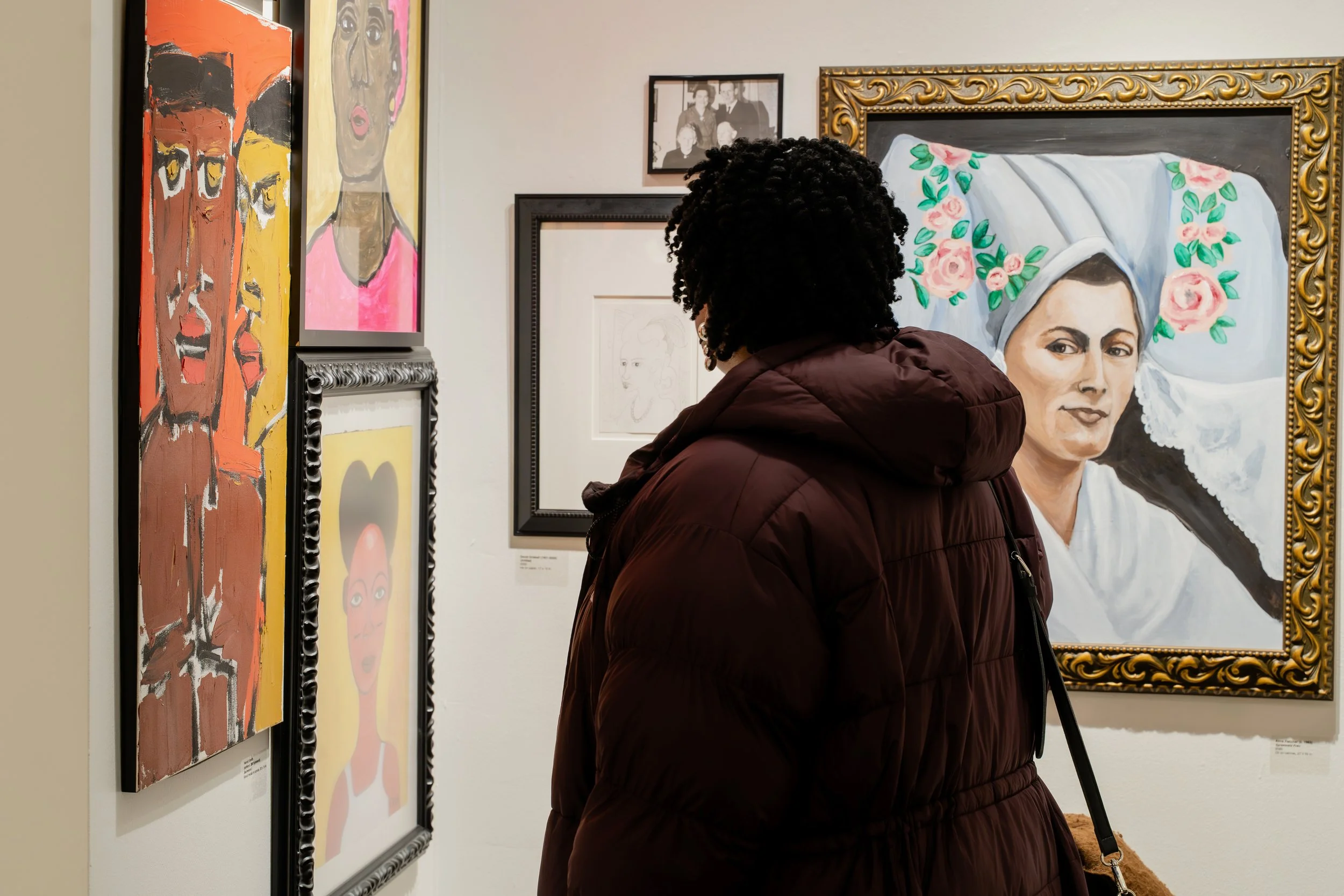
A visitor enjoying the salon-style installation of ‘In Our Image’ by ShowUp Curatorial Incubator participant Shardé Marchewski. | Photo credit: Sonya Tanae Fort.
ShowUp
Location
Boston, MA
Founded
2019
Focus
Access & Support for Underserved Artists
For many artists, the first years of building a career often unfold within a network of informal pathways where early opportunities are frequently unpaid, institutional knowledge is unevenly distributed and expectations accumulate without ever being clearly articulated.
The work itself is only part of what determines whether a career takes hold, as advancement is often tied to who you know, as well as an ability to endure and absorb financial and professional uncertainty long before any stability arrives.
It is within these conditions that new approaches to access and support have begun to emerge.
In Boston, a nonprofit gallery and education space called ShowUp has developed an art entry program designed to make the systems that shape artistic careers more visible, navigable and materially supportive for the artists moving through them.
Located in the city’s South End, a neighborhood defined by its concentration of galleries, studios and working artists, ShowUp sits within one of Boston’s most active art corridors, where proximity often shapes visibility and opportunity.
That location places the organization in direct conversation with the institutions and networks that influence how artists gain traction, while also allowing it to operate as an accessible point of entry within that same ecosystem.
“The art market remains one of the last and largest unregulated industries,” ShowUp founder and executive director Christine O’Donnell told Hyvemind. “Pathways to professional success can often feel gate-kept by unpaid labor and the need for 'insider' knowledge or high-level networking.”
Through a combination of programming, education and paid opportunities, the organization works to make the mechanics of the art world legible earlier in an artist’s career, allowing participation to extend beyond those already positioned to navigate it.
ShowUp’s Approach to Access, Visibility and Support
ShowUp is a Boston-based 501(c)(3) nonprofit contemporary art gallery and education space dedicated to amplifying underrepresented voices.
“We are a laboratory for both the artist and for what the model of an art gallery can be,” O’Donnell revealed.
Each year, the organization mounts multiple exhibitions alongside artist talks, workshops and community-based initiatives, while also running the ShowUp Cultural Infrastructure Program, a twelve-session course designed to introduce participants to the mechanics of the art world.
ShowUp’s mission is to:
CONNECT artists with local and global communities
AMPLIFY underrepresented voices and visions
PROVIDE tools for self-sufficiency
EMPOWER creators to experiment and engage in meaningful exchanges
How the Model Works:
The structure of ShowUp mirrors the expectations of larger institutions, with exhibition timelines that can stretch from six months to two years and workflows that require coordination across curatorial, logistical and administrative demands.
“We run ourselves like a commercial gallery or a small museum, offering a high level of rigor to artists and curators alike,” O’Donnell said.
That rigor also extends to what comes next, where participants learn the operational fluency required to navigate future opportunities, from contracts and marketing approvals to the pacing and structure of exhibition planning.
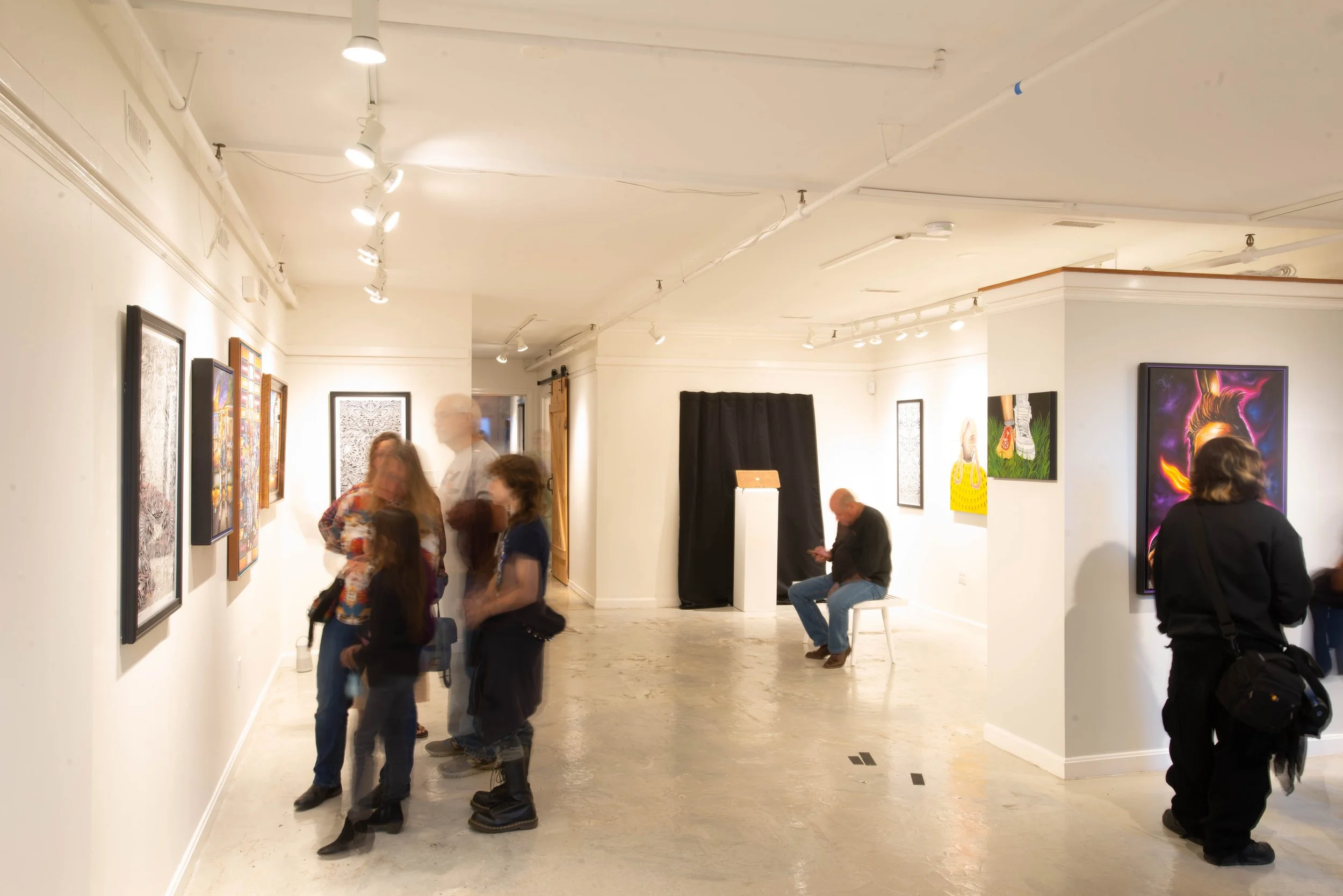
Between Two Worlds: Making Sense of Modern Life from Indigenous Perspectives gallery view.
The show featured work by Hailey-Jade Araujo, Carlin Bear Don’t Walk, Allison Begay, Scott Strong Hawk Foster, Sierra Henries and Danielle SeeWalker. Curated by Nayana LaFond.
Photo credit: John Brewer.
“With this experience comes the confidence that artists need when approaching their next, and bigger, opportunities, she said.”
O’Donnell told Hyvemind that artists who arrive at ShowUp often do so at a point where their work is developed but their access remains limited, whether due to geography, networks or a lack of familiarity with institutional pathways.
“These individuals don’t need us to rescue them,” O’Donnell said. “But it is an absolute joy to collaborate and amplify the work of talented artists and the visions of curators who wouldn’t otherwise have the opportunities we provide.”
Compensation is also embedded into that structure. As a W.A.G.E.-certified organization, ShowUp ensures that artists are paid for their work, a policy that shifts who is able to participate and remain in the field.
What ShowUp Makes Possible
The effects of ShowUp’s model are most visible in the curatorial work it has helped bring into the world, particularly in the early incubator programs that laid the foundation for what ShowUp has since become.
“There are a few different stories and people that have been really important to me over the years,” O’Donnell said. “I’m particularly proud of the work we’ve done to bring in independent curators as part of a curatorial incubator that was the first iteration of SCIP, and how we are continuing that work.”
Those early programs resulted in a series of exhibitions that reflected both the range of curatorial voices ShowUp is working to support and the level of rigor expected within its model.
In Our Image, curated by Shardé Marchewski, ran in early 2026, while AEROSOL: Boston’s Graffiti DNA, its Origin & Evolution, curated by Jennifer Mancuso, brought together artists including Timmy “Zone” Allen and Ricardo “Deme5” Gomez in a survey of the city’s graffiti history.
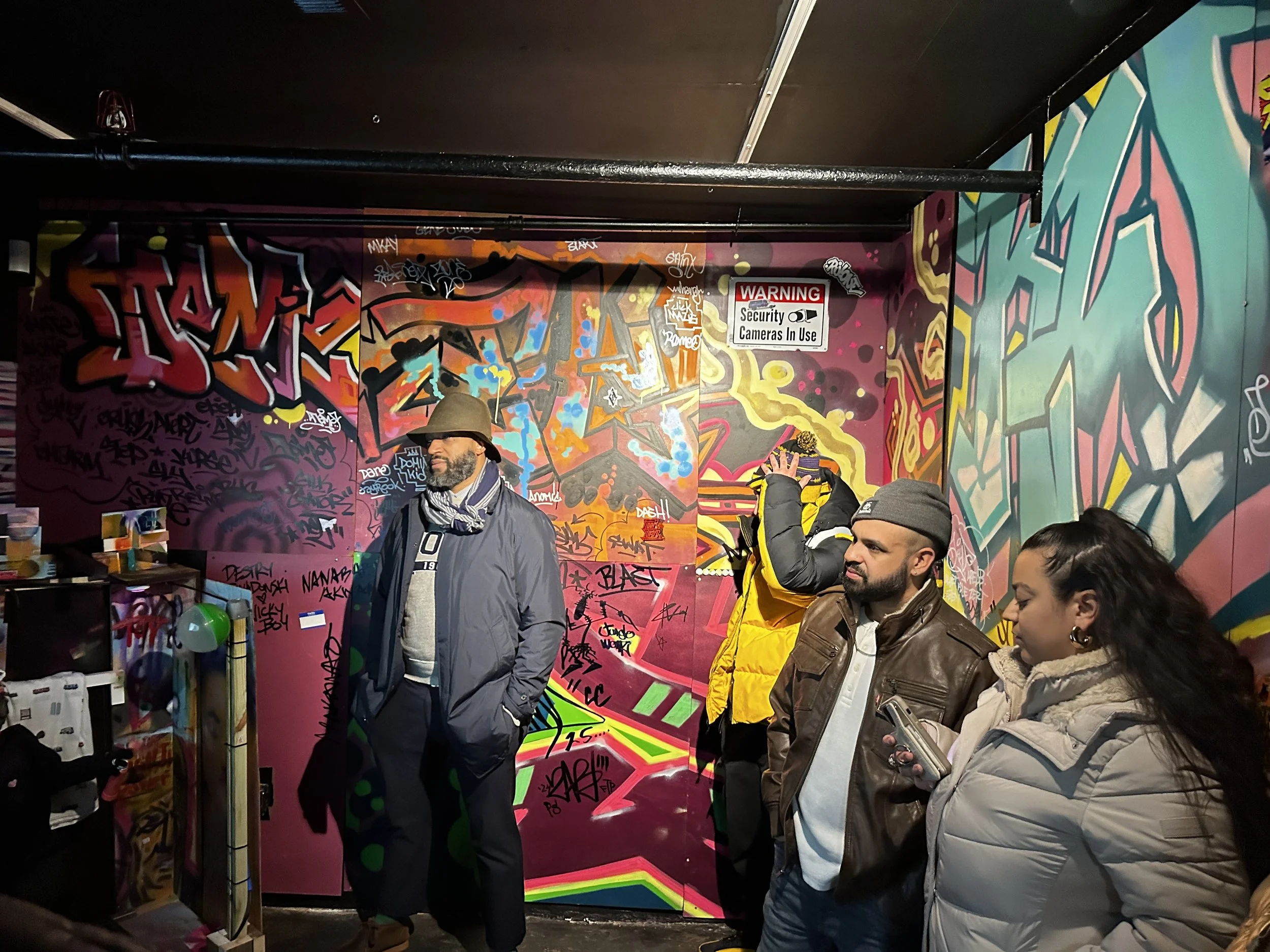
Installation view of graffiti-panels co-created by exhibiting artists for AEROSOL exhibition.
Curated by Jennifer Mancuso for ShowUp’s curatorial incubator program.
Photo credit: John Brewer.
Earlier exhibitions such as Cutting Edge: Contemporary Papercutting, curated by Rosa Leff, extended that approach internationally, featuring artists from across disciplines and geographies while reinforcing the gallery’s focus on emerging and under-recognized practices.
Those efforts have since expanded into the Cultural Infrastructure Program, reflecting a broader commitment to redistributing access to both opportunity and the knowledge required to navigate it.
“By providing more democratic access and closing the existing opportunity gap through knowledge and power sharing, we believe we’ll foster an enriched and more exciting arts ecosystem.”
This feature was published as part of Hyvemind’s Working Models series: stories from the people and organizations reshaping care, community and system repair.
We’re always looking to highlight organizations, collectives, and community experiments that are changing how care, work and wellbeing are built.
If your team is running a program or initiative that others could learn from, we’d love to hear from you.
To be featured in an upcoming story send us a note: hello@thehyvemind.com
