The Illusion Economy: What Layoffs, Black Friday and AI Have in Common
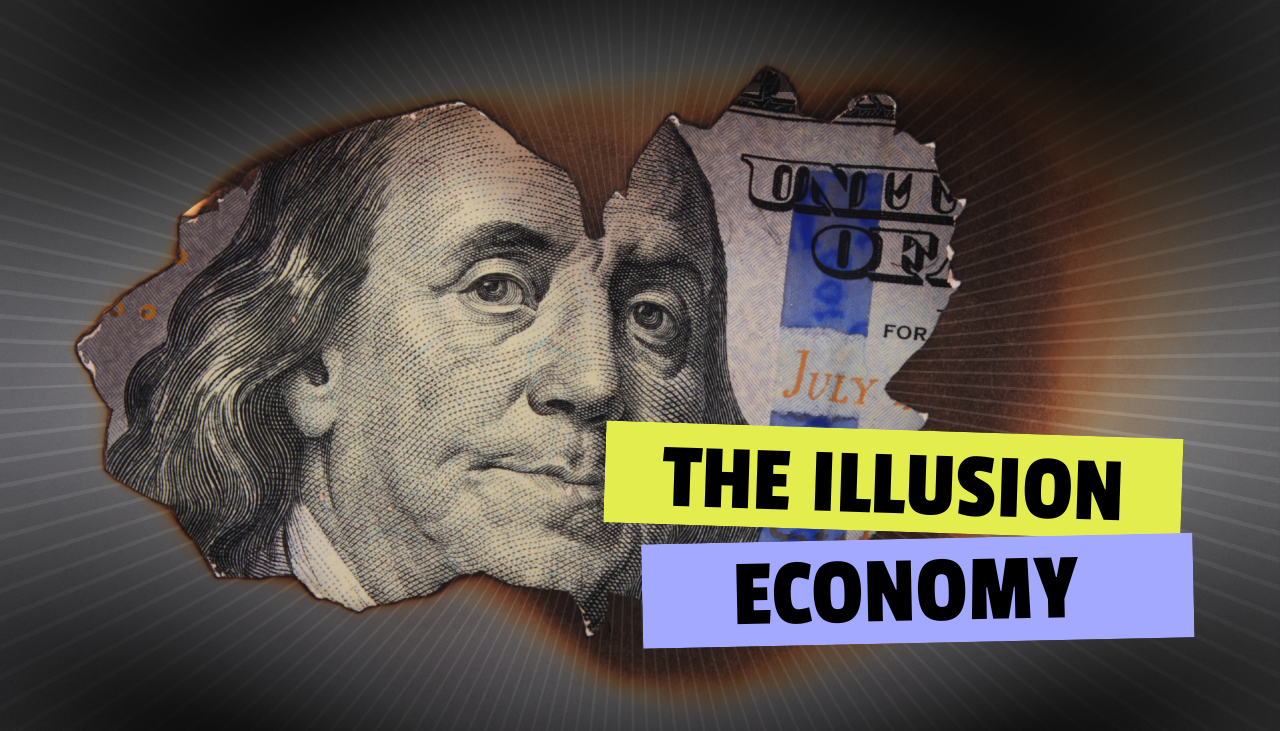
By now the contradictions are hard to miss. The economy, we are told, is strong. Unemployment is low. Consumer spending is resilient. A technological revolution is underway.
And yet, millions of people feel poorer, less secure and more replaceable than they did a few years ago. Layoffs arrive in waves. Prices rise faster than wages. Corporate profits remain insulated. And nearly every public metric insists that stability prevails.
The disconnect is not accidental. Three of the most dominant economic narratives of the moment; a cooked unemployment rate paired with forever layoffs, the annual theater of Black Friday and the explosive rise of artificial intelligence are not separate crises unfolding in parallel.
They're three masks of a system that survives by rewriting the math, the meaning and the truth while asking you to smile through it. You feel this, right?
The "4 Percent" Unemployment Rate: How Workers Disappear From the Numbers
How do you get record layoffs and a steady unemployment rate in the same breath?
The trick lies not in job creation but in erasure. Workers who stop actively applying for jobs—whether because prospects are bleak, health is fragile or child care is unavailable—are quietly reclassified as “not in the labor force.”
Once removed from the count, they cease to trouble the headline number. Their absence becomes statistical success.It's like a hospital calling a patient cured because they stopped showing up, not because they got better.
Here's the actual burn:
Over a million job cuts were announced this year.
One hundred fifty-three thousand pink slips in October alone.
Worst year since the pandemic for layoff announcements.
That's not a spreadsheet glitch. That's one hundred fifty-three thousand families hit in just 30 days.
And when you zoom out, the lie gets louder: Labor force participation is barely above 60 percent. Which means nearly 4 in 10 adults are not working or not counted.
Yet the headlines still say 4 percent unemployment. Does that sound closer to what you and your neighbors are seeing?
The Performance of Consumer Confidence: Black Friday and the Annual Feeling of Being Played
Every November, the same story reappears on cue: record crowds, surging traffic, triumphant revenue projections. Black Friday, once a retail boundary between solvency and collapse, is recast annually as proof that consumer confidence remains intact.
Meanwhile, prices are inflated before the "sale," discounts are manufactured and consumers are left broke, skeptical and tired of the hustle.
But this year, something else is unfolding in parallel: a small but widening consumer strike shaped as an intentional opting out of the Thanksgiving sales cycle.
Not because people do not need things, but because they no longer wish to be manipulated by urgency without value—otherwise known as the oldest trick in transactional psychology.
Retailers, of course, still reported “record weekends,” even as storefronts continue to close across the country. Preference is blamed. Wages are not. Supply chains are rarely interrogated.
The reality that millions of households have been permanently priced out of discretionary consumption remains inconvenient.
Black Friday used to be a ritual, but that ritual is losing meaning.
The AI Bubble and the Next Bailout
The third lens is technological and financial. Nvidia, the dominant supplier of the specialized chips that power large artificial-intelligence systems, has invested directly in OpenAI, one of the most prominent developers of those systems.
OpenAI, in turn, uses that capital to purchase Nvidia’s hardware. On Wall Street, the arrangement is often described as “vendor financing” or, more generously, “strategic alignment.”
Look closely, however, and the flow of capital begins to resemble a closed circuit.
Chip makers invest in the companies building A.I. models. Those companies then spend heavily, often immediately, on the very chips produced by their investors.
Revenue appears to surge. Demand appears insatiable. Capital circulates and is booked as growth. Pension funds and index investors, many several steps removed from the transaction, are invited to read the results as proof of an expanding market rather than a self-reinforcing one.
None of this is illegal, nor is it unprecedented. Similar structures have appeared in previous technology booms, from telecommunications infrastructure to subprime finance.
But the arrangement complicates the prevailing narrative that today’s A.I. surge reflects organic demand at scale, tested and affirmed by end users rather than amplified within capital markets.
Outside earnings calls, the promised transformation often appears uneven. For example, customer-service chatbots still struggle to resolve basic problems. “Smart” productivity tools still require multiple human interventions to function as advertised.
And in many workplaces, the most immediate effect of A.I. adoption has been neither efficiency nor innovation, but head-count reduction justified by future capabilities that remain largely theoretical.
And when the bubble pops, the explanation will likely sound all too familiar. “Few could have anticipated the shift.” “The market moved faster than expected.” And, “temporary support may be needed ‘for the stability of the system.’”
They’ll sell the miracle, they’ll keep the upside, and you’ll get the cleanup bill.
The Pattern Beneath the Headlines: What These Stories Have in COmmon
Taken together, these stories follow a consistent structure.
When layoffs accelerate, discouraged workers are removed from the labor count, preserving the appearance of a tight job market. When consumer purchasing power weakens, prices are raised ahead of discounts, allowing spending totals to hold even as households strain. And when technological growth needs reinforcement, capital is recycled within a small circle of firms and reported as expanding demand.
The numbers themselves are not fabricated, they are selectively framed, with each narrowing the field of vision just enough to maintain confidence while muting contradiction.
Your Power Lies in the Middle of the Illusion: What Happens When Belief Shifts
If the contradictions in the economy feel personal, that’s because they are.
Economic systems are often discussed as abstractions, but they are built, sustained and defended through everyday participation. They endure not because they are universally believed, but because enough people continue to move through them as if no alternatives exist.
Consumer behavior, capital flows and labor decisions still shape outcomes at the margins. Therefore, every time you skip the Biggest Sale Ever, move your money to a credit union or fund a local creator over a global platform, you pull power out of the illusion.
And while these choices rarely register immediately in quarterly results, they will, over time, help reshape the demand signals markets rely on. Because markets, after all, depend on belief as much as participation—and when belief erodes, performance becomes harder to sustain.
Systemic change does not usually begin with confrontation. It begins when lived experience drifts far enough from the official story that people stop organizing their lives around it.
The house of cards doesn’t fall from a single push. It collapses when enough people stop pretending it’s a fortress.