Why ‘Backrooms’ Became the Horror Story of Neoliberalism’s Youth
Backrooms evokes younger generations’ sense of wandering in a failing society, lost somewhere between its glory days and its inevitable demise.
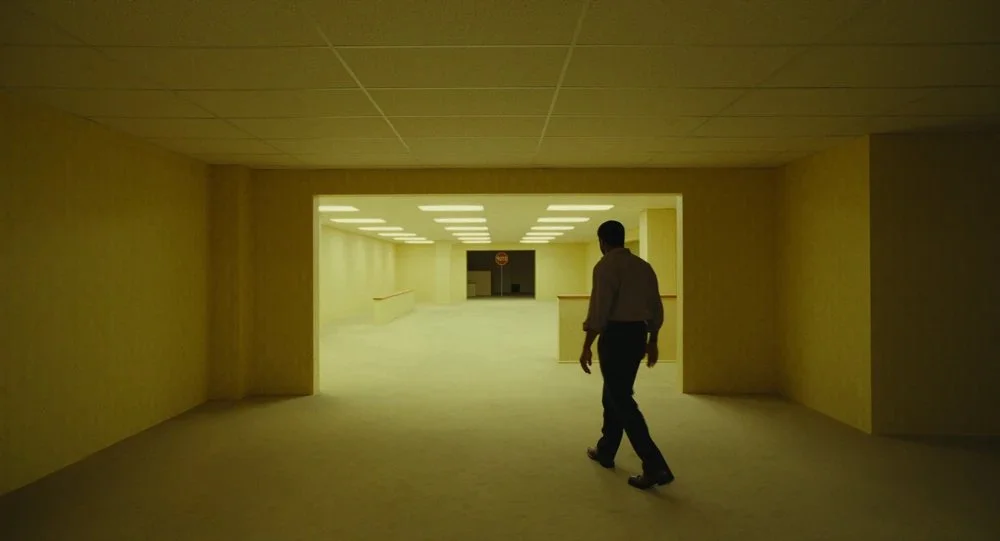
Image courtesy of A24
At the core of any horror phenomenon is an opportunity for a deeper understanding of what speaks to, motivates, and frightens a generation.
Within the cultural phenomenon that has become “Backrooms” (now culminating in the release of A24’s most successful film ever) are the myriad reflections of multiple younger generations that feel cut adrift from meaningful societal values, left feeling abandoned and too often lost in the landscape of their own minds.
Lost in the endless hallways of a long-abandoned business complex of ambiguous purpose, wandering through ‘The Backrooms’ can evoke a sense of almost childlike wonder at a world rapidly fading from memory.
But nostalgia is a form of depression, and failure to move on from what has been lost ensures a meaningless future.
For the entire adult lives of Millennials, Gen Z, and soon Gen Alpha, there has been a persistent sense of the ‘good old days’ being far behind when comparing their life experiences to either the Baby Boomers or, to a somewhat lesser degree, Gen X.
Today’s younger generations have long acutely felt unable to bridge the gap between the expectations they were given for how life should work if one ‘does all the right things’ and the realities of a system of social, cultural, and economic oppression that has long passed its expiration date: neoliberalism.
Understanding Neoliberalism’s Impact on Today’s Youth
“Neoliberalism” is perhaps most commonly understood today in modern political critique as a political and economic evolution of capitalist philosophy that is fundamentalist in its zeal for ‘free-market,’ laissez-faire economics at the expense of any otherconsideration.
It’s the private equity firm destroying local businesses for the sake of nihilistic investors, it’s the privatization of essential services such as healthcare and the postal service, it’s the commodification of more or less everything.
Neoliberalism has been the process of not only rapidly financializing the economy at the expense of the ‘real’ economy that working class people actually live in, but dismantling every remaining vestige of what could be loosely summarized as ‘the social contract:’ the collection of assurances that came in the form of the welfare state, unions, workers’ protections, and other public programs and collective institutions.
Yet, even that supposed focus on ‘free-market’ economics is a ruse: to name but one glaring contradiction, massive neoliberal corporations often enjoy tremendous tax subsidiesfrom the government as well as massive bailouts when their financial adventurism inevitably falls apart.
Anyone who has read Smith’s “The Wealth of Nations” is unlikely to identify functioning ‘markets’ in such a transparently corrupt configuration.Indeed, rather than standing for any consistent, identifiable set of values (even those one might disagree with, such as unregulated ‘free’ markets), neoliberalism has really seemed obsessed with one thing, de facto: making a small handful of absurdly wealthy individuals even wealthier.
In other words, whether watching the mega wealthy infiltrate the government and influence elections or devastate public and natural resources to pursue AI technologies, one thing has become abundantly clear to much of today’s youth in particular: modern societies are being strip-mined for everything of use, value, or meaning to simply make this new class of nobility even richer.
That’s not a functioning society and, indeed, neoliberalism is non-functional as an organizing ideology. Thrown into a nihilistic world of endless profit maximization for a handful of people, today’s younger generations are left with no meaningful blueprints for how their lives should sustainably function, cast aside as non-essential to a program of wealth accumulation that can only be described as pathologically short-sighted.
These social and economic conditions create a pronounced sense of meaninglessness, or the feeling that one’s tribe has lost its purpose and its cohesion.
Backrooms Evokes Neoliberal Nihilism and Despair
Pulitzer Prize-winning journalist Chris Hedges names neoliberalism’s nilhilism-inducing conditions plainly in his 2025 essay “The Politics of Cultural Despair:”
“The social bonds, including jobs that gave working Americans a sense of purpose and stability, that gave them meaning and hope, have been sundered.
The stagnation of tens of millions of lives, the realization that it will not be better for their children, the predatory nature of our institutions…have engendered, along with despair, feelings of powerlessness and humiliation. It has bred loneliness, frustration, anger and a sense of worthlessness.”
Despair within the neoliberal context is key to understanding the emotional journeys of Backrooms' two leads:
Chiwetel Ejiofor’s excellent portrayal of Clark, a failed, alcoholic, divorced would-be architect, and Renate Reinsve’s similarly excellent Mary, Clark’s therapist who also struggles to get out from under the shadow of her childhood with an abusive, schizophrenic mother.
The Backrooms as a horror concept started on 4chan with a simple but uncanny, deeply liminal image of a seemingly empty furniture store in Oshkosh, Wisconsin (this Wayback link is where the image was likely sourced). It quickly went viral much like the now tremendously popular (and voluminous) SCP Foundation, truly taking off when YouTube filmmakers such as Even Royalty and Kane Parsons made short horror films inspired by the concept.
Most successful was Parson’s first, titled ‘The Backrooms (Found Footage),’ produced using Blender when he was only a teen and currently sitting at a whopping 82 million views.
In terms of immediate, aesthetic appeal, ‘The Backrooms’ capitalizes on one of the most influential modern horror trends: liminal spaces. Often misunderstood as essentially anywhere that feels abandoned or otherwise creepy, liminality refers specifically to the crossing of a threshold. In literal terms, that could be as straightforward as a hallway or metro station.
On a basic level, the images of ‘The Backrooms’ can evoke a sense of childlike abandonment, akin to the fear of being left in a grocery store by your parents or being the last child to be picked up from daycare, a fear that seems to particularly speak to Millennial and Gen Z fans of analogue horror and other recent horror trends.
It joins a recent slate of YouTube projects that evoke younger generations’ feelings of shame and isolation in response to a world that itself represents a kind of abandonment, a failure to ensure the promise of a workable future.
‘The Backrooms’ concept hooks audiences, however, with the fantastical: it’s often unclear how one enters the Backrooms, it’s clearly extradimensional, and its size is incomprehensible: a truly unending liminal space where one wanders but never arrives.
It’s here that ‘Backrooms’ evokes liminality in a broader sense. ‘Liminality’ was initially described by Arnold van Gennep, who in 1909 posted an anthropological study titled Les Rites De Passage. In it, the liminal refers to a sense of disillusionment, disorientation, or an otherwise disquieting sense of ambiguity that occurs within a ‘rite of passage:’ in other words, adolescence.
Like graduated college students who are completely unable to find gainful, middle-class employment, the concept of wandering these liminal spaces for eternity reflects the troubled and frustrated internal emotional landscapes of so much of today’s youth.
While Parson’s “Backrooms” effectively portrays the strange, avant-garde landscapes that have come to represent ‘The Backrooms” as a kind of digital urban legend, the emotional core of his story is portrayed through the client-therapist relationship between Clark and Mary.
Though not obvious from the onset, a kind of adolescent liminality, this inability to move on from childhood to a fully accountable, ‘adult’ presence in the world, is precisely where we meet Clark and Mary. We learn that both characters are haunted by past events or mistakes they can’t effectively move on from.
An early scene finds the two in a therapy session; Mary describes the cycles people find themselves stuck in, the habits they can’t seem to break out of, the patterns they can’t understand in a calming but ultimately well-rehearsed, flat recital. Clark receives it with veiled frustration, acknowledging the “truth” in a half-hearted way only someone who doesn’t truly believe it can.
Some part of him recognizes the logic, the wisdom, but he doesn’t feel it. He’s not there. In fact, he’s not truly present even in therapy, lost in the maze of his own suffering, his own inability to sort through his feelings.
Seeking to cut through, Mary suggests a roleplaying exercise where Clark plays out a fateful interaction with his wife. We quickly learn that Clark is separated, that his wife is continuing to live in his once-home, that he suffers from alcoholism, and is generally in denial of his own culpability in the marriage’s disintegration, instead indulging in anger and blame.
We later learn that Clark is the owner of a failing, largely abandoned furniture store, a clear reference to the origins of “The Backrooms” mythos, and that he spends his nights on a for-sale mattress within while bitterly drinking his nights away.
Due to power fluctuations at the store, Clark inadvertently finds an invisible portal to “The Backrooms” in the store basement and is greeted immediately by the now-iconic yellowed office landscape and a large stack of discarded furniture.
In shock, Clark’s explorations lead him to a series of rooms that look familiar but are abstracted to varying degrees: hallways with out-of-place stop signs, impossible doorways, shifting perspectives, and even a cardboard cutout of a caveman that looks like it belongs in a museum. There is no truly unifying theme beyond the fact that “The Backrooms” appears as bits and pieces of the recognizable.
Eventually, Clark realizes he isn’t alone and narrowly escapes. Meanwhile, we learn that Mary has her own demons to wrestle. At a party, she becomes apparently overwhelmed at the sight of a healthy mother-daughter dynamic and retreats to a side room to take a nondescript pill, presumably to calm down. We see flashbacks of a troubled relationship with her mother who, suffering from apparent schizophrenia, kept her locked up in a home where even cracking a window was forbidden.
It’s suggested that the childhood home was eventually forcefully entered, with Mary presumably ending up in protective custody. When Clark comes to Mary with his discovery, she isn’t able to navigate his extraordinary claims without suggesting that he may be drinking or otherwise not in his right mind.
Enraged, he sets out to record proof. Roping in a young couple, Kat and Bobby, who helped him film his commercial, he embarks on a plan to film “The Backrooms” together with the pair. This quickly goes wrong when, predictably, the entity Clark narrowly avoided before reappears and kills Billy. This ultimately results in Clark being split up from Kat somewhere in a deeper region of the nightmare.
Mary soon pieces together that Clark is missing, and in going to search for him, finds the entrance to “The Backrooms.” Astonished by what she has found, she quickly encounters Clark who, behaving strangely, subdues Mary before the entity finds her.
In one of the film’s most interesting sequences, we see a wide shot of Mary’s childhood home which then begins to descend into another, deteriorated version of that same home. As the shot continues to descend, each new level of the home becomes increasingly abstracted.
Each new version of the room is like an increasingly abstract memory of what, for Mary, is a traumatic environment, and eventually, we find ourselves again in the uncanny confines of “The Backrooms.”
For me, this sequence strongly evoked Caretaker’s “Everywhere at the End of Time,” an experimental six-album project meant to evoke an Alzheimer’s patient’s descent into complete cognitive senescence, from yet-lingering memories of earlier days to the haunted, distant horns of big band music to eventually more and more abstract, disturbing, and disintegrated soundscapes.
Eventually, we arrive somewhere deep in this abstracted space and turn to Mary and Clark. Tied up by Clark, Mary finds herself at a dinner table with bizarre figures, would-be people with too many eyes and other distorted features.
Seemingly catatonic, they don’t notice her, but Clark has positioned both them and her as if to have a meal together. We quickly learn that Clark has been stuck down in “The Backrooms” for an ambiguous amount of time and has more or less gone mad. Kat’s head is in the kitchen fridge, with Clark lamenting that he tried to help her but “she wouldn’t listen.”
Clark soon insists on another roleplaying session in a desperate attempt to prove that his perspective is correct, going so far as to scalp one of the catatonic figure's red hair and placing it on Mary’s head, presumably the color of his wife’s hair. This attempt quickly falls apart when Mary loses her patience; she tells Clark that his problem isn’t his wife, and that it isn’t even his drinking: rather, it is his inability to take accountability for anything, much as Clark takes no accountability for risking and ultimately losing the lives of Billy and Kat. She insists that there’s nothing Clark can do to change, and this is just the way he is. Most importantly, she admits to him and herself that she no longer believes she can help or save him.
Shocked, Clark releases her, then turns to the entity that has been tormenting him and other visitors: a distorted, twisted, monstrous version of the pirate character he played in an ad for his failing furniture store. In a wave of relief and despair, Clark tells the creature it’s alright, that “we don’t have to change,” only for the creature to unexpectedly and brutally kill Clark, a rather clear kind of punishment.
Terrified, Mary leaves and eventually manages to escape altogether into the care of a mysterious organization called Async, which features more heavily in the YouTube web series Parsons created.
In an interview between an Async researcher and Mary, they try to pry out information on what happened. Mary is really only concerned, however, with what they’re going to do with her. Unable to lie effectively, or simply not good at being reassuring, the researcher’s answer doesn’t satisfy Mary, and a type of realization drops across her face, a subtle resignation.
While this can be widely interpreted, what I saw was someone finally realizing that their worst fears were being realized. Not only were they likely to keep what she experienced a secret by insisting she is crazy, and who would believe her, she betrayed her own aspirations as a therapist by, arguably, woefully failing Clark and even leading him to his own death.
By giving up on her patient and, by extension, her relationship with others and the commitments she has made to them, she has given up on herself and indulges in nihilism much as Clark decided he “didn’t have to change.”
Ultimately, she abandons herself to one of her own deepest fears: ending up disconnected, disoriented, and alone, like her mother. We cut to a final shot where we see Mary, deep in “The Backrooms,” sitting alone in a chair with a distorted, monstrous face.
On Rejecting Nihilism and the Death of Community
The film is intentionally ambiguous in its conclusions, its filmmakers wanting viewers to draw their own.
For myself, I can’t understand the internal struggle of Mary and Clark outside the environment they inhabit: a disconnected and dysfunctional world where purpose and meaning are left up to the individual to find, but without any functional guidance and in the context of a world whose socioeconomic decline ultimately informs a lack of purpose.
In one 2023 study, researchers found 61% of Gen Z has been diagnosed with an anxiety disorder and is 37% more likely to go to therapy or receive mental health care (Millennials weren’t far behind, at 35%).
In a more recent survey, when asked why Gen Z feels anxious, 65% noted poor financial stability, 78% “felt addicted to their phone or social media,” and a whopping 86% are simply worried about the future.
Churned out by an exploitative college tuition system, whether today’s younger generations feel they are failed artists or simply failures in establishing any kind of career that can support a family, they find themselves entirely stripped of the comforting illusions that guided the post-war West’s titanic economic growth, lost in the endless confines of a hollowed-out economy and spiritually-dead society long past its prime that is somewhere between its glory days and its inevitable demise.
Clark and Mary, caught up in their own fear, suffering, and past mistakes they can’t (or simply don’t wish to) get out from under, become victims of a sense of internalized malaise, of misrememberedimpressions of reality that only appear as if they must define their lives going forward.
Clark could have chosen to fight his addiction and take accountability for his abusive behavior, maybe even repairing his relationship to his wife. Mary could have realized that she was not going to invariably ‘turn into’ her mother, that her client-patient relationships didn’t have to be attempts to ‘rescue’ either them or herself, and that she too could escape the loop, the patterns, the meanderings of her own dysfunctional behavior.
It’s a dysfunction that we see mirrored in ‘The Backrooms’ as incomprehensible spaces that ultimately lacks purpose or direction. Yet, getting lost in those inner hallways, in nostalgia, in regrets, is as deeply alluring as it is dangerous when one feels they are fundamentally flawed, broken, or worthless: Hedges’ politics of cultural despair.
The very same generations compelled by the evocative mystery and haunting melancholy of ‘The Backrooms’ have spent their lives confronted endlessly with the splendor of an age middle class life that is long past and an uncertain future that feels as if it can rarely if ever be understood in terms of hope or progress.
Yet, today’s youth and, broadly speaking, today’s working class nonetheless have distinct opportunities for growth and renewed meaning, but only if they can break from the depressive cycles of shame that keep them locked away in a psychological landscape of outdated assumptions on what life should look like.
To endlessly wrestle with the failing norms, standards, and expectations of a failing society is a recipe for madness,
much as Clark was unable to accept that he wasn’t able to achieve the career of his dreams, descending into self-loathing and narcissism.
Today’s western youth have only ever seen their standard of living degrade, lost in mourning of would-be identities, of a past prosperity poorly remembered or never experienced.
But there is a way forward, and as Parson’s “Backrooms” suggests in its cautionary tale (and which other popular YouTube projects, such as “The Amazing Digital Circus,” make even more explicit), it may lie in returning to the present, in taking accountability, in having faith in ourselves and others, in deeply reorienting ourselves and our values toward what we can control and influence: our relationships, our local environment, and ultimately the communities we build.
The world may be a mess. Cruelty often seems inexorable from power. The future is deeply uncertain. Atrocities are committed with tax-payer dollars every day.
We must choose (and affirm that we can choose) to not give up on one another and ourselves;
If we don’t, then we are truly lost in the spaces between, in the gaps that keep us isolated, alone, and ultimately unable to enact any real change.