
The Art of Remembering: Inside Justin Yoon’s Painted World
Through dreamlike scenes drawn from memory, artist Justin Yoon explores nostalgia, identity and the mythology of everyday life.
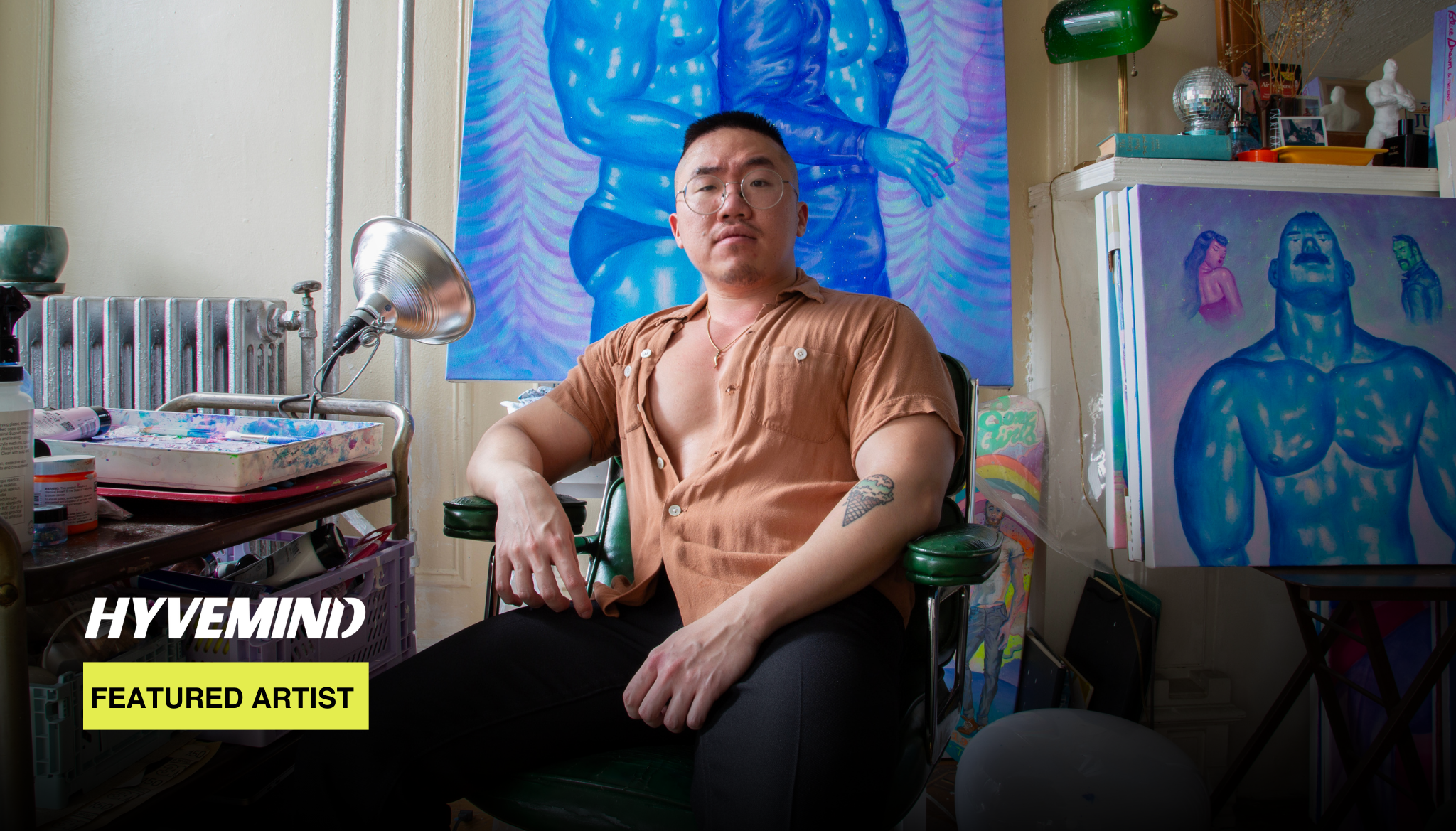
Images provided by Justin Yoon
Justin Yoon paints the residue of moments that pass quickly: music drifting through a car at night, the soft exhaustion after a party, jazz playing in the background of an apartment, the glow of a movie theater and friends lingering a little longer before the night ends. His paintings dwell in the hazy territory where memory and imagination begin to blur.
Yoon, a Brooklyn-based artist, builds his work from these small emotional landscapes. Born in Glendale, California and raised largely in Bundang, South Korea, he grew up moving between cultures that shaped the way he imagines time, identity and belonging.
As a teenager in Korea, American culture arrived through television, film and music shared by his family. Sitcoms, old Hollywood films and mid-century Americana helped form an imagined version of the United States long before he returned to live there.
When Yoon moved to New York in 2010 for college, those early impressions began to fold back into themselves. Memories of South Korea, along with moments from adolescence and early adulthood that once felt ordinary, slowly became central to his work.
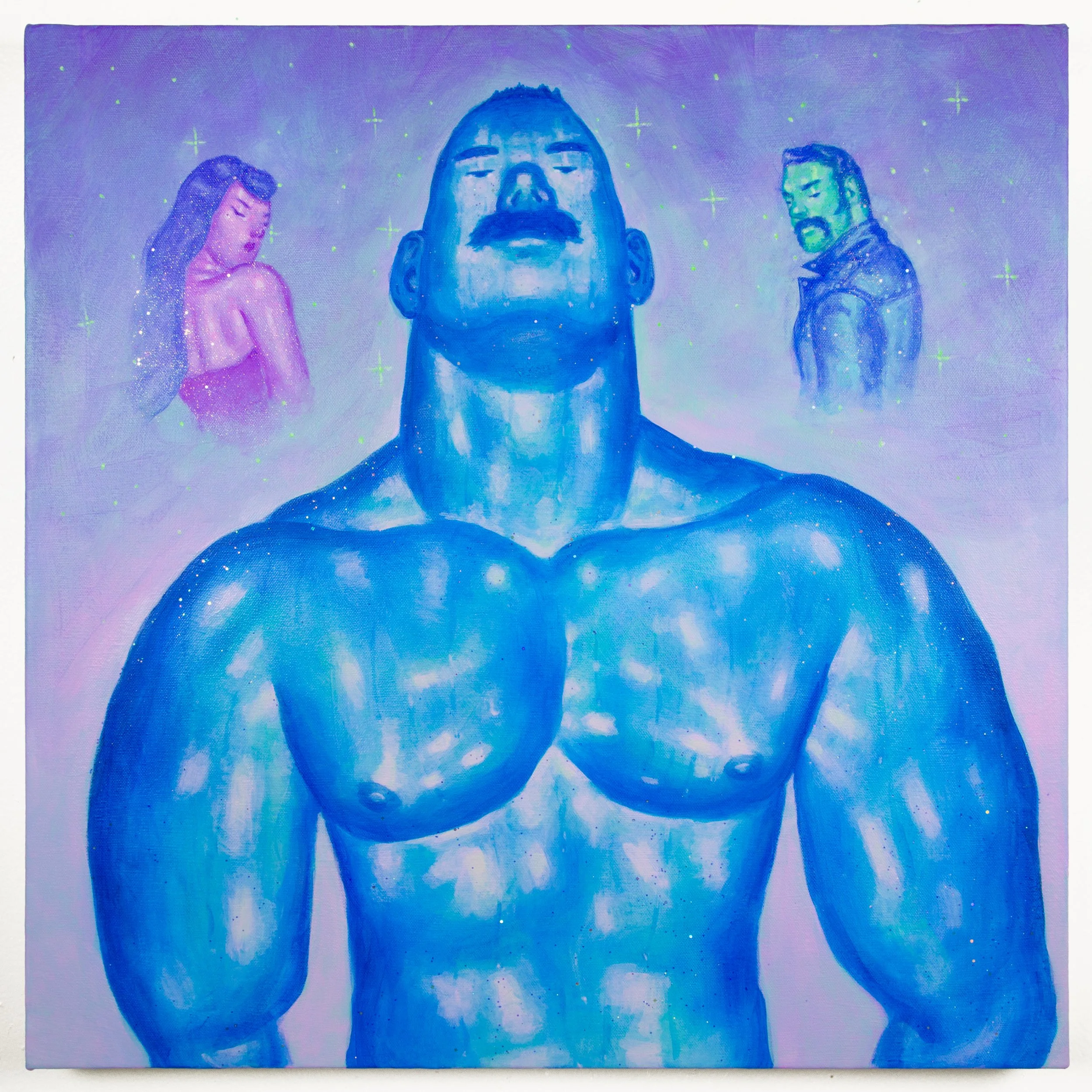
His paintings bring his memories into a dreamlike narrative world populated by recurring characters, including a blue-toned figure he calls “Blue Dream.” Moving through scenes filled with suburban interiors, fast food, lava lamps and cinematic spaces, these figures carry elements of Yoon’s personal history while exploring broader questions of queer Asian identity, desire, friendship and solitude.
For Yoon, nostalgia is less about returning to the past than understanding how it continues to shape the present. It operates as a way of understanding how identity forms across time, geography and imagination. The ordinary moments that pass unnoticed in daily life begin to take on the weight of myth.
In this conversation with Hyvemind, Yoon reflects on the memories, cultural influences and personal mythology that continue to shape the evolving world inside his paintings.
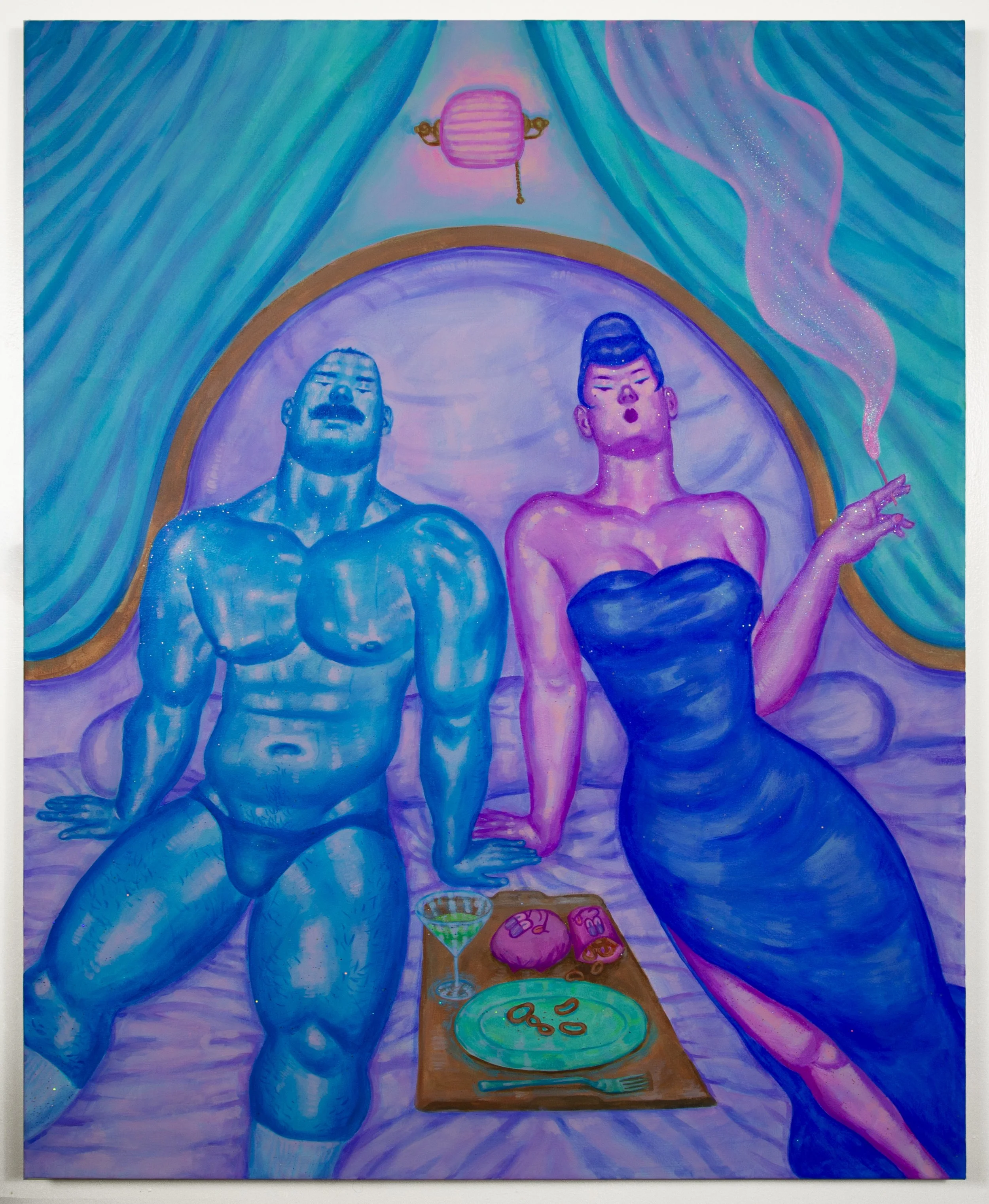
Room Service, 2025
Hyvemind: Hi Justin! Welcome. Let our readers get to know you and tell us a bit about yourself!
Justin Yoon: I am Justin Yoon, an artist based in Brooklyn, NY, and I make paintings and drawings. I was born in Glendale, California. I grew up in Bundang, South Korea, and I have been based in New York ever since 2010.
I make works that are inspired by idealized nostalgia, queer and Asian-American identity mixed with the influence of American culture such as old Hollywood movies, jazz, fast food and even TV shows and comics.
I love narratives, especially personal ones told through a fictional lens, which is what I try to do—to capture the experiences and moments in time that I feel are significant, yet oftentimes are also considered fleeting and mundane.
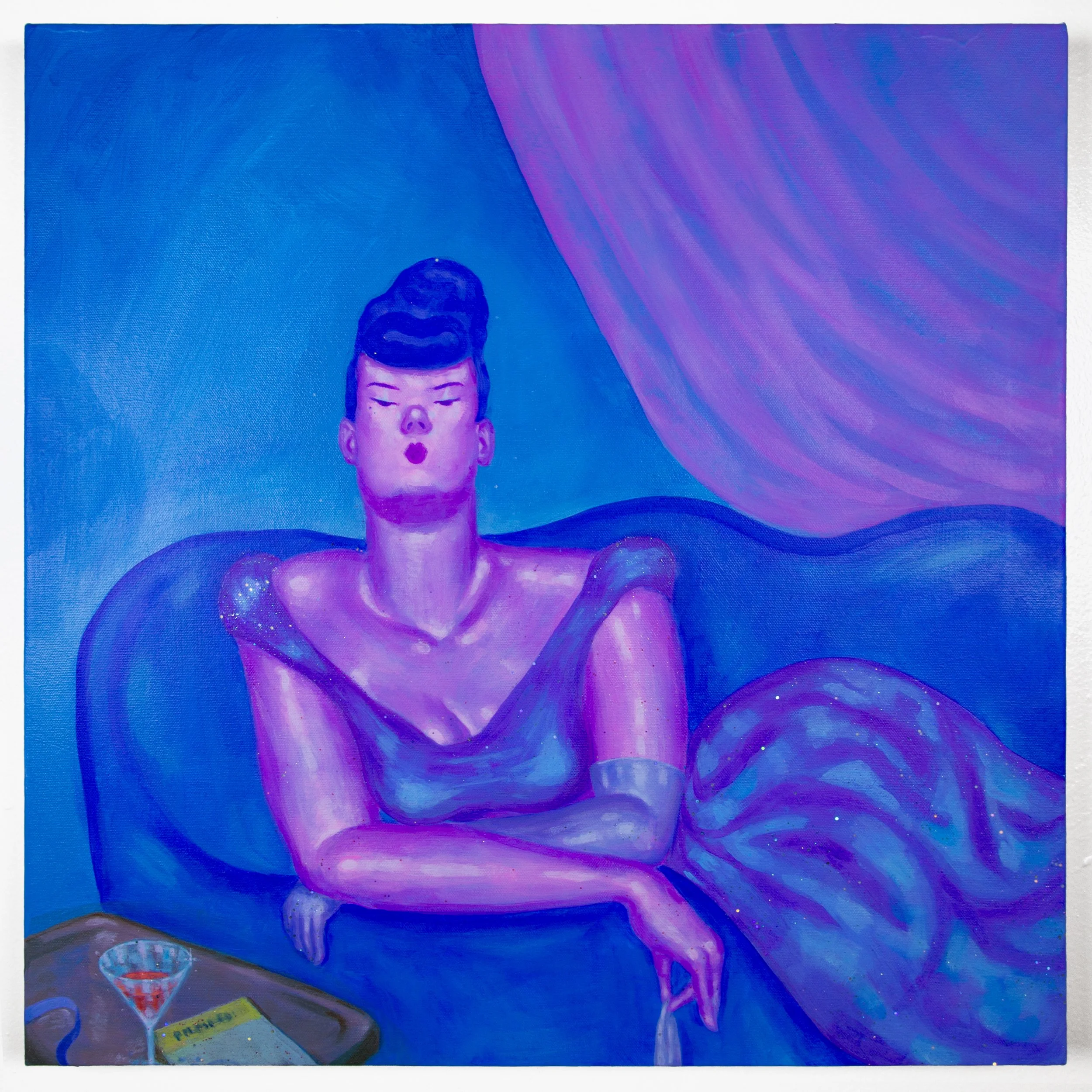
After the Party, 2025
HM: How did you get into art and painting? What pulled you to this form of self expression?
JY: My parents were romantic and creative. My dad was a big fan of movies—he would show me all kinds of different movies that he deemed important culturally. He was also a big lover of music, ranging from classic rock to blues and Jazz. This impacted me deeply, as he shared all of his interest and knowledge with me.
My mom was a very visual person. She studied fashion design and shared her love for color, shapes, clothes and aesthetically beautiful things in life.
My brother was naturally talented in both music and art He used to draw comics and I would copy him growing up. I started anything my brother drew and anything I found visually appealing. I was drawing comics like Garfield and copying various mangas.
That’s how I started, and I continued until this practice grew into me creating my world through paintings and drawings.
Dreaming is Free, 2024
HM: Tell us a bit about your background. How does your lived experience inform your work?
JY: I grew up mainly in South Korea from age 6 to 18, but before that I was in Glendale, California. The idea of leaving behind LA in my memory was so impactful, as the reverse immigration imprinted this idealized, romanticized memory of America and California in my mind. Even when I was growing up in Korea, I was immersed in American media like Hollywood movies, TV shows such as Friends, Sex and the City, That '70s show, 30 Rock and even reality shows too.
I started slowly developing this fantasized idea of what Americana is to me, heavily influenced by old Hollywood movies and the idea of 1930s-1970s American imagery, which made me yearn to be back in the US as I was growing up in Korea.
When I finally moved to New York in 2010 for college, I realized I was yearning for the 2000s South Korean things that seemed insignificant while I was growing up there. Looking back, it had a bigger impact on who I became, as if the nostalgia itself is what makes me obsessed with things. Through my 20s in New York, I kept yearning back for a moment in time that was forever gone—like the “idea” of New York and California in the past before I was born.
I started to understand myself more as a creative person who strives and yearns in the ideas of things—memories, or little moments that seem small like hanging out with friends after school, parties I had during college years, me playing The Sims, listening to jazz at night alone, late night car rides in the back of my parents car looking out the window listening to my dad’s music, walking around New York while listening to the Strokes and Phoenix with nowhere to go, going to Quad Cinema or the Angelika alone and watching whatever they are showing or going to the theater alone in general.
These little things I found so poignant and important that it encompasses a major theme in my work now. It was a natural manifestation of what I found so romantic, mixed with the yearning I had for queer imagery of Asian people, which I had a hard time finding. I was yearning for the Romantic approach to sensuality with oneself, of an Asian American, in a queer, yet nostalgic context. It all came together on the canvas that way.
Do You Realize Who You Are?, 2025
HM: What are some of your major inspirations? (other artists, music, movies, places?)
JY: Movies are my biggest inspiration. Richard Linklater’s Before Sunset & Dazed and Confused, Lee Yoon-Ki’s My Dear Enemy, Wes Anderson’s Rushmore, Sofia Coppola’s Lost in Translation and David Lynch’s Mulholand Drive all had a huge impact on me.
Music is a big part of my inspiration as well, especially Jazz. Chet Baker, Bill Evans, Erroll Garner among others have been a big influence on my work.
Theater is a big influence to me as well, especially shows from the 70s and early 80s, and Stephen Sondheim’s works.
Of course, LA, South Korea and New York are all big, big influences to me as well, as the feeling of these places filled with my own memories and nostalgia has an overwhelming chokehold on my experience in this life.
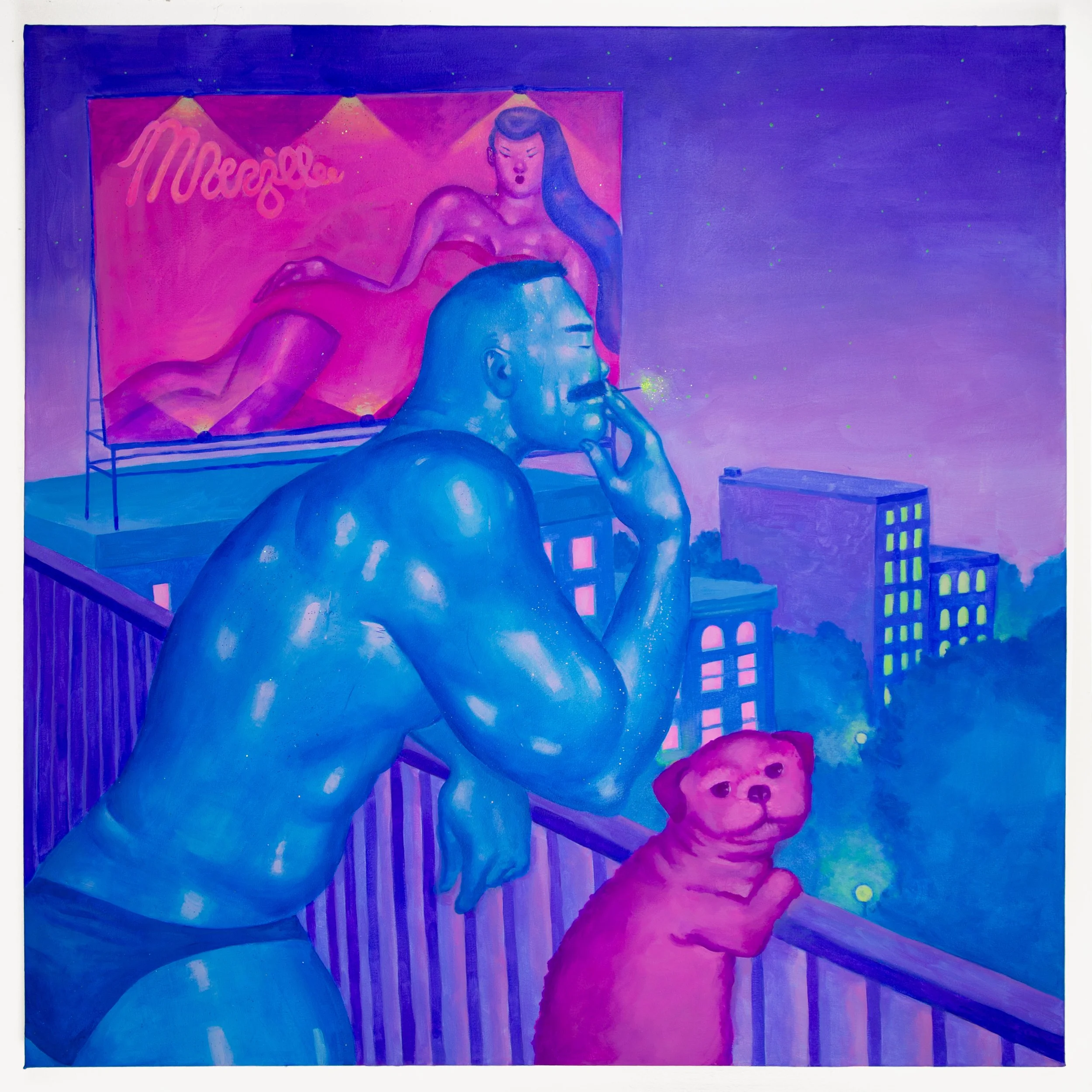
Some Kinda Love, 2025
HM: Many of your paintings include the same blue muscular male figures. Can you talk about why you make this choice and why?
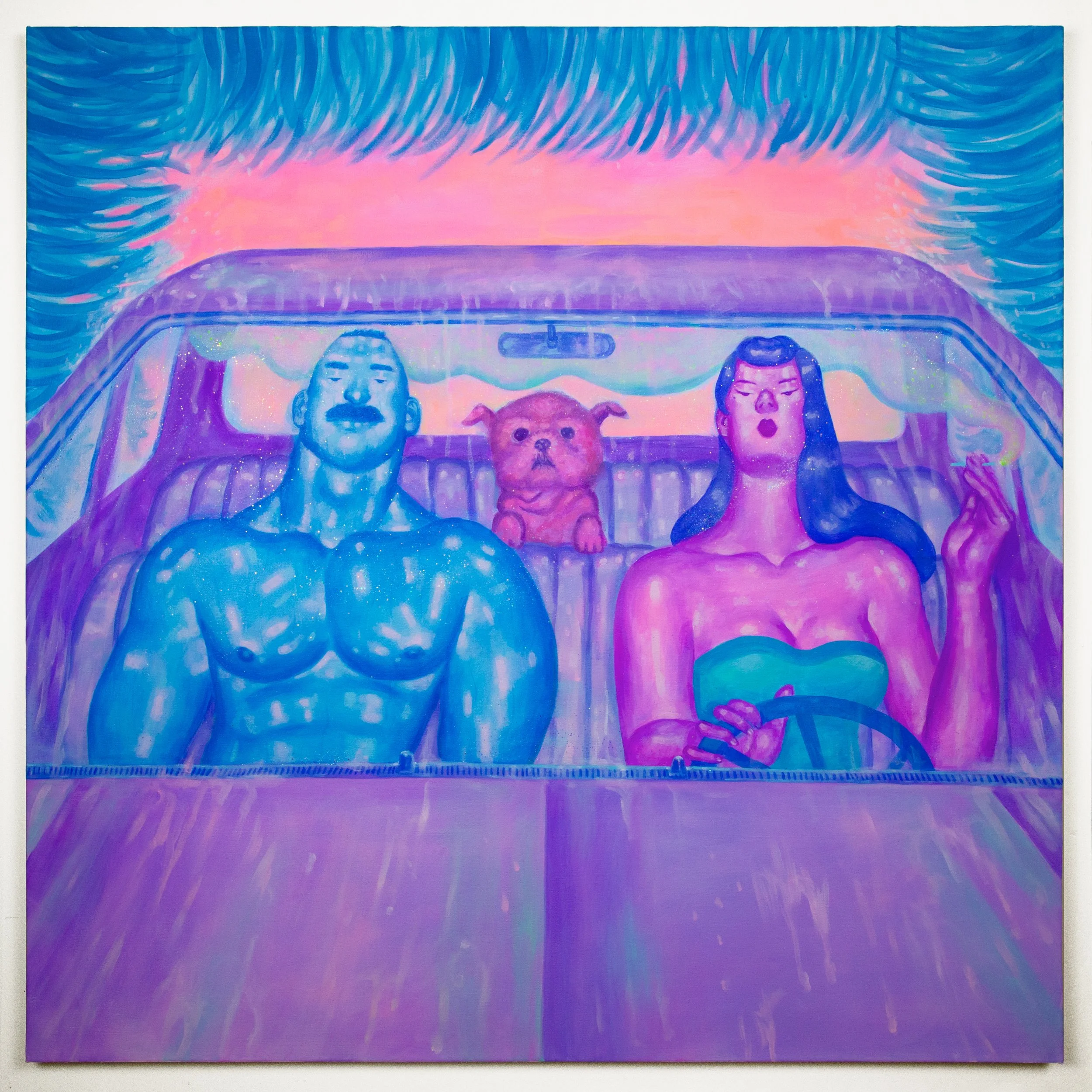
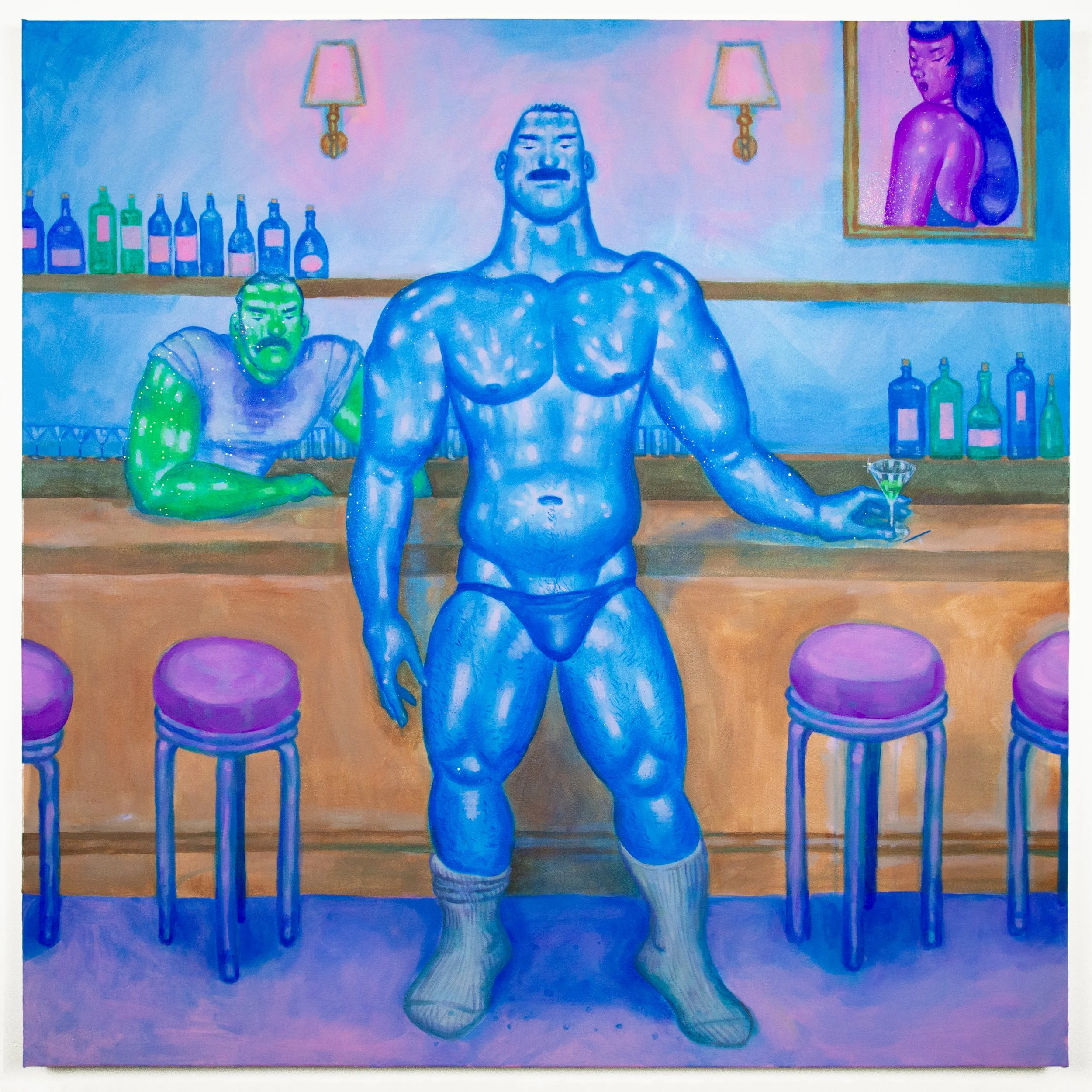
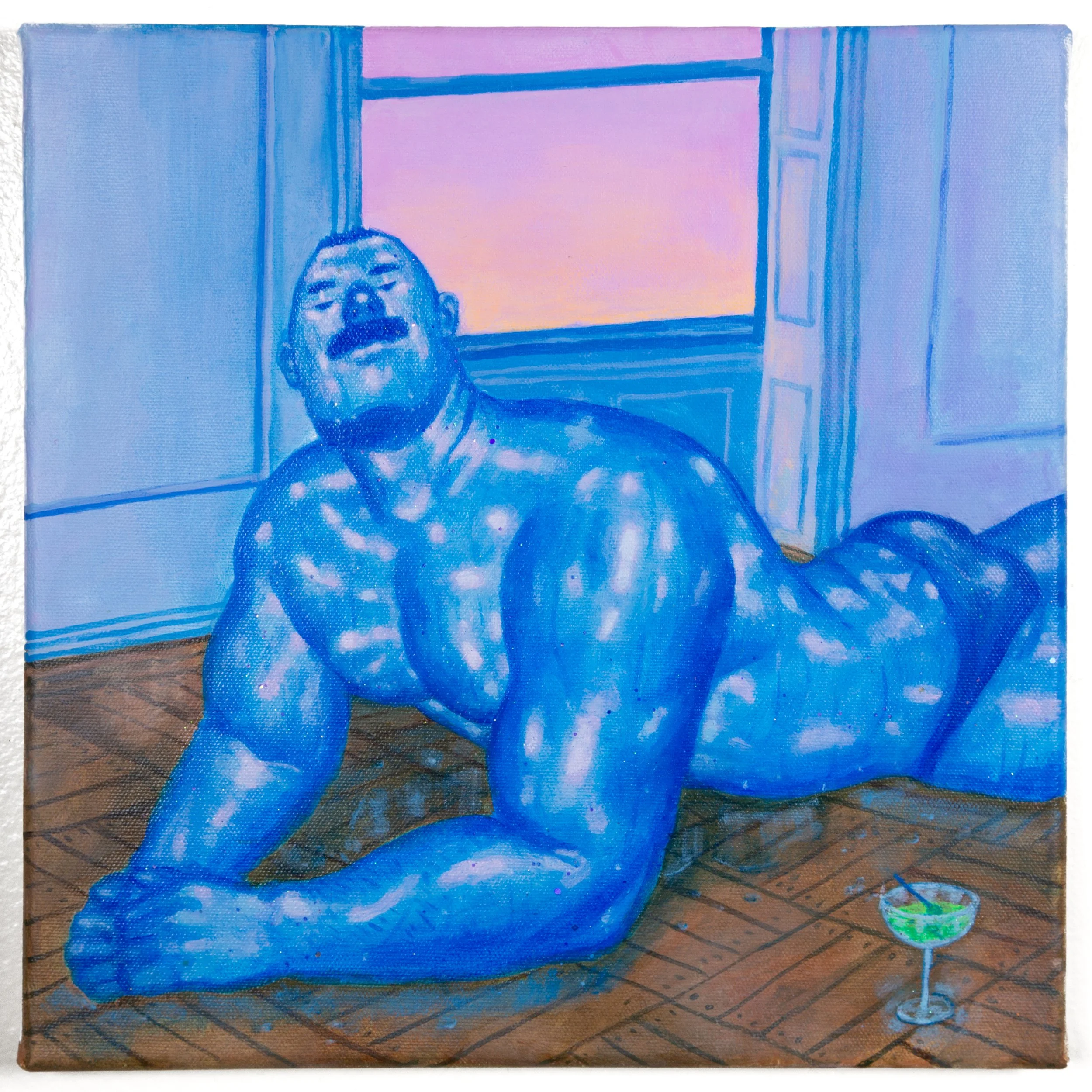
JY: The blue muscular male figure is named “Blue Dream”—he is a recurring character alongside Marge, Fivepoundz (the shih tzu), Machoman Park, and Phoebe. They are characters I created over the years slowly to represent myself, everyone I know, all stars and imagery of people that influence me, all the different feelings I have and many little moments personified.
I always yearned to see a sensual, strong, powerful, super-masculine and feminine imagery of queer Asians, to the point of tongue-in-cheek exaggeration of it. When I see Asian queerness portrayed, it is often demure, subtle, tortured, quiet, somber or just strictly sexual in the context of sex itself. I wanted these characters, who carry my universal yet personal, romantic and soft emotions, to appear almost as if they are playing in the stereotype of hyper masculine and feminine sensual imagery of what old Hollywood portrayed.
I wanted to own that sensuality, without the notion of “sex” itself or “couples” or “romantic love”. I think there is something so much more gay and romantic about platonic love that you have with your own body, your friends, and your family—chosen or otherwise. There is a beautiful power to it that explodes with complex emotions when you choose to actively appreciate and exaggerate those moments and feelings. So I create the narrative world with these idolized Asian queer characters. (Including Fivepounds the shih tzu—Asian dog)!
A Meet Up, 2025
HM: Do your recurring characters or visual motifs evolve alongside you? What do they help you hold or explore?
JY: Other than the recurring characters mentioned above, I also reuse a lot of Americana-inspired imagery, such as Old Hollywood, lava lamps, Suburbia, 70s, LA and NY inspired scenes, fast food and more.
This imagery is always present alongside my characters, and it helps me hold onto my original sense of identity I formed through my childhood and I so dearly revisit. It actually now spans through my 20s and my early 30s as well, as I actively revisit every part of my existence. This helps me guide through where I am now.
I often think it is similar to journaling. I am trying to understand myself now and where I am going through uncovering symbolism I have placed unknowingly.
Oftentimes, I only notice after the piece is finished. Things happen unconsciously, like how David Lynch said “to jump into the deep purple ocean of unconsciousness in your mind” to catch the fish of inspiration. That is how I feel I explore things through these recurring narratives and imagery.
But Not For Me, 2025
HM: What’s your favorite piece you’ve made?
JY: Each piece I make means a lot to me in a significant way. They all represent a part of myself. I can’t pick one favorite piece.
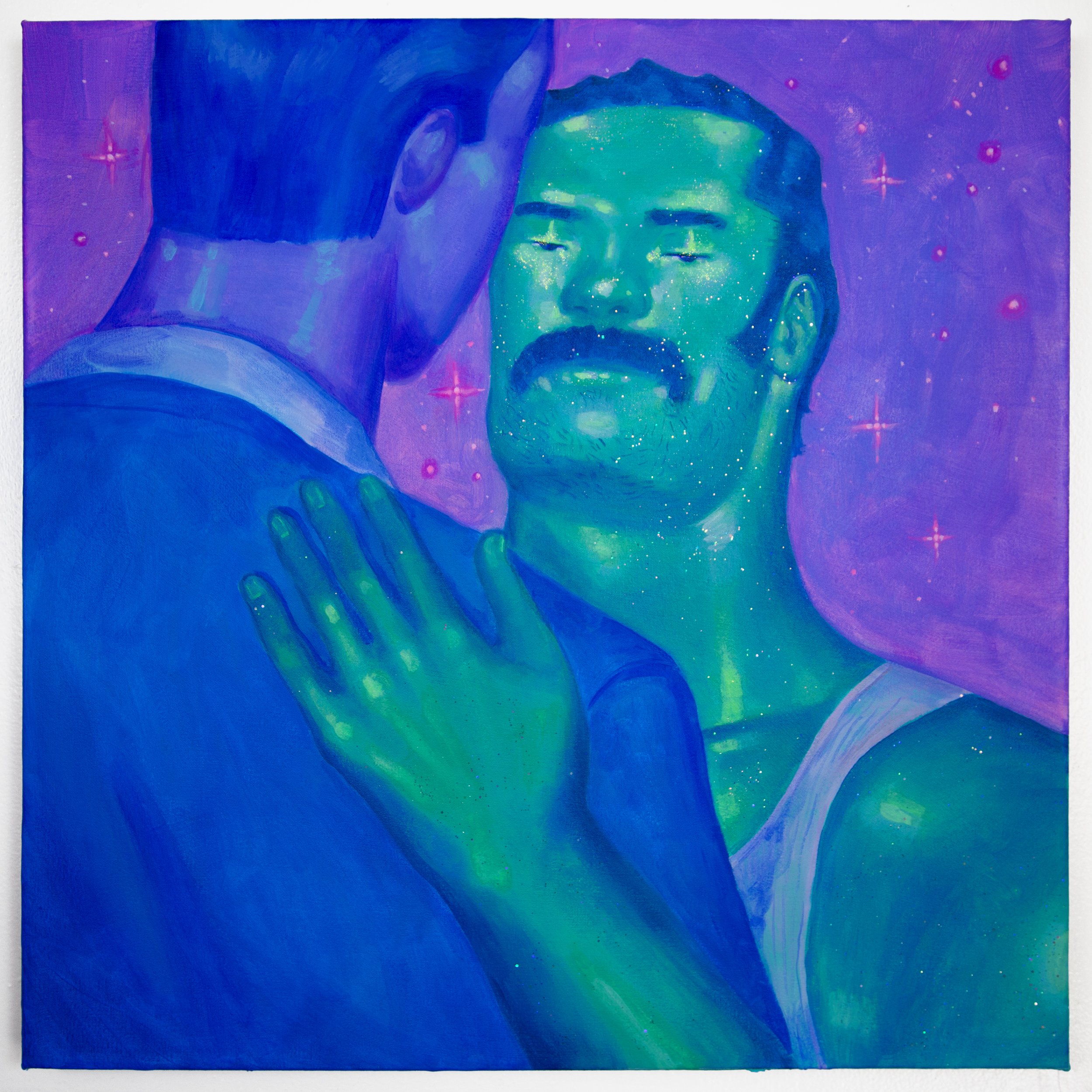
It’s Best That I stick to My Tune, 2024
HM: What questions about identity, history or connection feel most present or important in your work at this moment?
JY: We are all a part of our own history. Thomas Wolfe, author of Look Homeward Angel, says in the opening letter of the book that, “we are the sum of all the moments of our lives”. This is also a quote from Before Sunset, and I think that is deeply truthful to how I see the history and identity of an artist.
It’s all a part of your story—not only the personal moments in your life, but the people who came before you. When you create a narrative, all of that is being poured in without your intention. I yearn to understand where you come from and how you become who you are—are big themes to me.
I always seek to know more about the past, even for the time before I existed. I try and understand or capture something of time long-gone. For me, this creates a connection between my yearning and my sense of self. This has always been something that lingers in my mind as I work and try to find and tell stories of my own personal experiences. I think everything personal is universal.
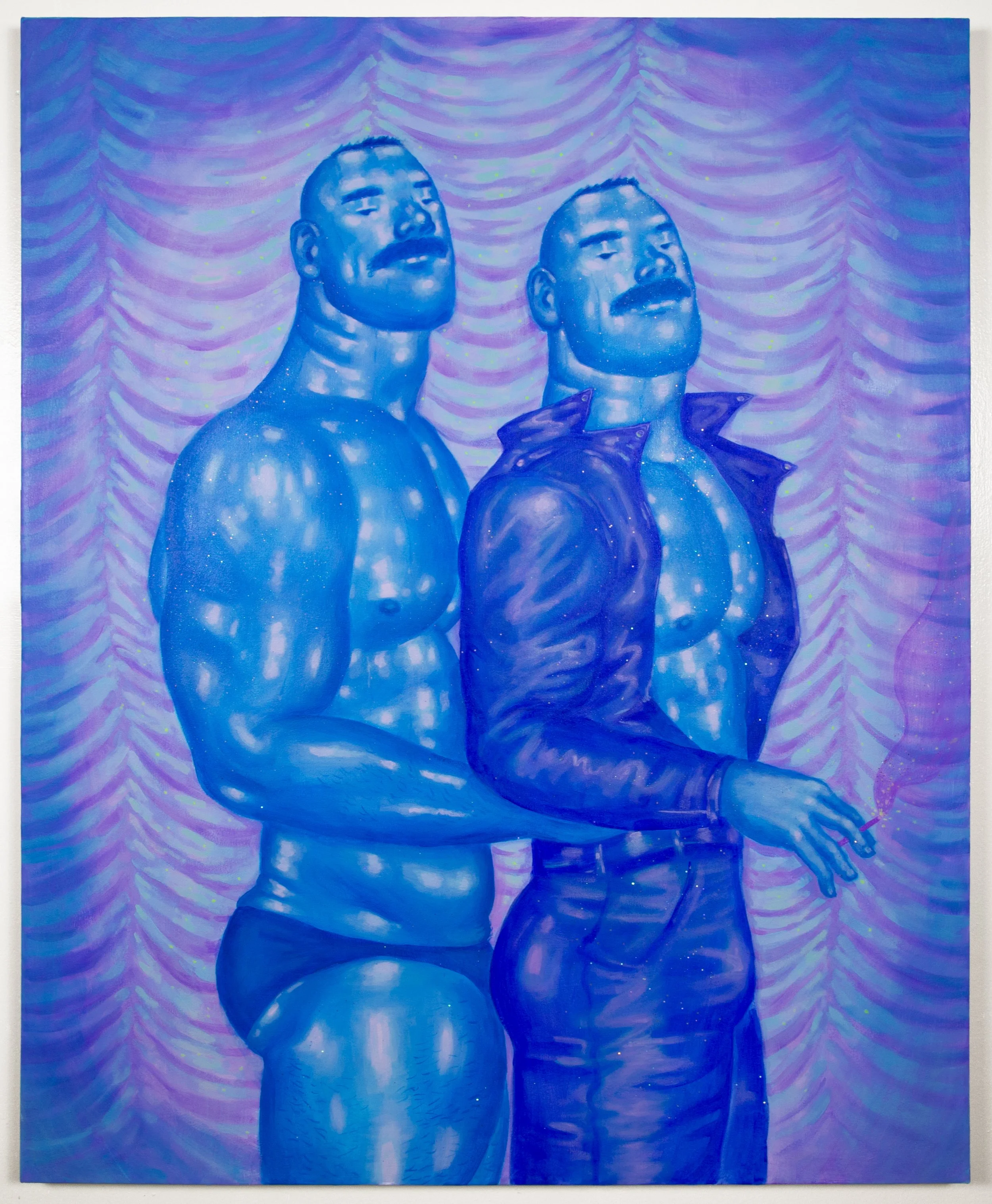
Mood Indigo, 2025
Q: What are your current inspirations or obsessions and what are you excited to explore next through your art?
JY: I am currently exploring more about myself. More about solitude, more about the romance of loneliness and the idea of how we are born into this world surrounded by people. And how romantic that is. Fleetingness is so beautiful.
Things are beautiful because nothing is eternal. There are moments in time that are forever gone, and those moments make the world what it is.
Check out Justin Yoon’s work on his website here .
Follow Justin on IG: @jyoonny