
Artist Paul Anagnostopoulos Paints Queer Desire Into the Classical World
In his newest series, Catasterism, the NYC artist revisits Dionysus and Ampelos through queer semiotics.
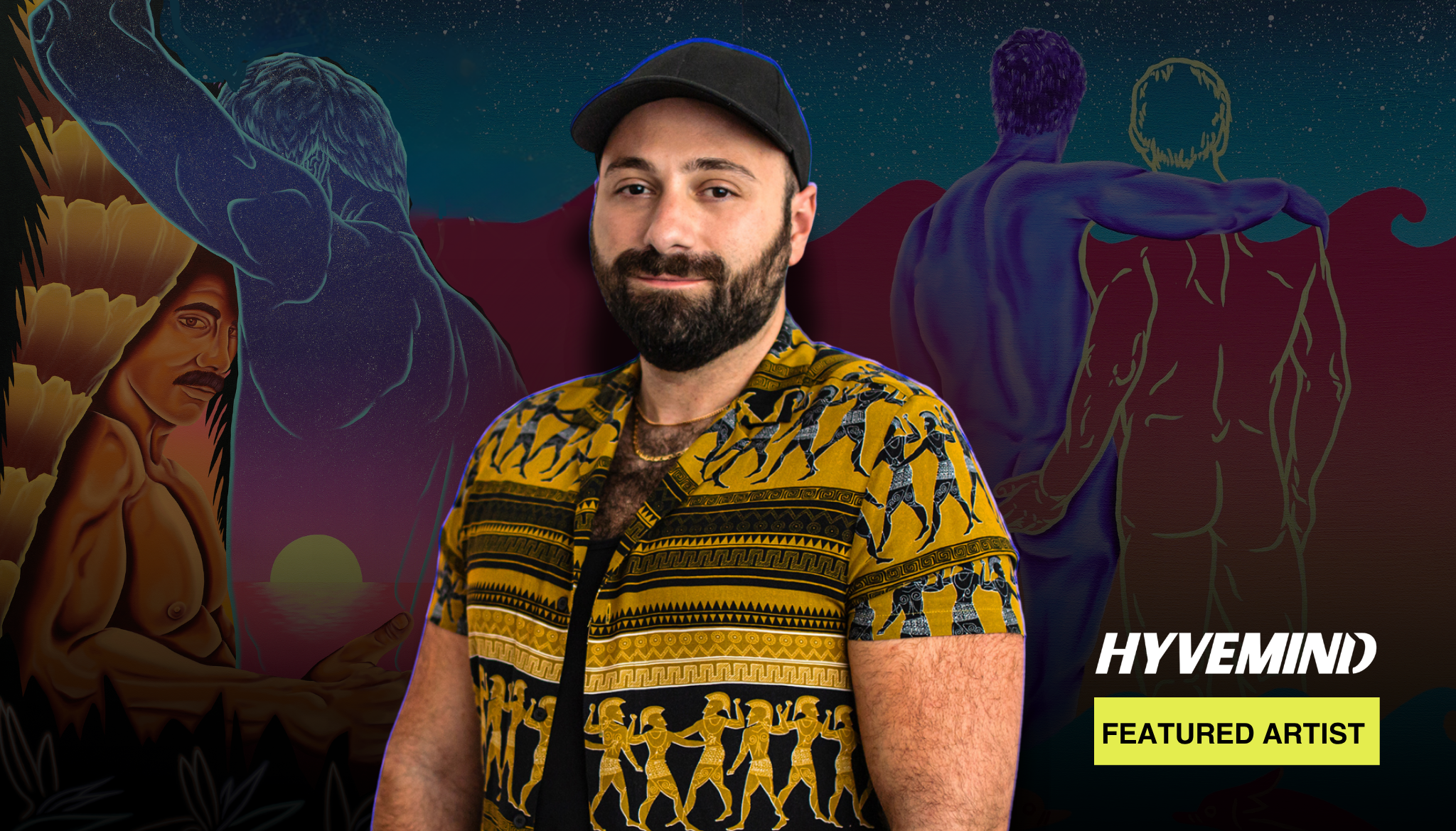
In the artwork of Paul Anagnostopoulos, Greco-Roman mythology becomes a living language for queer desire, tenderness and endurance.
Based between Queens and Long Island, the New York artist works across canvas, shaped panels and terracotta vessels, building vivid, highly charged worlds where ancient stories, art history, personal memory and queer life meet.
His paintings are steeped in classical reference, yet they move with a contemporary emotional charge. Saturated sunsets, electric color, homoerotic tenderness and camp humor run through the work, giving ancient forms a sense of immediacy while raising deeper questions about what gets preserved, erased or returned to view.
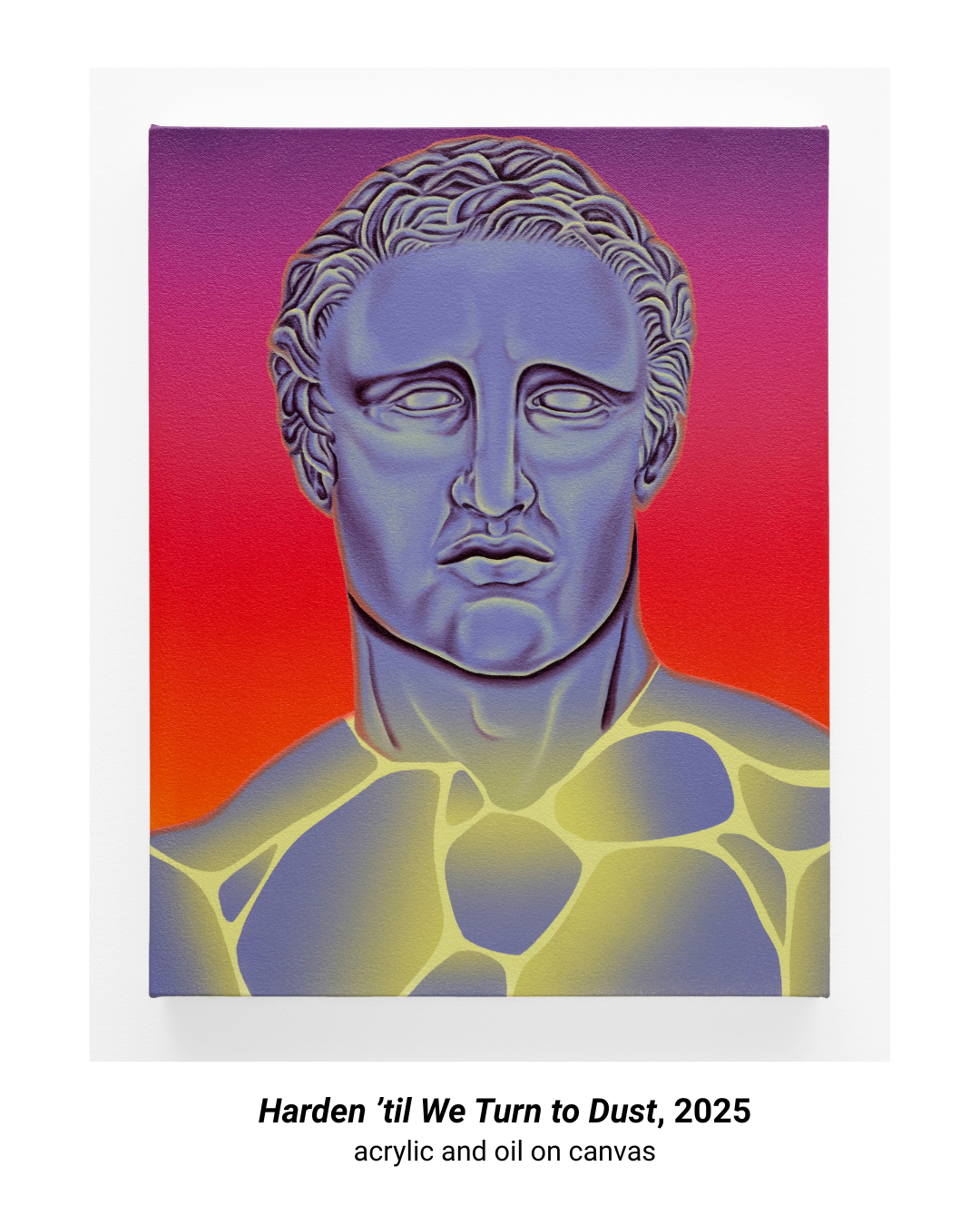
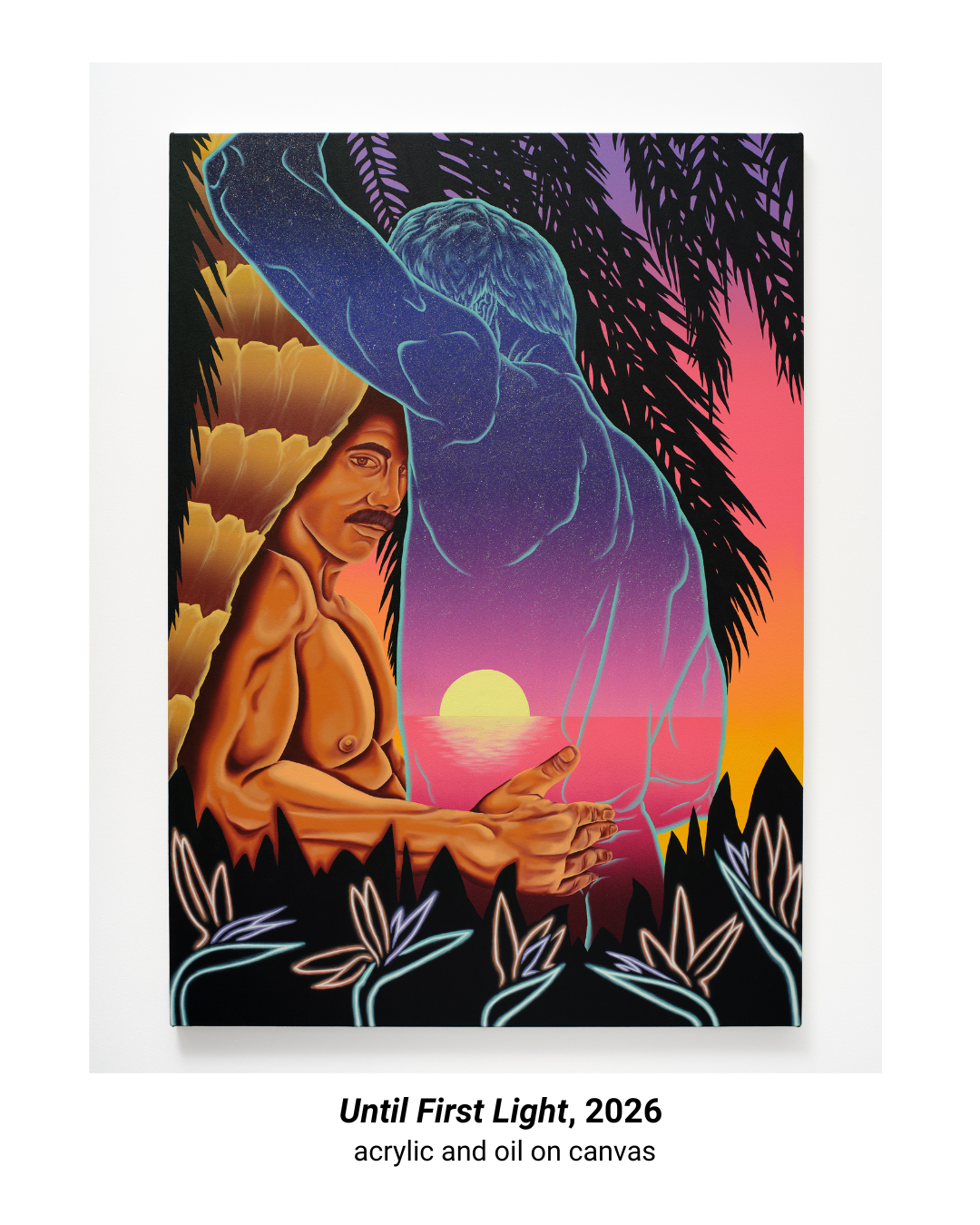
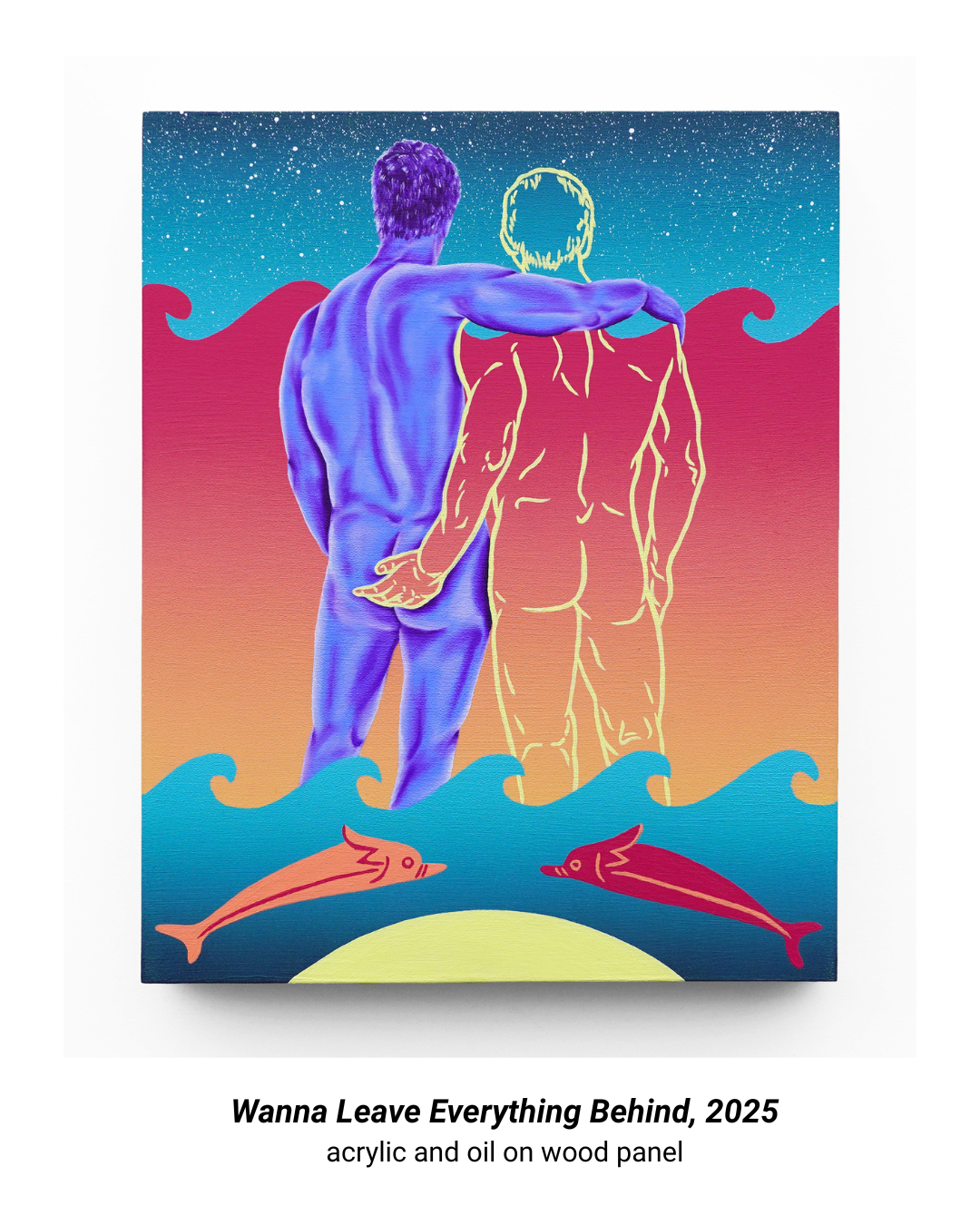
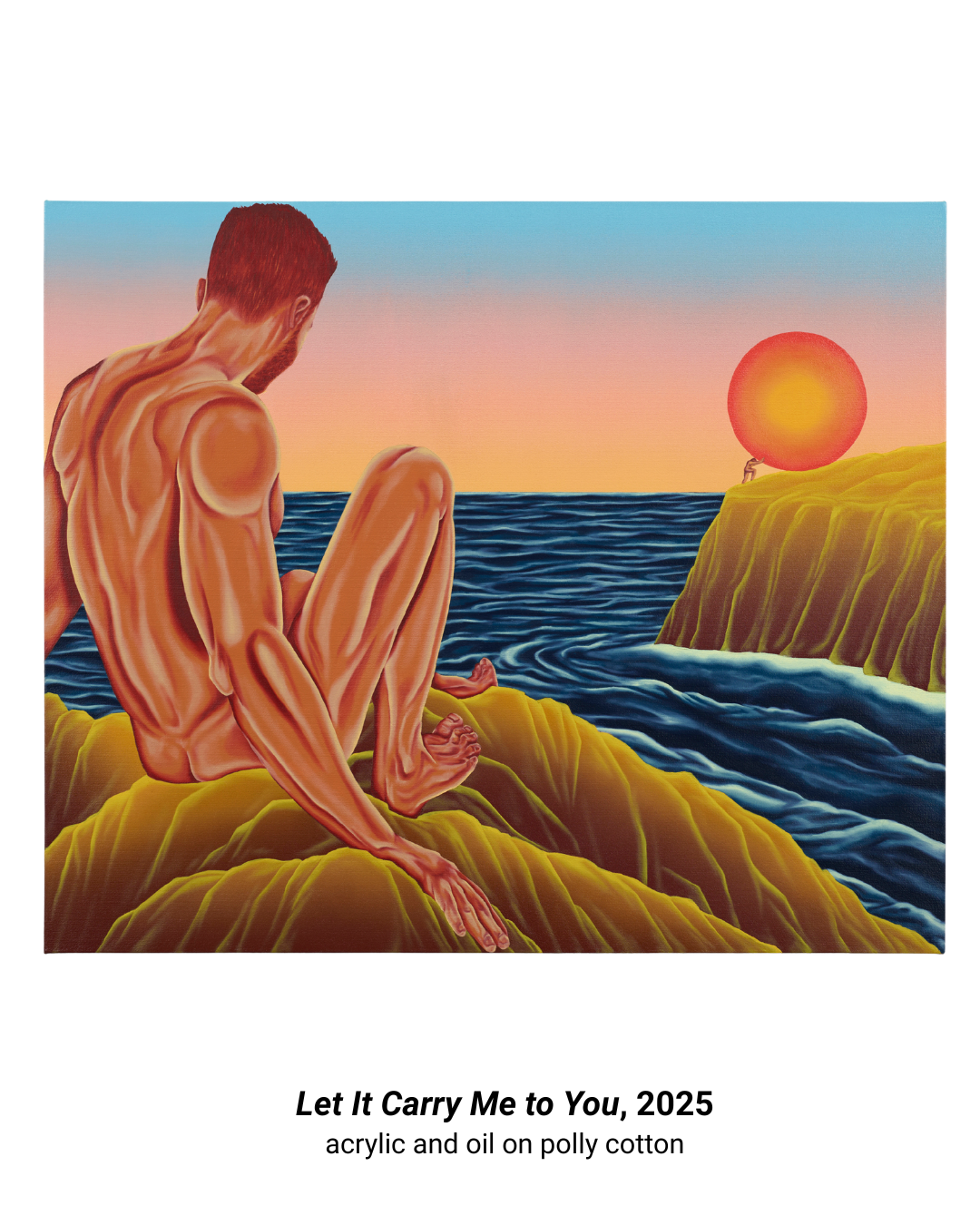
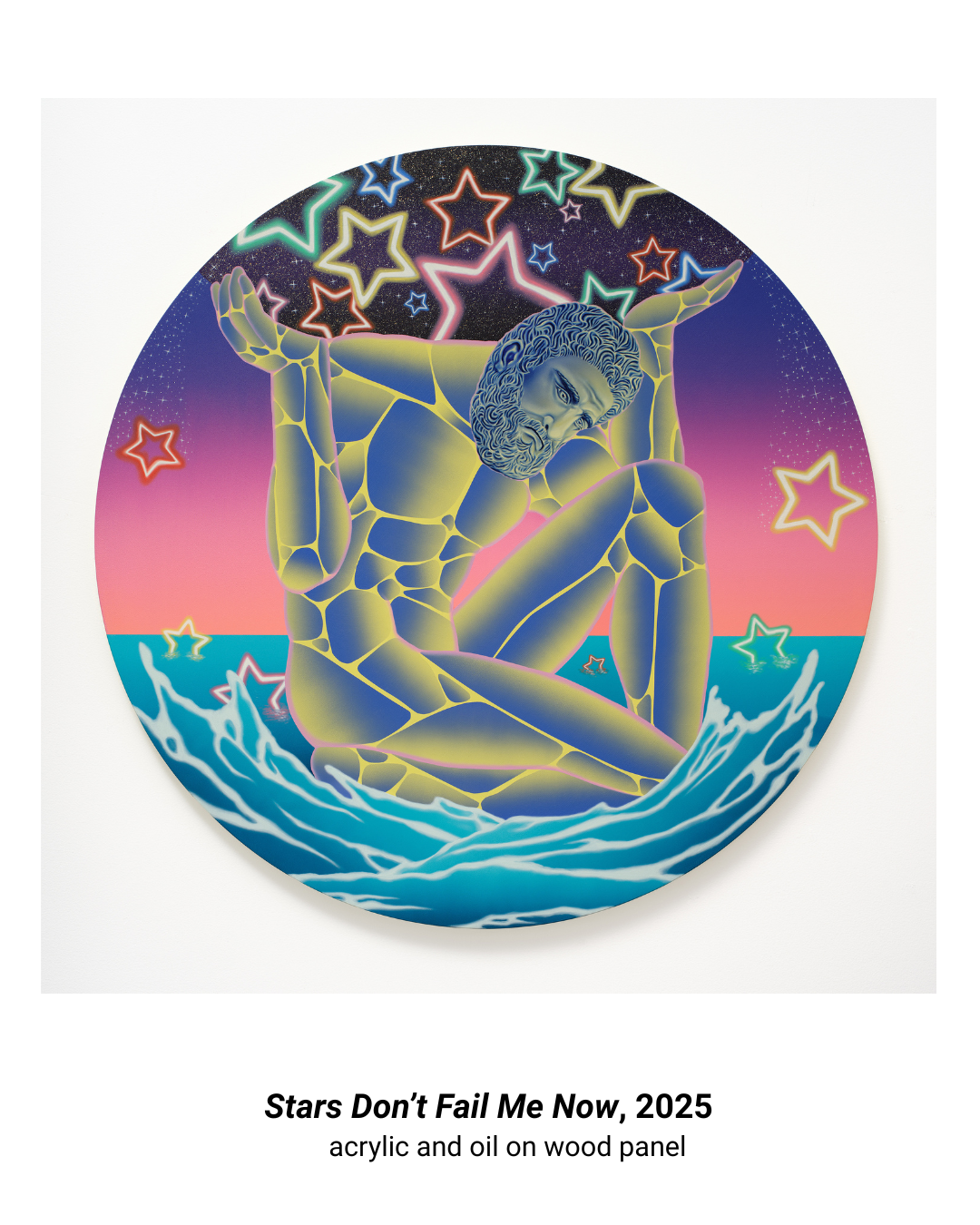
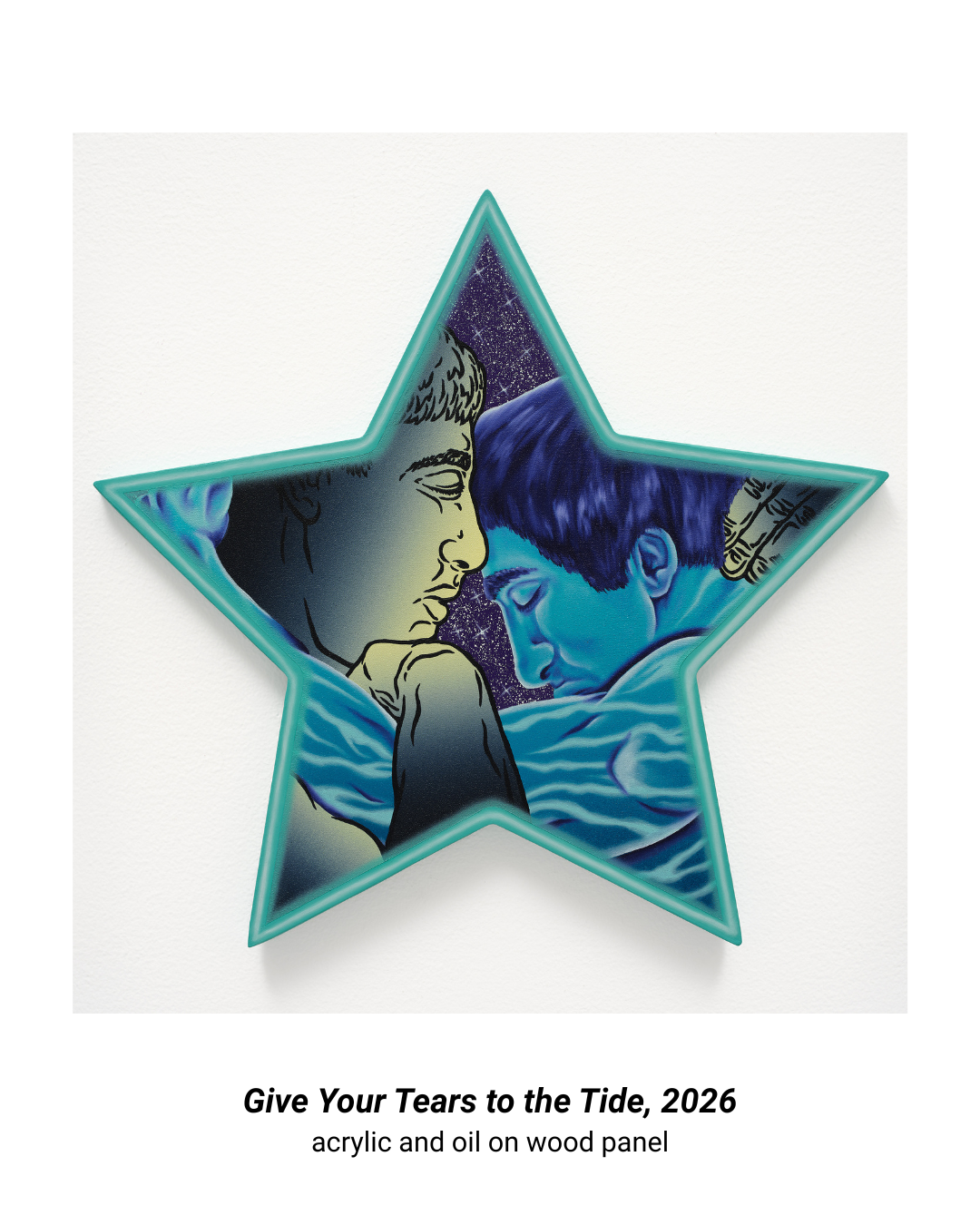
In his newest series, Catasterism, showing with Feia at Future Fair in New York from May 13–16, he revisits the mythic relationship between Dionysus and Ampelos, drawing from ancient texts, autobiographical fragments, Mediterranean landscapes and queer semiotics.
The title refers to the mythological act of transforming a mortal or figure into a star, constellation or celestial body, a fitting frame for work preoccupied with love, loss and remembrance.
In the conversation below, Anagnostopoulos discusses the early experiences that shaped his visual style, from childhood drawings and comic books to the souvenir ceramics in his grandmothers’ homes, and the role painting plays in preserving queer history across time.
Hyvemind: Welcome Paul! Introduce yourself & tell us a little bit about who you are.
Paul Anagnostopoulos: Hey! I’m Paul Anagnostopoulos, an artist based in Queens, NY and Long Island, NY.
I make paintings on canvases, shaped panels, and terracotta vessels. I grew up on Long Island and later on attended NYU for undergrad and then Hunter College for grad school so NY has always been home.
I’ve been fortunate enough to attend many artist residencies and there was a solid 2.5 year period when I lived out of a suitcase. I hopped around Iceland, Italy, Greece, Mexico, Hawaii, New England and California.
All of this travel influenced my work and the way I think. The world I build in my paintings is an amalgamation of all of these incredible landscapes I was fortunate enough to experience.
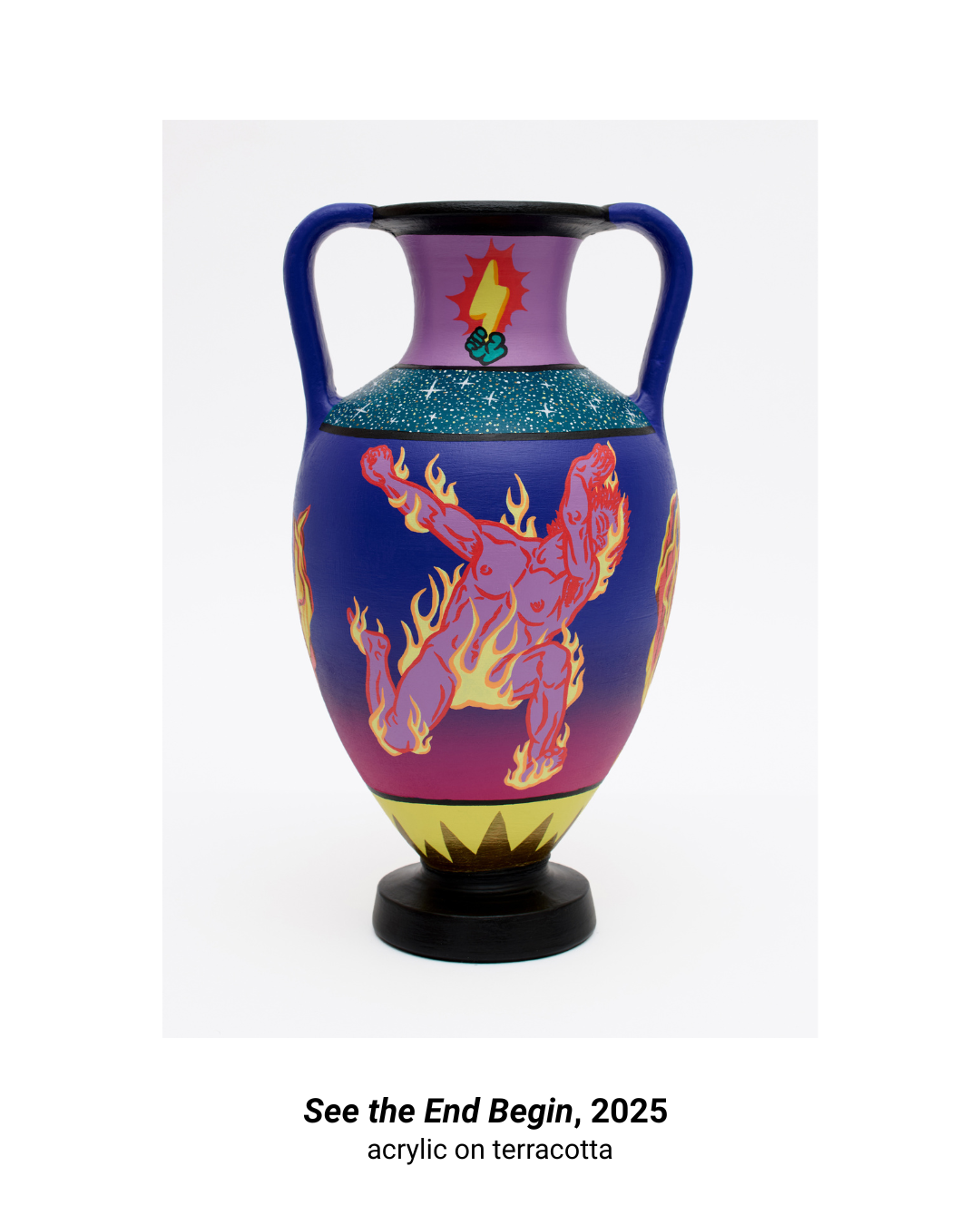
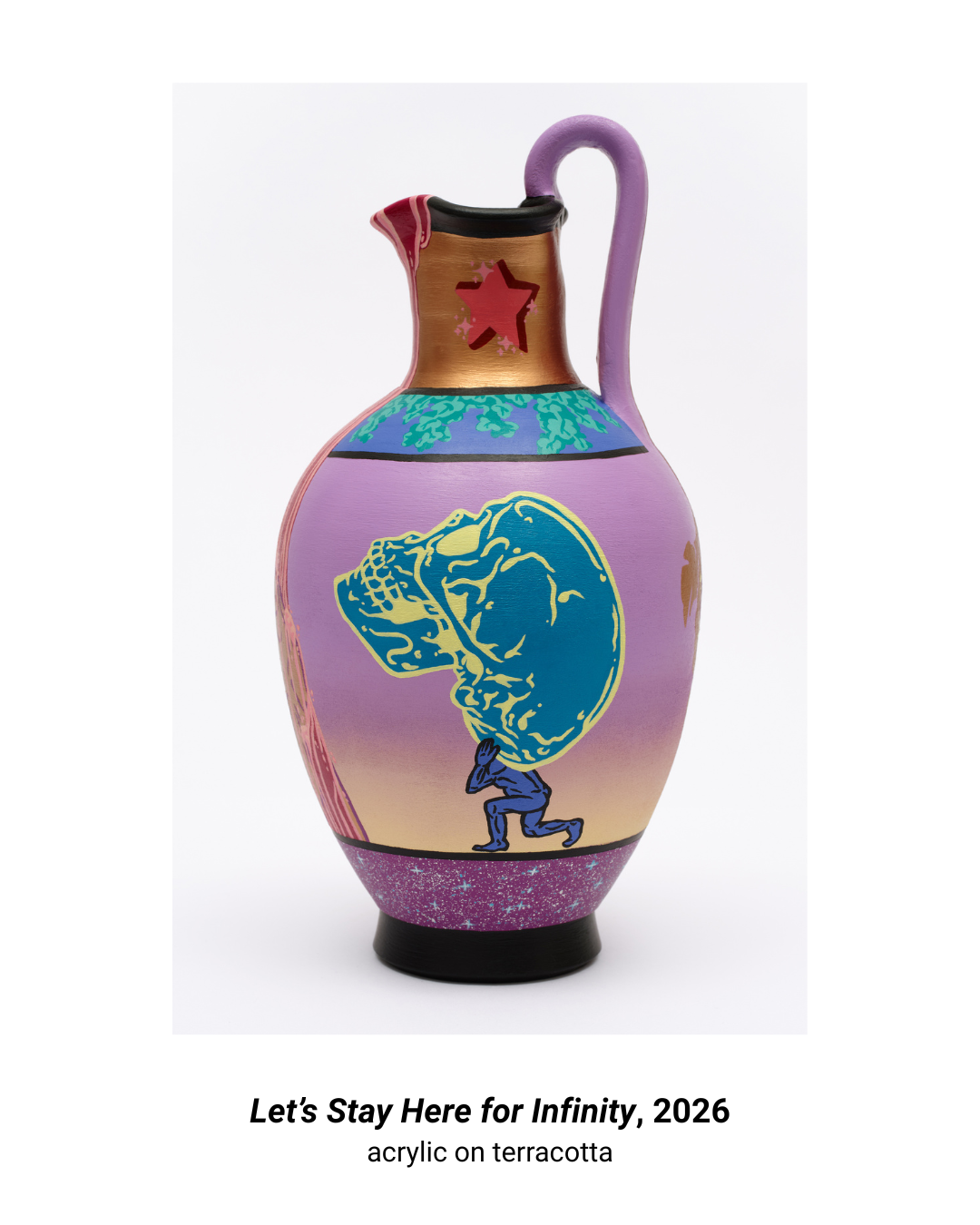
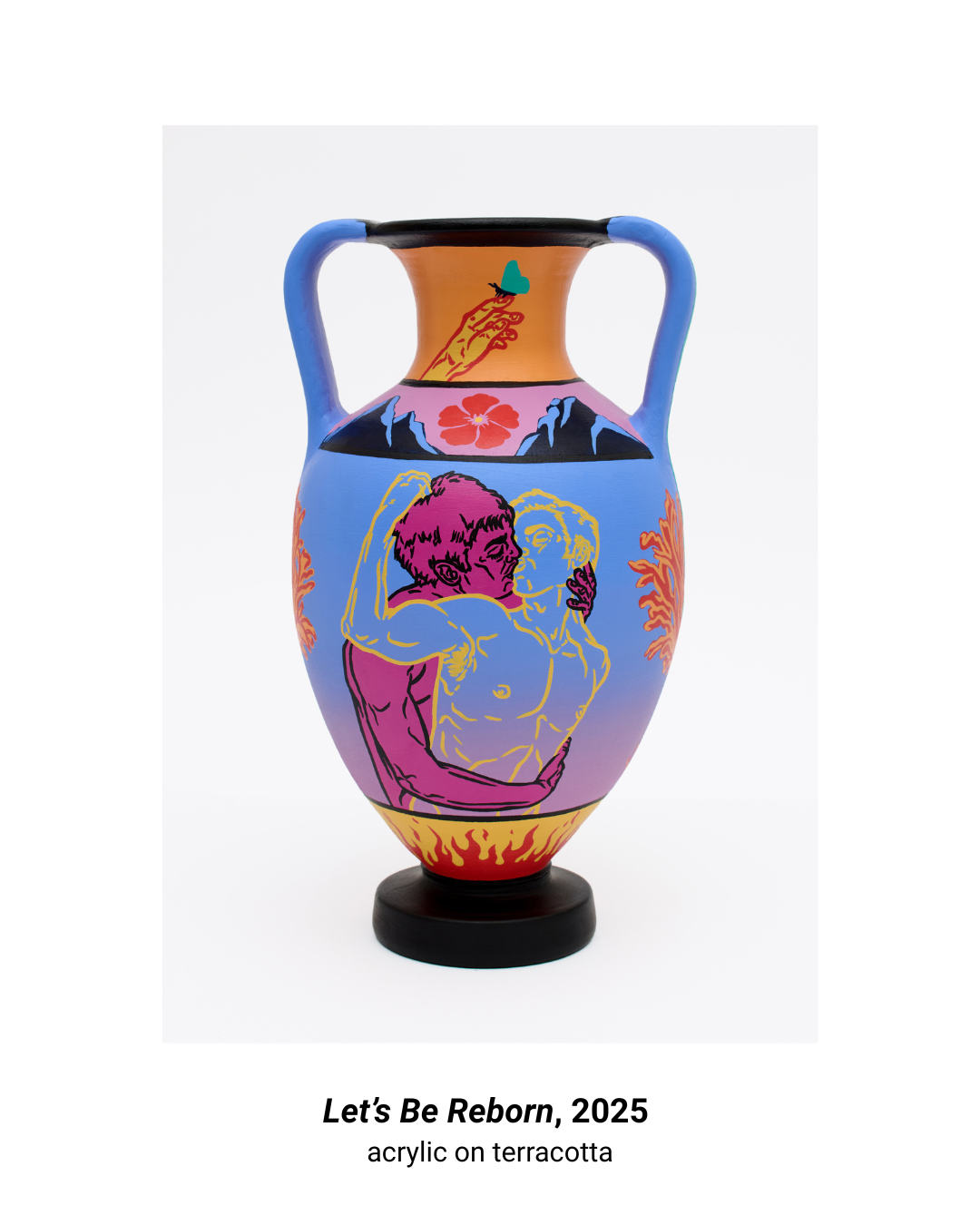
HM: How would you describe your work to someone who has never seen it before?
PA: At its core, my work is an exploration of Greco-Roman mythological tropes through a contemporary queer lens.
Conceptually, I focus on connecting people across time and space to emphasize how the queer community has always been here and always will.
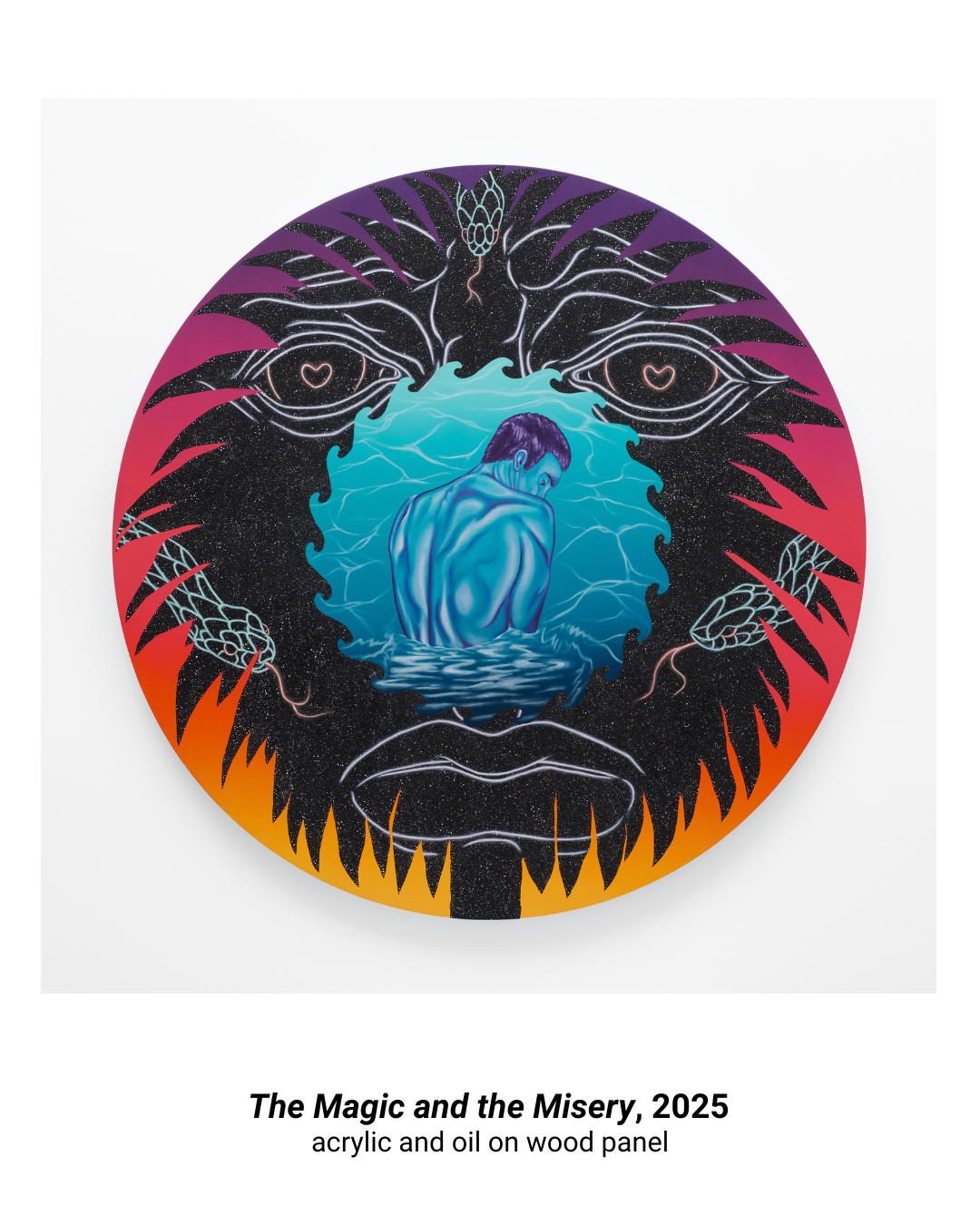
I create vibrant images drenched in sunset tones and electric colors. I play with both flat and illusionistic painting techniques to establish spaces that exist somewhere between two and three dimensions.
My visual vocabulary blends classical motifs, modern cultural references, and sketches from my time plein air drawing and figure drawing.
HM: What influenced you to start creating and what influences you now?
PA: I’ve been drawing for as long as I can remember.
Growing up, my idea of playing outside was sitting in the grass with my coloring book and crayons. I started off drawing my own comic books and took cartooning classes with the incredible Al Baruch, a Disney animator who worked on Peter Pan and Lady and the Tramp.
I always had a love for combining imagery and storytelling. When I was around 8 years old, my parents took me to the MoMA for the first time and I fell in love with Roy Lichtenstein’s Drowning Girl. I remember thinking to myself, if this guy can paint comics and be an artist in a museum, why can’t I? This set me on my path.
Other influences that remain steady through my practice range from 70s-80s album covers to 90s video games to solo days wandering the MET.
The two most recent sources that inspired my latest series are Nonnus’s Dionysiaca and Hal Fischer’s Gay Semiotics.
HM: Can you talk about your cultural and aesthetic choices? Why are they important to you personally?
PA: My decision making and foundation developed as a response to my heritage. I’ve always maintained a dialogue with art history.
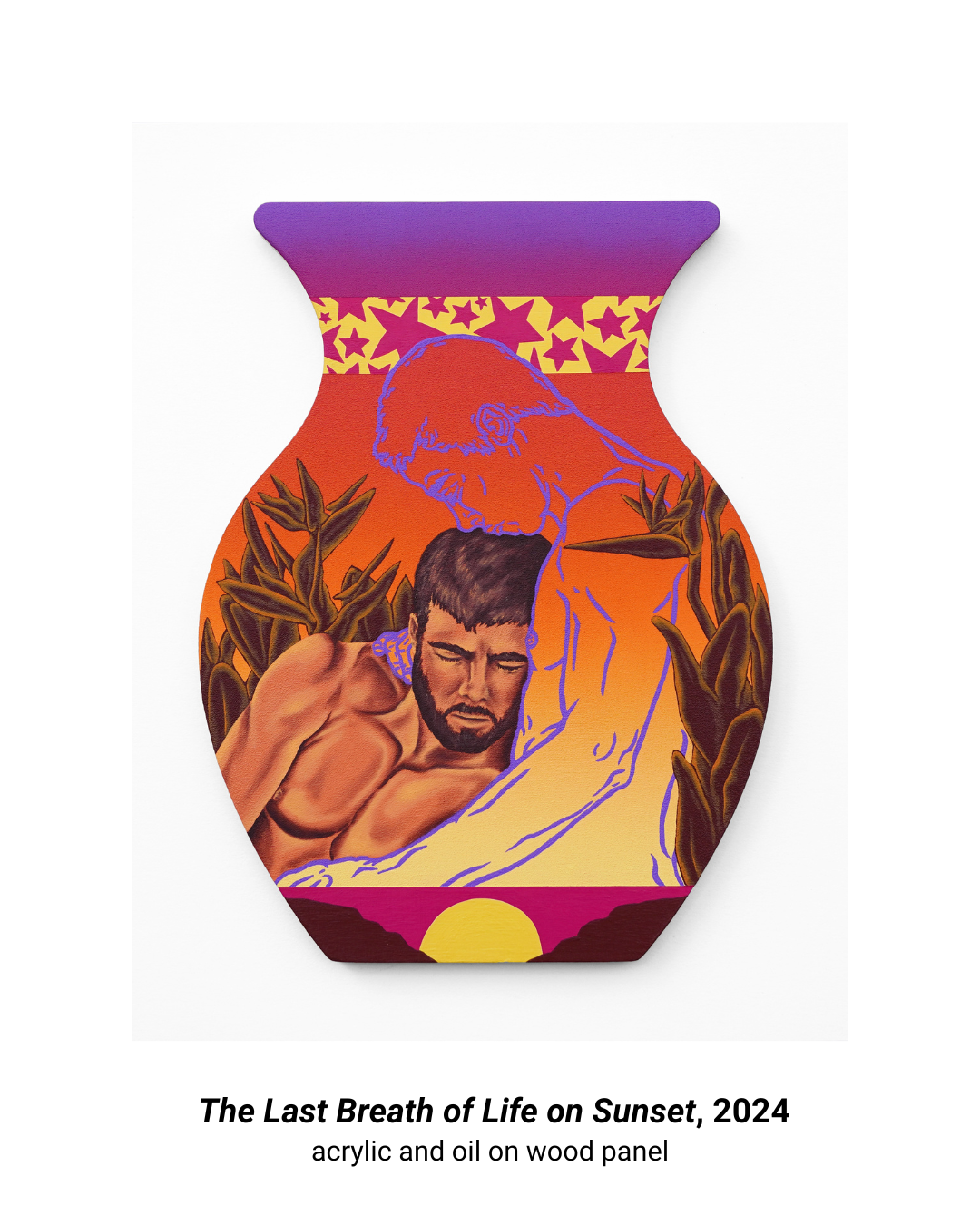
I grew up drawing the vases in my yiayia’s home. Countless ceramics lined her shelves and huge amphoras filled with silk flowers were in every corner. The first time I saw art historical masterpieces, they were in the form of souvenir replicas.
These objects also filled my Italian grandmother’s home. Michelangelo’s Pietà sat on her kitchen counter and other Vatican treasures were scattered about. These kitschy homages to cultural greatness informed my earliest understanding of images.
There’s an earnest sense of humor in the way kitsch appeals to the masses and is embedded in sentimentality. The original masterpiece is so loved and adored that it is reproduced for all to enjoy, it develops a nostalgic endurance.
I create from this same understanding of art. A campy commodification layered with cultural allusions.
My work shares an affinity with souvenirs: smooth surfaces, dramatic colors, cheeky humor, and art historical connotations. Images of people in my life and self-portraiture merge with cultural references to become a tender memento that operates as a symbol of adoration on multiple levels.
HM: Let’s talk specifically about homoeroticism and queer desire in your work. What does it mean to you to create through this lens with the mediums you choose to work with?
PA: It’s all about uplifting queer storytelling as a way to combat bigotry and erasure.
I grew up in the late 90s and 2000s, a time when being gay was only mentioned as either a humiliating punchline, a brutal news report, or HIV/AIDS story. There was so much loss because of violence and disease.
I constantly think about this lost generation. I want to tell their stories and create a world that celebrates them.
This ties in with my ancient interests for classical culture has been completely sterilized and whitewashed in contemporary America. I reinsert humanism and queerness back into antiquity.
I create as a means to preserve our community’s enduring lineage.
HM: How has your work influenced your understanding of yourself or helped you see yourself in new ways?
PA: It’s really helped me clarify what’s actually important to me.
My work is very time consuming so I’m constantly thinking, reflecting, and meditating while I paint.
It’s time to just be with myself. Nothing’s better or more healing than a long studio day.
HM: You just wrapped a new series and are about to exhibit at a solo show. Can you tell us about the series and the upcoming show?
PA: I’ll be showing my new series Catasterism at Future Fair in NYC this May 13th-16th. I’m working with the LA based gallery Feia on this solo booth presentation.
This series spans paintings and vessels that reimagine Dionysus and Ampelos’s mythic relationship through a contemporary viewpoint. Referencing both Nonnus’s Dionysiaca and Ovid’s Metamorphoses, I explore each version’s tragic ending.
In the former, Dionysus transforms the dying Ampelos into the first grapevine and in the latter he transforms him into the star Vindemitor (Latin for “grape-gatherer”) in the Virgo constellation.
The show’s title takes its name from this act; catasterismis the mythological transformation of a mortal or mythological figure into a star, constellation, comet, or other celestial object.
I think of constellations as the ultimate tribute and symbol of adoration: a cosmic sign of love and loss. Using Hal Fischer’s Gay Semiotics as an aesthetic touchstone, I distill my imagery through a similar unapologetic lens.
Autobiographical fragments also make their way into the series with landscapes based on my sketches and color studies while traveling the Mediterranean and Maui.
HM: Is there anything we didn’t ask you that you want to tell us or talk about? Talk about it please!
PA: I’d love to just touch on the color in my work.
I always begin with something hot; fiery reds, oranges, and pinks in saturated tones form the palette’s foundation. When combined with somber, darker tones,typically the complement or purples, these hues inject warmth and activate the image.
For the past few years, magenta tones have been the base for many of my colors, whether mixed with blues for darks or with pastels for vibrancy.
Twilights and sunsets often inspire my color choices. This time of day is full of contradicting possibilities, both enchanting and ominous, melancholic yet seductive.
I push color up to the line of camp. I’m interested in referencing this style as a way to bring in comical innuendos, providing another facet to my melodramatic and melancholic images.
My use of color also follows a relatively overlooked classical precedent, ancient art was often painted, gilded, and inlaid with colorful materials.
Polychromy on classical sculpture served an illusionary purpose with strong naturalistic effects and was key to understanding these objects’ movement, emotion and meaning.
HM: After your show in NYC, what’s next for you? What art and exhibitions are you planning or dreaming into existence?
PA: Definitely a nap and some time to go touch grass!
After I finish a series, I take some time out of the studio to let the well refill so to speak.
I also experiment with new materials and ideas with no pressure of showing them.
Concurrently, I’m showing a painting in a group exhibition at Novado Gallery in Jersey City, NJ from May 9th - June 6th. Later in 2026, I’ll be making a new work for a group show in Brea, CA and then a new series for a solo exhibition in Los Angeles, CA in May 2027.
Upcoming Show Dates
Catasterism with Feia
For those in NYC this May, Catasterism will be shown in Booth R5 at Future Fair.
May 13–16, 2026
