
Elites Knew the Climate Crisis Would Be Like This. They Chose to Ignore It.
The climate crisis is accelerating. Warming has seemed to greatly speed up, placing human activity front and center in climatological changes that we are collectivelysimply not ready for.
This must become a clarion call for global working class organizing to replace the genocidal powers that be, because no matter how grim the picture may be today, it will be vastly worse without peaceful communities of collective care and law-abidingpolitical institutions set up to mitigate the damages going forward.
Organizers can work to do this by highlighting the ways in which the climate crisis is linked to every other ‘bread and butter’ policy concern of note, whether that be the rising cost of living, increasing global conflict, or the need for greater community resilience in response to climatological disasters.
However, even more galvanizing may be to simply point out that elites knew this was coming and lobbied against climate awareness anyway, de facto allowing for a future where expendable poor working class people would die for the sake of profit.
Climate catastrophes truly are growing in frequency, with a recent Yale Climate Connections report finding that the “frequency of billion dollar disasters has increased dramatically.”
Fatalities from heat are also rising; the U.N. estimates that excessive heat is responsible for over 175,000 deaths in Europe annually, a figure “set to soar.”
And water, the very essence of life on this planet, is running out of fresh supply across the globe: declared the U.N. INWEH, the world has entered an “era of global water bankruptcy.”
Indeed, the full title for the U.N. report is one of the most alarming collection of words I’ve ever had the misfortune to encounter: “Global Water Bankruptcy: Living Beyond Our Hydrological Means in the Post-Crisis Era.” It’s the kind of thing that makes you wonder why exactly you were, say, trying to quit cigarettes in the first place (butplease keep trying to quit cigarettes).
Notes recent research in the journal of Geophysical Research Letters, “The rise in global temperature has been widely considered to be quite steady for several decades since the 1970s. Recently, however, scientists have started to debate whether global warming has accelerated since then…Warming proceeding faster is not unexpected by climate models, but it is a cause of concern and shows how insufficient the efforts to slow and eventually stop global warming under the Paris Climate Accord have so far been.”
The Letter goes on to explain that by controlling for variables such as El Nino, they have found a 98% confidence interval that climate change is indeed speeding up, and that at this pace, the Earth will exceed the 1.5c warming limit set by the Paris Climate Accord before the turn of the next decade.
That confidence seems far from the debate someone (e.g.) watching cable news in the U.S. might associate with climate change, the never-ending editorial tug between whether it is ‘real’ or not, ‘serious’ or not, ‘man-made’ or not.
And it is in spite of that manufactured doubt that powerful forces in the global economy already knew plenty about the risks of climate change and some of its likely outcomes. They chose to ignore it.
That should be galling to working class people everywhere, because the evidence for climate breakdown this summer has been ubiquitous: heat domes in Europe that have caused well over a thousand excess deaths in 2026 alone, power grids are strained while data centers demand increasingly precious water and electricity, forest firesacross the West that are raging out of control (and no, they are not reducible solely to ‘poor forest management’), and dire warnings about dwindling food security exacerbated by needless wars of aggression have become commonplace existential concerns for working class families.
Everyday people rightfully feel abandoned by systems of power that have all but completely stopped responding to their needs across the political West, increasingly pessimistic about efforts to avoid the worst effects of climate change; found a recent Pew Research Center poll, “About six-in-ten Americans say countries around the world, including the U.S., will not do enough to avoid the worst effects of climate change.”
Breakout investigative reporting in 2015 found that top-dollar private research efforts by megacorp/oil barons at Exxon-Mobil found significant evidence for the fossil fuel industry’s culpability in a warming planet back in the 1970s.
So clear were some findings that in 1978 one researcher, a top technical expert in Exxon’s Research & Engineering division, wrote that we had a time window of “five to ten years before the need for hard decisions regarding changes in energy strategies might become critical,” explaining that some countries would “have their agricultural output reduced or destroyed.” In 1978.
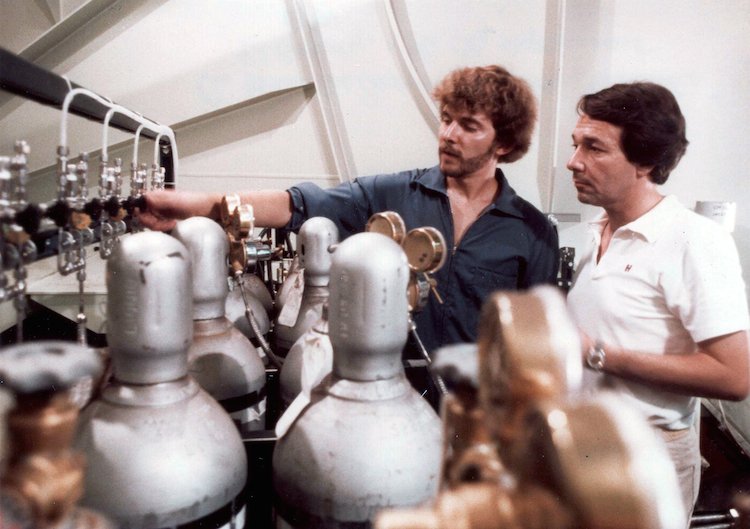
In response? Exxon would expand its climate research to understand how it might propose an existential threat to their business model…briefly. By the late 1980s, they would suddenly stop all of it and instead become top players in the multi-decade campaign to deny climate change altogether.
The findings of the initial reports on Exxon’s abuses have since spurred greater climate organizing and investigations. One of the most remarkable of these in recent years has been the Democratic staff of the House Committee on Oversight and Accountability’s 2024 report starkly titled “Denial, Disinformation, and Doublespeak: Big Oil’s Evolving Efforts to Avoid Accountability for Climate Change.”
Highlights from the report’s executive summary include:
- Documents that demonstrate that oil companies have recognized since the 1960s that their business model causes climate change and yet have worked for decades to undermine public knowledge on this existential threat.
- “Big Oil’s deception campaign evolved from explicit denial of the basic science underlying climate change to deception, disinformation, and doublespeak.” This included efforts to market ‘natural gas’ as a workable ‘bridge fuel’ instead of just another way of releasing carbon into the atmosphere for profit.
- Big Oil has a history of celebrating carbon capture technologies and algae-based biofuels as carbon reduction champions while failing to make the investments needed to actually realize their promise.
- The fossil fuel industry leverages trade associations and other partners to spread propaganda and otherwise lobby against any concrete climate policies.
- The fossil fuel industry has financed misleading work at universities to manufacture a false impression of credibility for its propaganda campaigns while simultaneously suppressing legitimate academic voices.
- All six named entities in the report — Exxon, Chevron, Shell, BP, API and the Chamber — worked to obstruct or otherwise delay the investigation, continually refusing to fully comply with the investigation and displaying little to no regard for congressional authority: “The companies further obstructed the investigation by significantly redacting or entirely withholding more than 4,000 documents without any valid basis.”
The 60 page report’s findings should be more than sufficient grounds for criminal charges—of which there have been zero, as there are no courts in America to try executives for committing to extreme socioeconomic harms through their business models.
Over in the U.K., similar coverups have been underway. Found a Guardian report titled “UK has ‘no future’ if it fails to act on ecosystem collapse threatening national security,” the Labour party has again been found to burying a report by the UK military and other intelligence leaders about a looming global collapse of ecosystems and the threat that poses to the U.K.’s very food supply.
Writes Fiona Harvey for The Guardian, “Despite growing concerns for the UK’s food security, likely to be worsened by the third heatwave this summer currently afflicting the UK and swathes of the northern hemisphere, the government has refused to publish the full report.”
As readers, you may already know well enough that the climate crisis is dire. If there is anything to take away from these reports, then, it is simply that there should be no debate (perhaps outside of varying theories on how bad it will get and how soon): the climate crisis is real, it affects our very existential security in the short term rather than the long term, and power knew about it.
They knew. They know. And if we do not collective take action, it will be curtains for a civilization that had once seemingly limitless potential—had it just found a way to live in harmony with natural systems rather than carry on with the illusion that those systems could be dominated and subdued for a system of endless consumption.
We cannot abide a system wherein powerful forces not only knew of existential threats to civilization, but can profit from denying those threats, maintain power by denying those threats and not face justice for the billions of lives threatened by their pathological pursuit of profit. That cannot be allowed to stand if we are to build a meaningful society moving forward, one that has not forsaken its very soul.
That collective path forward must be one that is broad, multigenerational, multinational and generally inviting to any and all in the working class committed to a fight for a just world that restores its relationship with the natural world on the only planet we have.
Rather than playing endlessly at ruling class games meant to divide and conquer us (purity tests and undying squabbles amongst the left, what Max Fisher was concerned with when he wrote ‘Exiting the Vampire Castle’), movements must be sufficiently inclusive and action-oriented, focused on policy goals and power changes that are essential to real politics, not anti-politics.
Writes Karen Bell in Working-Class Environmentalism: An Agenda for a Just and Fair Transition to Sustainability, “There is no need to separate, and thereby create an unnecessary conflict between, middle-class concerns about wilderness and climate change and working-class concerns about human health, safety and economic survival.”
It is difficult work, but it is essential work to fight the rise of far-right “crisis cults that promise a return to a golden age” while the situation gets transparently worse.
I can’t sit here and tell you that I feel our chances seem great. But sitting and “waiting around to die” is a worse fate than doing what we can now, today, to create meaning, peace and stability in ours and others lives. That work takes shape wherever people decide that the life around them is worth tending to.
As Dr. Emily Schoerning, founder of American Resiliency, reflected in Hyvemind’s recent Working Model feature, the work ultimately comes back to the living world directly around us.
“The land stays with me, and all the living things in the land. When the work gets hard, when I need to process information that is very upsetting, I go outside. I look at all the living things that didn't use to be here when I came five years ago,” Dr. Schoerning said. “If I can help more people engage in change on the ground, work for life on the ground where they are, all these little live things, I know the impact is real to them.”
For many species, she noted, a year is a generation. Whatever time we can give them, that time matters.
Work for a livable climate.
Learn more about organizations fighting for climate accountability, ecological protection and a livable future — and find ways to support or get involved in their work.