
After the Earthquake, Haiti Asked for Work. Deux Mains Founder Julie Colombino-Billingham Responded
How Sustainable Fashion Brand Deux Mains Is Reimagining the Meaning of ‘Made to Last’
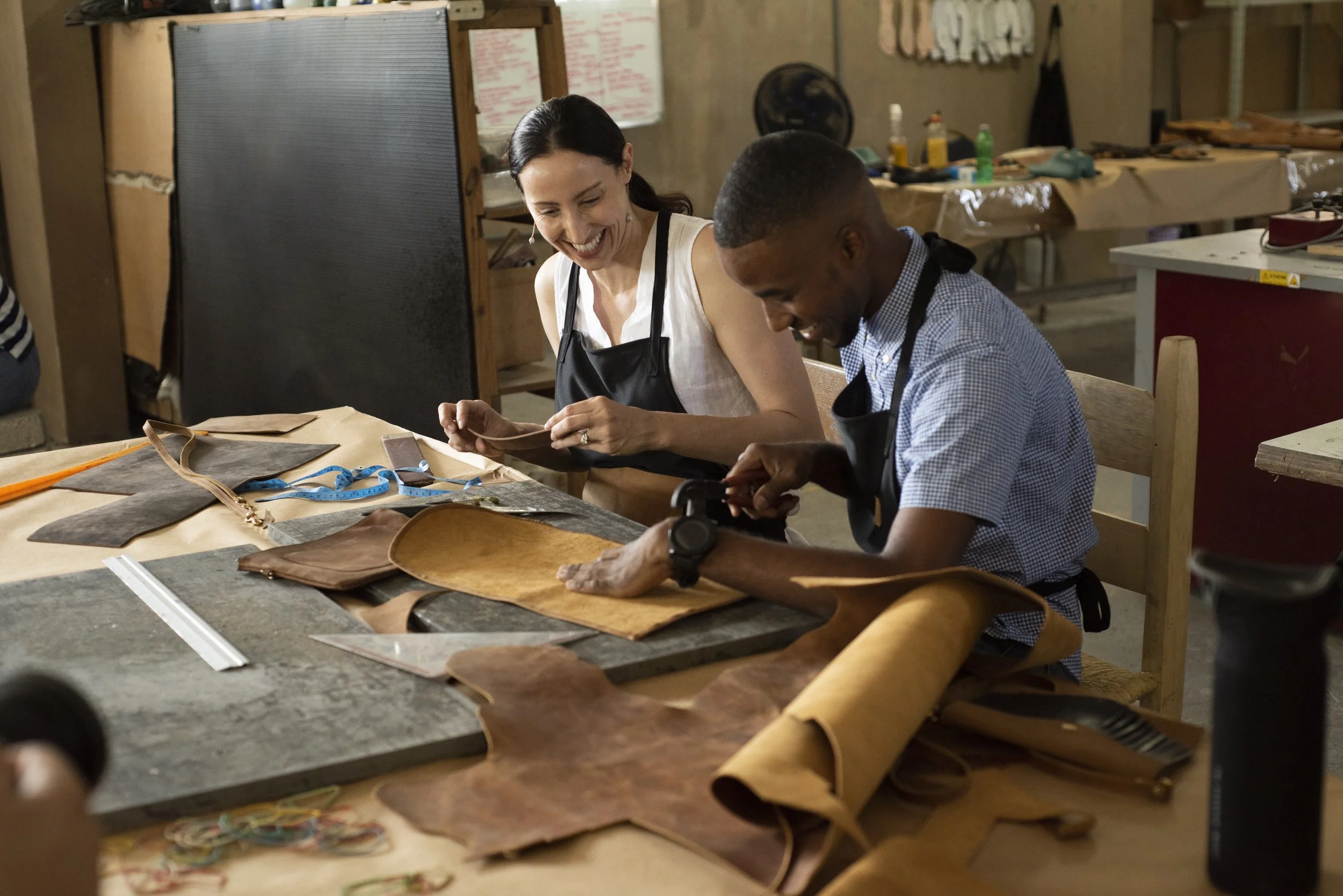
Julie Colombino-Billingham and Artisan Michel | Photos Courtesy of Deux Mains
Ten days after the 2010 earthquake rocked the island nation of Haiti, the runway at Port-au-Prince airport was no more than a cracked and jagged strip of concrete, still fresh with the marks of sudden impact.
Then disaster relief worker Julie Colombino-Billingham’s plane circled overhead for hours, banking slowly above the city as they waited for clearance that never formally came. When the aircraft finally touched down, the doors opened to chaos. Relief workers rushed onboard, streaked with dust and blood, speaking only in fragments and gestures.
Colombino-Billingham froze in her seat. Beyond the tarmac, Port-au-Prince appeared flattened and unsettled, as if the ground itself had not yet decided where it would rest.
“I was petrified. If I'm going to be totally honest, this was not a moment of bravery for me,” Colombino-Billingham, founder of Deux Mains, told Hyvemind. “But then I realized that there were a million people that had just suffered this disaster that had nowhere to go.”
She had arrived from Florida with no long-term plan beyond helping in the quake’s immediate aftermath. At the time, she worked in nonprofit management and emergency logistics, trained to respond to disasters but not to imagine what followed them.
“I didn’t have any ties to Haiti, but I just felt this ridiculously strong pull to respond to this disaster,” she recalled.
But when her employer denied her request for leave, Colombino-Billingham made a decision that would redirect the next fifteen years of her life.
“And so right on the spot,” she revealed. “I quit my job and packed for Haiti.”
In the weeks that followed, Colombino-Billingham moved through clinics and tent camps that had risen almost overnight, distributing supplies and filling logistical gaps wherever she could.
With their logos stamped onto tarps and trucks, aid organizations were everywhere, yet so were shortages. Food arrived and ran out. Water systems were installed and failed. Relief came, and then it went.
“I just felt like none of this was helping,” she recalled. “None of this was really doing anything.”
What the earthquake had destroyed was visible in collapsed buildings and shattered roads. What it exposed was less obvious: an economy already weakened by centuries of disruption, and a population accustomed to being helped but rarely asked what it needed next.
A Country Where Labor Has Long Been Interrupted
By the time the earthquake struck in January 2010, Haiti had already lived through more than two centuries of economic disruption.
Once the most profitable colony in the world, the country was later forced to compensate its former enslavers for the cost of its own independence, a debt that siphoned public resources for generations. The decades that followed brought foreign occupation, trade policies that undermined domestic agriculture and repeated cycles of political instability—each one interrupting the possibility of sustained economic life.
“Not only was the disaster so pervasive,” Colombino-Billingham said, “but the poverty that was all around Haiti prior to it was just impeding any disaster response efforts at all.”
In the months after the quake, billions of dollars in international aid flowed into the country, accompanied by convoys of NGOs, contractors and consultants. Much of that money bypassed Haitian institutions entirely. Decision-making authority sat offshore, supply chains were imported and employment, where it existed, was short-term and project-based, tethered to funding cycles rather than local demand.
Three months into her stay, while distributing water filtration systems in one of the camps, Colombino-Billingham was stopped by a Haitian woman whose words would reframe her understanding of why she was there.
“I was distributing water filtration systems into a camp when a Haitian woman grabbed me by the arm and said in Creole, ‘White lady, I don’t want any water, but I need a job,’” she said.
The exchange was brief, but it unsettled her sense of purpose. “And it was like that catalytic moment where I was like, job creation, I need to be creating jobs.”
Colombino-Billingham went on to explain that the woman’s request reflects a cultural norm that outsiders often misunderstand. In Haiti, dignity is closely tied to contribution. Work is relational and tied greatly to belonging, obligation and participation in family and community life. Receiving aid without the ability to reciprocate can feel destabilizing, even dislocating.
From that point on, Colombino-Billingham began spending less time coordinating aid and more time listening. She met women who had once worked in factories, sold goods in markets and sewn clothing to support their families. The earthquake had taken their tools, their workspaces and their customers, leaving skills intact but disconnected from opportunity.
“The challenge wasn’t skill,” she said. “The challenge was access to market, access to equipment, rebuilding after there were no factories, no buildings or anything like that.”
Among those women was Jolina Auguste, who ran an orphanage beside the camp where Colombino-Billingham slept. Jolina and her husband had both lost their incomes in the quake. The orphanage housed more than twenty children whose parents had either died or simply could not afford school fees or food.
Their first product idea emerged from what was already at hand. Discarded tires lined the roads, a byproduct of Haiti’s absent waste infrastructure and the quake’s upheaval. Many people had lost their shoes, Jolina’s children among them.
Colombino-Billingham had seen sandals cut from tire rubber years earlier in Malawi. Jolina knew women who could sew, others knew how to cut and shape the material. From those overlapping forms of knowledge, a small atelier took shape, producing sandals that were sold to UN workers moving through the camps.
“When I say we built our first atelier,” Colombino-Billingham said, “Let me be very clear, it was a lean-to with a tarp. We were on the floor cutting tires with razor blades. There was nothing glamorous about it.”
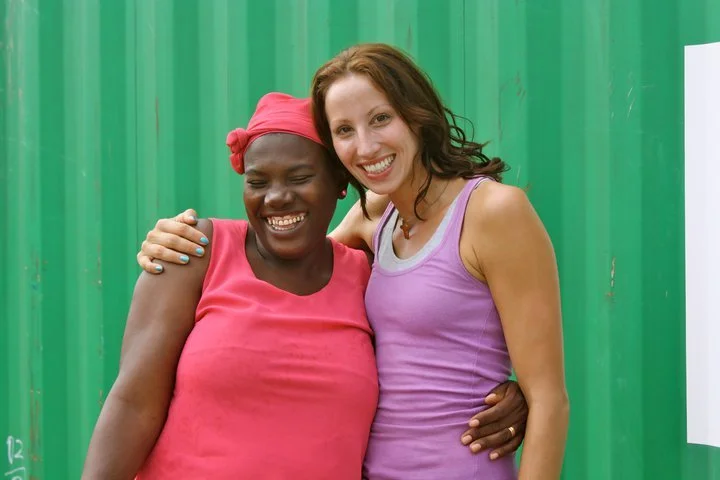
Jolina and Julie
Deux Mains: Work Made to Last
Over time, the operation shifted from a charity-funded training effort into a business, later formalized as Deux Mains, which now operates as a manufacturing business that is deeply embedded in Haiti’s local economy.
From its factory in Port-au-Prince, artisans produce leather handbags and shoes that are sold into international markets, including mainstream retail.
The handbags are built from responsibly sourced leather and finished by hand. Designs draw from everyday Haitian life—woven patterns inspired by palm-frond baskets, forms shaped by how bags are carried and used—then refined to meet market demand abroad.
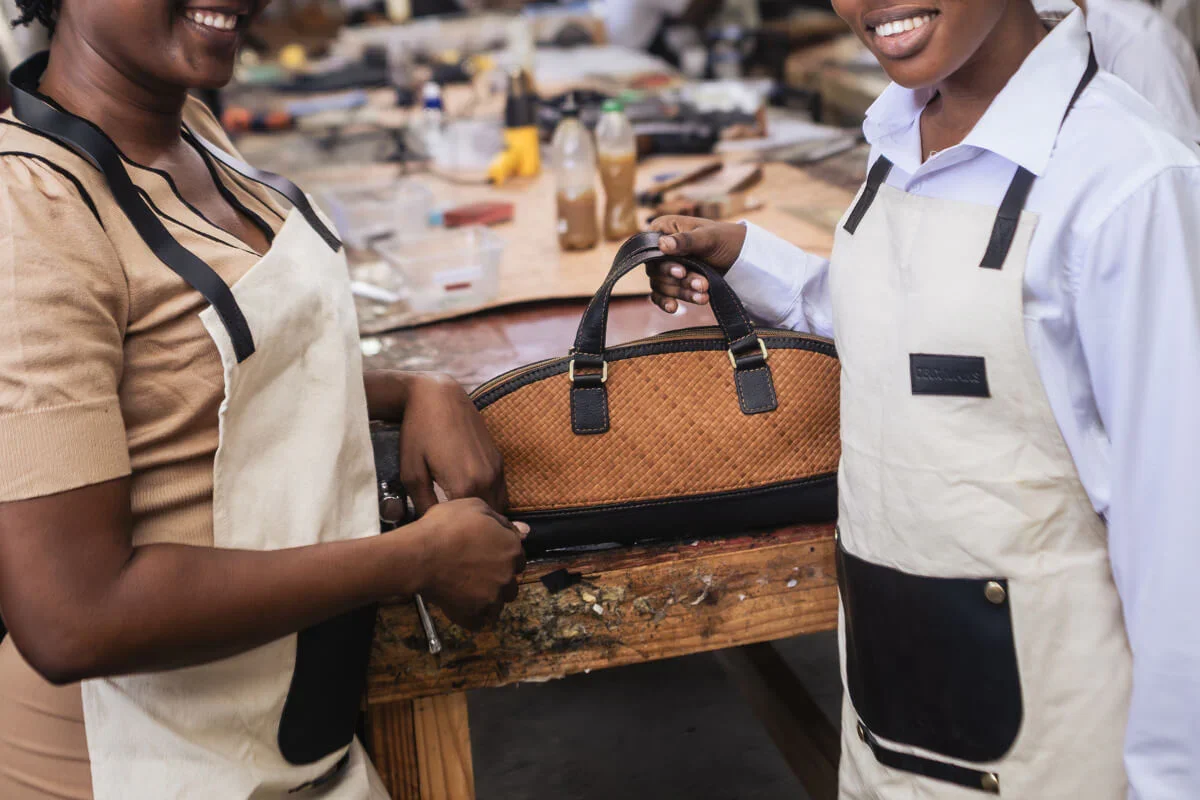
Deux Mains Satchel Bowler Bag
Alongside handbags, the factory produces leather school shoes for Haitian children. In Haiti, school uniforms are mandatory, and footwear that does not conform can decisively limit a child’s access to education. This year, the factory produced roughly 11,000 pairs
“Buying a $39 pair of school shoes made locally keeps a job in Haiti,” Colombino-Billingham said. “That’s more impactful than donating old shoes.”
That distinction reflects a broader economic tension that has shaped Haiti for decades: imported solutions often address immediate needs while weakening the local systems that might prevent those needs from recurring.
Locally made goods do the opposite: they circulate wages, preserve skills and anchor production in place.
And that anchoring matters in a country where women frequently support extended households while remaining excluded from formal economic authority.
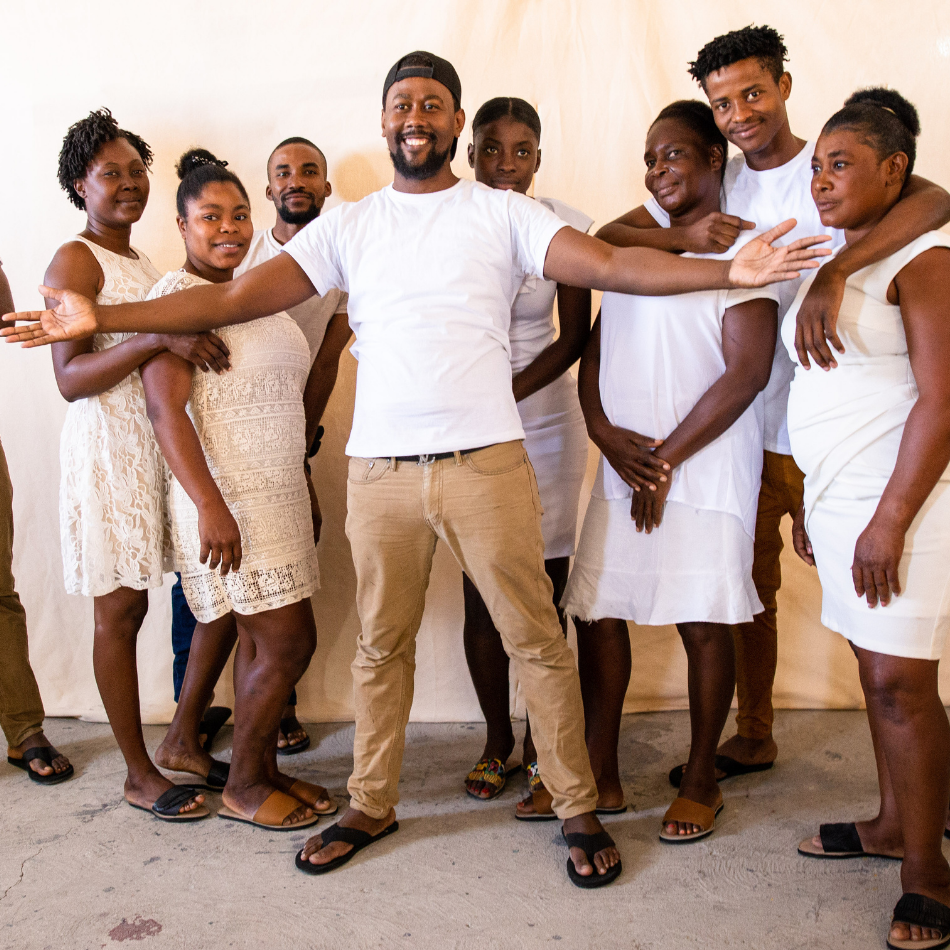
Deux Mains artisans
In Haiti, where women often support extended households without formal economic authority, predictable wages shift decision-making in practical ways. Income can be planned rather than improvised.
More than half of Deux Mains’ workforce is made up of women, many of whom hold leadership roles, including Jolina, who now leads operations on the ground.
The effects of that leadership are not easily quantified, but they are observable over time.
“What we’re seeing is that women are choosing when to have children, and choosing how they want to live,” Colombino-Billingham said. “That’s what changes families.”
Fifteen years after a woman in a tent camp asked for work instead of water, the premise remains unchanged. In Haiti, labor functions as a stabilizing force. When employment endures, families stay intact, skills remain in circulation and communities retain a measure of control in an economy shaped by interruption.
Colombino-Billingham has since documented her experience in “From Loss to Legacy: How a Fashion Business Rose From Haiti’s Rubble,” a memoir drawn from journals kept during her early years in Haiti and interviews with the Haitian colleagues who built the company alongside her. It is available for purchase on Bold Story Press or directly from Deux Mains’ store.
“What I’ve learned,” she said, “Is that change doesn’t usually come all at once. It comes because something is able to last.”
