‘They Hate Us For Our Freedom’: The Lie That Sells War Across the West
An examination of how a single phrase shaped public understanding of 9/11 and the wars that followed.
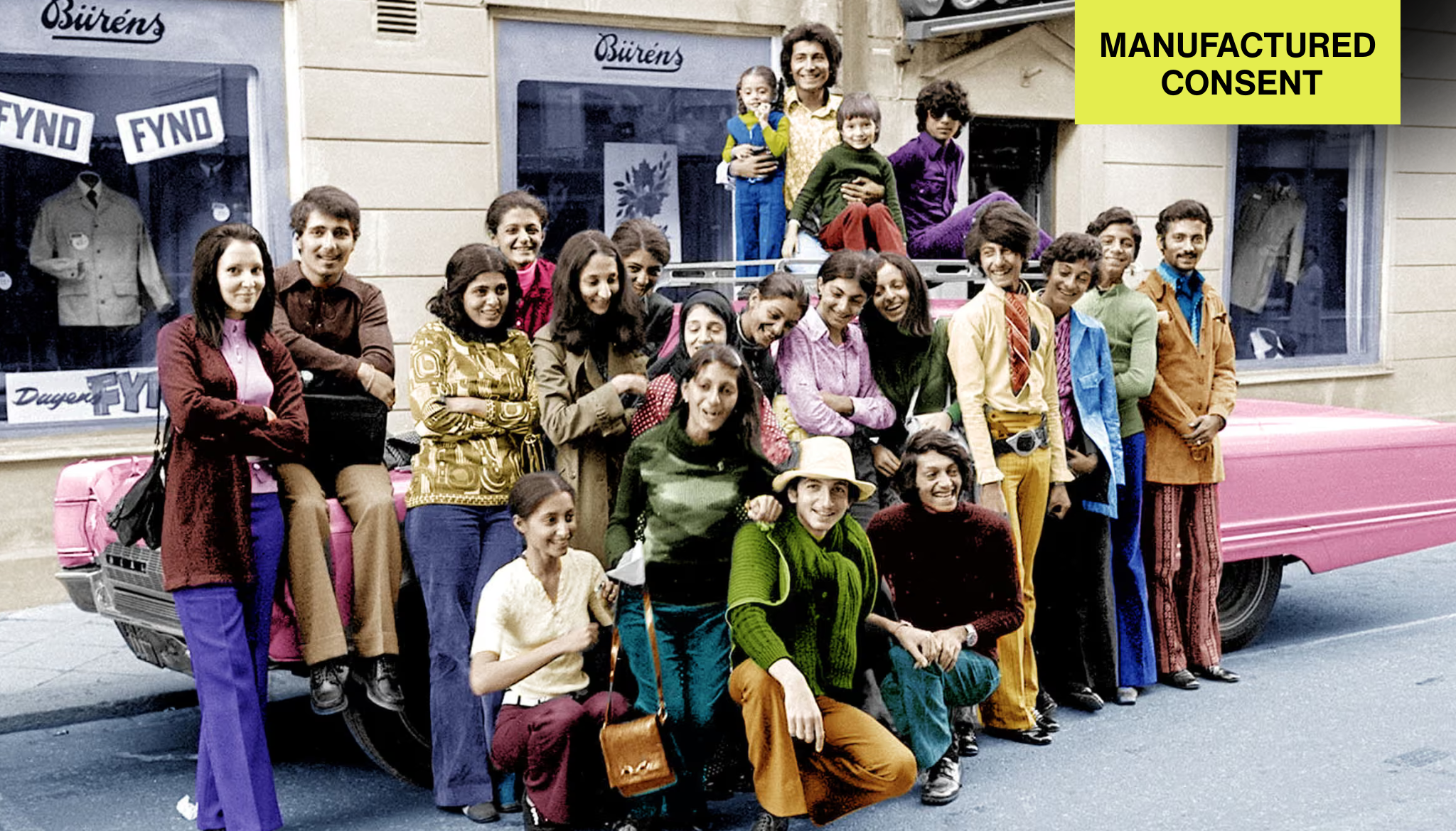
The Bin Laden Family vacationing in Sweden, 1971. A young Osama Bin Laden is pictured middle row, second to the right. |
On September 20, 2001, nine days after the deadliest terrorist attack in American history, President George W. Bush stood before a joint session of Congress and told the American people why they had been attacked.
"They hate our freedoms," he said.
It was a simple, emotionally satisfying answer. It required nothing of us—no self-examination, policy review or reckoning with history. It asked only that we be afraid, and angry, and willing to follow.
There was one problem. The man who ordered the attacks had spent six years—across two formal declarations, multiple television interviews with American journalists, and a 4,000-word open letter explaining exactly why he was attacking the United States.
His reasons were specific, policy-based, and had nothing to do with American freedoms. The 9/11 Commission itself documented these motivations. None of it mattered. The lie was more useful than the truth.
This is the documented record of what was said, what was known, and what was deliberately hidden from the American people—told chronologically and sourced at every step. (See bottom of this article for full list of sources and further reading.)
The Creation (1979–1989)
On December 25, 1979, the Soviet Union invaded Afghanistan. Within weeks, the CIA launched Operation Cyclone, which would become the largest and most expensive covert action program in the agency's history.
Funding began at $695,000 in mid-1979, escalated to $20–30 million per year by 1980, and reached $630 million per year by 1987. Total U.S. expenditure exceeded $2 billion. The program was coordinated through Pakistan's Inter Services Intelligence (ISI), with matching funds from Saudi Arabia, and additional support from Britain's MI6.
The money went to arming, training and equipping the Afghan mujahideen—Islamic guerrilla fighters waging jihad against the Soviet occupation.
The CIA provided Stinger surface-to-air missiles, weapons, intelligence and logistical support. The program, as the Guinness World Records later catalogued it, was the "biggest bequest to any Third World insurgency" in history.
Among the thousands of foreign fighters who flooded into Afghanistan was a twenty-two year-old Saudi named Osama bin Laden, son of Mohammed bin Laden, whose Saudi Bin Ladin Group was a $5 billion construction empire intimately connected to the Saudi royal family.
As journalist John Miller reported for PBS Frontline: "Bin Laden left for the fighting immediately. When he arrived, he wasted no time.
Spending his money, he financed the recruitment, transportation, and arming of thousands of Palestinians, Tunisians, Somalians, Egyptians, Saudis and Pakistanis to fight the Russians."
Miller described the young Saudi riding his own bulldozers, digging trenches on the front lines. The United States and Osama bin Laden were on the same side. They shared an enemy, a battlefield and a logistics pipeline.
The official American position was that the mujahideen were “freedom fighters.” In 1983, President Reagan hosted Afghan mujahideen leaders in the Oval Office.
"These gentlemen are the moral equivalents of America's founding fathers," he said.
In 2007, Hollywood told this story as a feel-good movie. Charlie Wilson's War, starring Tom Hanks, depicted the Texas congressman who championed the covert program as a lovable rogue who helped defeat the Evil Empire.
The film ends with Wilson warning Congress not to abandon Afghanistan after the Soviet withdrawal—and Congress ignoring him. The movie rolls credits before the consequences arrive. It is a glamorous version of a story whose ending was September 11, 2001.
The Soviet Union withdrew from Afghanistan in 1989. The United States walked away.
The would be no reconstruction, stabilization or follow-through. The power vacuum left behind produced the Taliban, which provided safe haven to al-Qaeda, which carried out the deadliest terrorist attack on American soil.
The direct line from CIA covert action to 9/11 is not a conspiracy theory. It is the documented historical record, acknowledged by the 9/11 Commission itself.
The Rejection (1990)
In August 1990, Saddam Hussein invaded Kuwait. The 9/11 Commission Report documents what happened next, in Chapter 2, "The Foundation of the New Terrorism":
"Bin Ladin, whose efforts in Afghanistan had earned him celebrity and respect, proposed to the Saudi monarchy that he summon mujahideen for a jihad to retake Kuwait. He was rebuffed, and the Saudi government instead relied on the United States and its allies to protect the Kingdom and liberate Kuwait."
The Saudi royal family chose the American military over the man who had fought their proxy war in Afghanistan. Hundreds of thousands of U.S. troops deployed to Saudi Arabia—the land of Mecca and Medina, the two holiest sites in Islam.
After the Gulf War ended, the troops did not leave. American military bases became a permanent presence on Saudi holy ground.
For bin Laden, this was the turning point. The Saudi government revoked his passport and stripped his citizenship in 1994 "for publicly speaking out against the government for permitting U.S. troops to be based in Saudi Arabia."
His own family publicly disowned him. He relocated first to Sudan, then to Afghanistan. And he began telling anyone who would listen exactly what he intended to do, and why.
He Told Us (1996–2002):
What follows is the documented record of what Osama bin Laden publicly stated in formal declarations, on-camera interviews with American journalists and an open letter to the American people over a period of six years before and after the September 11 attacks.
August 23, 1996 — First Fatwa:
Bin Laden issued his "Declaration of War Against the Americans Occupying the Land of the Two Holy Places."
Published in the London-based Arabic newspaper Al Quds Al Arabi, the declaration's central demand was the removal of U.S. military forces from Saudi Arabia.
The full text is archived at the West Point Combating Terrorism Center.
March 1997 — CNN Interview:
In his first television interview, conducted by Peter Arnett in an Afghan mountain camp and produced by Peter Bergen, bin Laden was asked directly why he was declaring jihad against the United States.
As Bergen later wrote for CNN: "Bin Laden gave a long answer critiquing American support for Israel and US allies in the Middle East such as Saudi Arabia."
Bergen noted: "This reply undercut President George W. Bush's frequent later claims after 9/11 that the United States was attacked because of its 'freedoms.'
In his CNN interview four years before 9/11, Bin Laden said his rationale for jihad against the United States was American foreign policy in the Middle East."
When Arnett asked about future plans, Bin Laden replied: "You'll see them and hear about them in the media, God willing."
February 23, 1998 — Second Fatwa:
Bin Laden's second declaration, co-signed by Ayman al-Zawahiri and leaders of three other groups, was titled "Jihad Against Jews and Crusaders."
Published in Al Quds Al Arabi, it listed three specific grievances. These are direct quotes from the fatwa, available in full at the Federation of American Scientists:
First, for over seven years the United States has been occupying the lands of Islam in the holiest of places, the Arabian Peninsula, plundering its riches, dictating to its rulers, humiliating its people, terrorizing its neighbors, and turning its bases in the Peninsula into a spearhead through which to fight the neighboring Muslim peoples.”
Second, despite the great devastation inflicted on the Iraqi people by the crusader Zionist alliance, and despite the huge number of those killed, which has exceeded 1 million... the Americans are once again trying to repeat the horrific massacres.”
Third, if the Americans' aims behind these wars are religious and economic, the aim is also to serve the Jews' petty state and divert attention from its occupation of Jerusalem and murder of Muslims there.”
The fatwa concluded with an explicit ruling: "The ruling to kill the Americans and their allies, civilians and military, is an individual duty for every Muslim who can do it in any country in which it is possible to do it."
May 1998 — ABC News Interview:
John Miller of ABC News interviewed bin Laden in Afghanistan. The interview was excerpted in Esquire in February 1999. Bin Laden stated:
Your situation with Muslims in Palestine is shameful — if there is any shame left in America. Houses were demolished over the heads of children. Also, by the testimony of relief workers in Iraq, the American-led sanctions resulted in the death of more than one million Iraqi children. All of this is done in the name of American interests.”
He then offered the lesson of Afghanistan as a warning: "The Soviet Union entered Afghanistan in the last week of 1979, and with Allah's help their flag was folded a few years later and thrown in the trash. He predicted "a black day for America."
November 24, 2002: Letter to the American People:
Two months after the first anniversary of 9/11, Bin Laden published an open letter to the American people.
The full English translation was published by The Observer, the Guardian’s Sunday edition.
The letter repeated and expanded on the same policy-based grievances: U.S. support for Israel against Palestinians, U.S. troops stationed in Saudi Arabia, U.S. sanctions against Iraq, and U.S. support for authoritarian regimes across the Muslim world.
The letter remained publicly available on the Guardian’s website for twenty-one years. What happened to it in 2023 will be addressed later in this document.
The Pattern:
Three formal declarations, two on-camera interviews with major American news networks and an open letter published in one of the world's most respected English-language newspapers.
Over six years, the stated motivations never changed: U.S. military bases in Saudi Arabia, U.S. support for Israel, U.S. sanctions killing Iraqi civilians. Not once did bin Laden cite American "freedoms" as a grievance. Not once.
They Knew (1998–2001):
Bin Laden did not merely tell the world what he intended. He demonstrated it in an escalating series of attacks over three years that killed hundreds of people and wounded thousands.
And the American intelligence community tracked every step, generating warnings so specific and so urgent that the 9/11 Commission later titled its chapter on the subject "The System Was Blinking Red."
The Escalation:
On August 7, 1998, the eighth anniversary of the arrival of U.S. troops in Saudi Arabia, al-Qaeda detonated nearly simultaneous truck bombs at U.S. embassies in Nairobi, Kenya and Dar es Salaam, Tanzania.
The date was chosen deliberately. 224 people were killed, including 12 Americans, and over 4,500 were wounded. The vast majority of casualties were local Kenyan and Tanzanian citizens. This was the attack that placed bin Laden on the FBI's Ten Most Wanted list.
On October 12, 2000, a small boat laden with explosives was steered alongside the USS Cole, a guided-missile destroyer refueling in the port of Aden, Yemen.
The blast tore a forty-by sixty-foot hole in the ship's hull. Seventeen American sailors were killed and thirty-seven wounded.
The Warnings:
January 2000. The CIA Tracked Two Hijackers: The CIA monitored an al-Qaeda planning meeting in Kuala Lumpur, Malaysia from January 5–8. Two attendees were Khalid al-Mihdhar and Nawaf al-Hazmi—both future hijackers aboard Flight 77, which struck the Pentagon.
The CIA had intercepted communications identifying al-Mihdhar, obtained a copy of his passport and discovered he held a valid U.S. visa. Malaysian intelligence photographed the meeting at CIA's request.
When al-Mihdhar and al-Hazmi subsequently flew to Los Angeles on January 15, 2000, the CIA never notified the FBI.
The two men lived openly in San Diego, were listed in the phone book and even had contact with an FBI informant. They were not placed on any watch list until August 23, 2001—nineteen days before the attacks. By then, the FBI could not find them.
July 10, 2001. The Phoenix Memo:FBI Special Agent Kenneth Williams sent an electronic communication from the Phoenix field office to FBI headquarters warning that an "inordinate number" of individuals of investigative interest were attending civil aviation schools in Arizona.
He recommended the FBI compile a nationwide listing of flight schools and establish liaison with them.
The memo specifically named Hani Hanjour, who would pilot Flight 77 into the Pentagon. No action was taken. The memo was not shared with the CIA or the White House.
August 6, 2001. "Bin Ladin Determined to Strike in US: “Thirty-six days before the attacks, President Bush received a Presidential Daily Brief with that title while vacationing at his ranch in Crawford, Texas.
The brief, which was prepared at Bush's own request after he asked whether al-Qaeda might attack inside the United States, warned that bin Laden had "a desire to attack inside the United States."
It noted "patterns of suspicious activity in this country consistent with preparations for a hijacking."
It reported that the FBI was conducting "approximately 70 full-field Bin-Laden-related investigations."
It referenced a May 2001 call to the U.S. Embassy in the UAE "saying that a group of Bin Ladin supporters was in the US planning attacks with explosives."
National Security Adviser Condoleezza Rice would later tell the 9/11 Commission: "It was historical information based on old reporting. There was no new threat information."
August 16, 2001. Moussaoui: Flight instructors contacted the FBI because Zacarias Moussaoui had paid for flight lessons with large amounts of cash and wanted to learn to fly large jets but showed no interest in takeoffs or landings.
Moussaoui was arrested on an immigration violation. Minneapolis FBI agents, working with French intelligence, quickly confirmed his connections to radical Islamic groups and to bin Laden.
They requested a FISA warrant to search his laptop and belongings. FBI headquarters blocked the request.
The laptop was not searched until after September 11. FBI Special Agent Coleen Rowley later documented in a whistleblower memo how headquarters personnel "actively impeded the investigation."
She was named TIME Person of the Year in 2002.
Summer 2001. "The System Was Blinking Red.": CIA Director George Tenet testified to the 9/11 Commission that "the system was blinking red" throughout the summer of 2001.
Thirty-four separate threat warnings were issued between May and August. A June 2001 CIA report was titled "Bin Ladin Attacks May Be Imminent." Another: "Bin Ladin Planning High-Profile Attacks."
The 9/11 Commission adopted Tenet's phrase as the title of its eighth chapter.
The Commission's Verdict:
The 9/11 Commission concluded that the attacks revealed "four kinds of failures: in imagination, policy, capabilities and management."
The CIA tracked hijackers but never told the FBI. The FBI received warnings about flight schools but never acted. FBI headquarters blocked its own agents from investigating.
The President received a brief titled "Bin Ladin Determined to Strike in US" and took no urgent action. No one was fired, no one was demoted and no one was held accountable.
In 2004, President Bush awarded George Tenet, the CIA Director who oversaw these failures, the Presidential Medal of Freedom.
The Lie (September 20, 2001):
Nine days after the attacks, President Bush stood before Congress and the American people.
He had a choice. He could have told the truth: that the United States had been attacked by a man whose motivations were specific, documented and rooted in U.S. foreign policy decisions.
That the attacker had publicly declared war years earlier, citing American military bases in Saudi Arabia, American support for Israel and American sanctions on Iraq.
That the intelligence community had tracked the threat for years and failed to prevent it through bureaucratic dysfunction. Instead, he said this:
Americans are asking 'Why do they hate us?' They hate what they see right here in this chamber: a democratically elected government. Their leaders are self appointed.
They hate our freedoms: our freedom of religion, our freedom of speech, our freedom to vote and assemble and disagree with each other."
This was a fabrication. Bin Laden had given three on-the record interviews to American journalists. He had issued two formal declarations available in translation.
He had published an open letter. In none of these, not one, did he cite American democracy, freedom of religion, freedom of speech or any American value as a grievance. His stated motivations were about what America did, not what America was.
Bush's explanation required the American public to believe that a man who had spent six years articulating specific policy grievances was actually motivated by an abstract hatred of constitutional democracy.
It required ignoring the public record. It required, fundamentally, contempt for the intelligence of the American people.
The lie worked. It worked because it was simpler. It worked because it required nothing of us. And it worked because anyone who challenged it was destroyed.
The Suppression:
Jeremiah Wright. September 16, 2001:
Five days after the attacks, Reverend Jeremiah Wright, pastor of Trinity United Church of Christ in Chicago and a former U.S. Marine, delivered a sermon titled "The Day of Jerusalem's Fall."
In it, he quoted a former U.S. ambassador who had appeared on Fox News: "America's chickens are coming home to roost."
Wright placed 9/11 in the context of U.S. foreign policy—the bombings of Hiroshima and Nagasaki, support for state terrorism abroad, decades of intervention.
He was saying, in a church on the South Side of Chicago, what the 9/11 Commission would later document in a government report: that the attacks were a consequence of specific American policies.
In a separate sermon on April 13, 2003, Wright said: "The government gives them the drugs, builds bigger prisons, passes a three-strike law and then wants us to sing 'God Bless America.' No, no, no, God damn America, that's in the Bible for killing innocent people."
When excerpts from both sermons surfaced in March 2008 during Barack Obama's presidential campaign, Wright was not engaged on the substance of his arguments.
He was destroyed. The question was never whether his analysis of U.S. foreign policy had merit—a question the 9/11 Commission's own findings would have supported.
The question was whether his words were sufficiently patriotic. Obama delivered his "A More Perfect Union" speech, condemned Wright's specific statements, and eventually left the church.
The message was clear: connecting 9/11 to American foreign policy was political suicide.
The Letter Disappears. November 2023:
For twenty-one years, bin Laden's "Letter to the American People" sat on the Guardian's website, read occasionally by researchers and largely ignored by the public.
Then, in November 2023, as Israel's bombardment of Gaza intensified following the October 7 Hamas attack, young Americans discovered it.
The letter went viral on TikTok. A generation with no memory of 9/11 read, for the first time, the actual stated motivations of the man who ordered the attacks.
They read his critique of U.S. support for Israel. They read it in the context of watching, in real time, U.S.-supplied weapons destroying Gaza.
And many of them—as Newsweek reported under the headline "Bin Laden's letter to US stuns young Americans"—said they had never been taught any of this.
On November 15, 2023, the Guardian removed the letter from its website. A spokesperson stated: "The transcript published on our website 20 years ago has been widely shared on social media without the full context."
The replacement page acknowledged the letter had existed but no longer displayed it.
TikTok announced it was "proactively and aggressively removing this content and investigating how it got onto our platform"—an extraordinary statement, given that the content was a document published by one of the world's most respected newspapers.
The hashtag #lettertoamerica was scrubbed. NBC News, the Guardian, Newsweek, CBS News, The Hill and Common Dreams all covered the removal.
Consider what happened. A primary source document—the attacker's own stated explanation for the worst terrorist attack in American history, previously published by a major Western newspaper—was removed from public access because young people were reading it and drawing their own conclusions.
The document was not classified nor was not fabricated. But it was removed anyway because it undermined the narrative that had been manufactured twenty-two years earlier.
The Blowback the CIA Named
The term "blowback" originated in a classified CIA report on the 1953 overthrow of Iran's government—a coup carried out in the interests of the Anglo-Iranian Oil Company (now BP).
The word described the unintended consequences of covert operations that blow back on the originating country.
In 2000, one year before September 11, political scientist Chalmers Johnson published Blowback: The Costs and Consequences of American Empire.
He warned that U.S. imperial overreach, military bases in over 700 locations worldwide, and decades of interventionist foreign policy would generate terrorist retaliation. The book was prophetic. After 9/11, it became a bestseller.
Michael Scheuer, the CIA officer who served as chief of the agency's bin Laden unit from 1996 to 1999, stated publicly and repeatedly that bin Laden was a rational actor motivated by specific U.S. policies—not by hatred of American freedoms.
Robert Pape, a University of Chicago political scientist, compiled a database of every suicide terrorist attack worldwide from 1980 to 2003 and found that "the overwhelming driver of suicide terrorism is foreign military occupation, not religion or ideology."
Eugene Jarecki's documentary Why We Fight, which won the 2005 Sundance Grand Jury Prize, traced how the military-industrial complex Eisenhower warned about had captured American war-making.
The film featured Johnson explaining blowback to an American audience that still, four years after 9/11, had largely never heard the word.
The evidence was always there. The analysis was always available. The American public was simply never given it, and those who tried to provide it were silenced, discredited or ignored.
Where the Lie Leads
"They hate us for our freedoms" did more than mislead, it functioned as a permission slip.
It transformed a policy failure—the documented, preventable consequence of specific American actions—into an existential civilizational conflict that justified anything done in response.
Two decades of war, surveillance of American citizens, torture programs, drone strikes across sovereign nations. And, ultimately, complicity in what the International Court of Justice has found plausible grounds to call genocide.
The Genocide Convention and the Man Who Wrote It Into Law
The Convention on the Prevention and Punishment of the Crime of Genocide was adopted by the United Nations General Assembly on December 9, 1948.
Article II defines genocide. There is no affirmative defense: Not self-defense, provocation or retaliation. The Convention is absolute: genocide cannot be justified under any circumstances.
The United States ratified the Genocide Convention in 1988, forty years after its adoption. The enabling legislation that made it federal law, the Genocide Convention Implementation Act (also known as the Proxmire Act), was championed and co-authored by Senator Joseph Biden of Delaware.
Biden knew exactly what genocide meant under international law. He helped write the American legal framework for prosecuting it.
What Israeli Officials Said
On October 9, 2023, two days after the Hamas attack that killed approximately 1,200 Israelis, Israeli Defense Minister Yoav Gallant announced a "complete siege" of Gaza.
His exact words: "There will be no electricity, no food, no fuel, everything is closed. We are fighting human animals and we are acting accordingly."
On October 12, Israeli Energy Minister Israel Katz stated publicly: "No electric switch will be turned on, no water tap will be opened and no fuel truck will enter until the Israeli abductees are returned home."
On October 13, Israeli President Isaac Herzog was asked about civilian casualties. He replied:
"It is an entire nation out there that is responsible. It's not true this rhetoric about civilians not aware, not involved. It's absolutely not true."
On October 28, as Israel launched its ground invasion, Prime Minister Benjamin Netanyahu addressed the nation:"You must remember what Amalek has done to you, says our Holy Bible."
The biblical passage he referenced, 1 Samuel 15:3, reads: "Now go and smite Amalek, and utterly destroy all that they have, and spare them not; but slay both man and woman, infant and suckling, ox and sheep, camel and ass."
These were public statements, made on camera, by the heads of state and senior officials of a nation that is a signatory to the Genocide Convention.
"Baseless and Without Merit"
On December 29, 2023, South Africa filed an application at the International Court of Justice alleging that Israel's actions in Gaza constituted genocide under the Convention.
The 84-page filing extensively cited the statements above as evidence of genocidal intent.
The response of the United States—the nation whose own senator had written the Genocide Convention into federal law—came through National Security Council spokesman Admiral John Kirby. Asked about South Africa's case, Kirby called it "baseless and without merit."
On January 26, 2024, the International Court of Justice issued its ruling. The Court found that South Africa's claims were plausible enough to order provisional measures.
Israel was ordered to take all measures to prevent acts of genocide, to ensure its military did not commit genocidal acts, to prevent and punish incitement to genocide, to preserve evidence, and to allow humanitarian aid.
The Court specifically cited the dehumanizing statements by Israeli officials as evidence of potential genocidal intent.
The ICJ did not call South Africa's case "baseless." It found it plausible enough to warrant the most urgent protective measures the Court can order.
The man who wrote the Genocide Convention into American law—who could not credibly claim ignorance of what genocide means, what it requires, or that it admits no affirmative defense—allowed his administration to publicly dismiss as "baseless" a case that the world's highest court found plausible.
This was not a mistake. It was not a miscommunication. It was the same pattern documented throughout this series: a blatant, deliberate lie, delivered with the confidence that the American public would not check.
The Cost
As of early 2025, the documented toll in Gaza includes an estimated 64,000 to 75,000 violent deaths according to peer-reviewed studies published in The Lance—approximately 40% higher than official figures, with 59% of confirmed casualties being women and children.
The United States has provided $22 billion in direct military aid to Israel since October 7, 2023, with an additional $10–12 billion spent on related U.S. military operations in the region, according to the Brown University Costs of War Project.
The United States has vetoed six UN Security Council resolutions calling for a ceasefire— in some cases casting the sole dissenting vote against the remaining fourteen members.
On April 3, 2024, the Israeli investigative outlet +972 Magazine published testimony from six Israeli intelligence officers describing an AI system nicknamed "Lavender" that had generated tens of thousands of Palestinian targets for assassination with approximately twenty seconds of human review per target.
A companion system, "Where's Daddy?," tracked targets to their homes so they could be bombed with their families present.
On November 21, 2024, the International Criminal Court issued arrest warrants for Benjamin Netanyahu and Yoav Gallant on charges of war crimes and crimes against humanity, including starvation as a method of warfare, willfully causing great suffering, murder and persecution.
Aaron Bushnell
On February 25, 2024, a twenty-five-year-old active-duty U.S. Air Force serviceman named Aaron Bushnell posted his final message on Facebook:
"Many of us like to ask ourselves, 'What would I do if I was alive during slavery? Or the Jim Crow South? Or apartheid? What would I do if my country was committing genocide?' The answer is, you're doing it. Right now."
He then walked to the Israeli Embassy in Washington, D.C., set up a camera, and recorded this statement:
My name is Aaron Bushnell, I am an active-duty member of the United States Air Force and I will no longer be complicit in genocide.
I am about to engage in an extreme act of protest but compared to what people have been experiencing in Palestine at the hands of their colonizers, it's not extreme at all.
This is what our ruling class has decided will be normal."
Aaron Bushnell then set himself on fire. He died of his injuries the following day.
He did not have access to classified intelligence. He did not have a law degree or a seat in Congress. He did not write the Genocide Convention into federal law. He simply refused to look away from what his government told him was not happening.
The Pattern
Step back and see the full arc. The CIA funds and arms jihadist fighters in Afghanistan, including the networks that will become al-Qaeda. When the Soviets withdraw, America walks away.
The fighters it armed turn their grievances toward the power that armed them—grievances rooted in specific, documented policies: U.S. military bases on Saudi holy ground, U.S. sanctions killing Iraqi children, U.S. support for Israel's occupation of Palestinian territories.
The attacker states these grievances publicly, repeatedly, for six years in formal declarations, on-camera interviews with American journalists, and an open letter to the American people.
The intelligence community tracks the escalating threat. Specific, actionable warnings reach the highest levels of government. The system is "blinking red."
The attacks succeed. 2,977 people die. And the President of the United States tells the American people it happened because "they hate our freedoms"—a fabrication that bears no relationship to the attacker's own extensively documented stated motivations, and which the 9/11 Commission's findings directly contradict.
Anyone who tells the truth is destroyed. A pastor who says "chickens coming home to roost" is treated as a traitor. A generation that discovers the attacker's own letter has it scrubbed from the internet.
Meanwhile, the lie enables two decades of war and, ultimately, American complicity in what the world's highest court has found plausible grounds to call genocide, carried out with American weapons, shielded by American vetoes, dismissed as "baseless" by an administration whose president literally wrote the Genocide Convention into American law.
At the heart of a confidence game is gaining the confidence of the mark with a believable lie.
This is how it works. The lies are not sophisticated. They are blatant, deliberate, and delivered with the absolute confidence that the American people will not check.
That they will not read the fatwa. That they will not read the 9/11 Commission Report. That they will not read the Genocide Convention. That they will not notice when a primary source document is removed from the internet because young people started reading it.
The contempt is not just in the lying. It is in how little effort they put into it.
An active-duty airman saw through it. He looked at the same evidence his government dismissed, and he concluded he could no longer be complicit. He did not have special access. He had a conscience, and he was willing to use it.
This is what our ruling class has decided will be normal. The question is whether we accept that decision.
Sources & Further Reading
- The 9/11 Commission Report (2004) — Chapters 2, 8, and 11: U.S. Government Publishing Office
- Bush Address to Joint Session of Congress (Sept 20, 2001) — “They hate our freedoms” speech: CNN
- Bin Laden’s 1998 Fatwa — “Jihad Against Jews and Crusaders”: Federation of American Scientists
- Bin Laden’s 1996 Fatwa — “Declaration of War”: West Point Combating Terrorism Center
- “Letter to the American People” (2002) — Archived version: Internet Archive
- Peter Bergen on Bin Laden Interview (1997): CNN
- John Miller Interview with Bin Laden (1998): PBS Frontline
- Operation Cyclone — CIA program in Afghanistan: Wikipedia (sourced)
- Aug 6, 2001 PDB — “Bin Ladin Determined to Strike in US”: Federation of American Scientists
- The Phoenix Memo (July 2001): Wikipedia | Fortune
- CIA Tracking Failures (al-Mihdhar & al-Hazmi): DOJ Inspector General
- Coleen Rowley (FBI Whistleblower): Wikipedia | National Whistleblower Center
- U.S. Embassy Bombings (1998): FBI
- USS Cole Bombing (2000): FBI
- Guardian Removal of Bin Laden Letter (2023): The Guardian | NBC News
- Jeremiah Wright Sermon (2003): BlackPast.org
- South Africa v. Israel (ICJ Case): International Court of Justice
- Israeli Officials’ Statements (Oct 2023): Al Jazeera | NPR
- Gaza Death Toll Estimates: The Guardian | The Lancet
- U.S. Military Aid to Israel (Post–Oct 7): Brown University Costs of War Project
- ICC Arrest Warrants (2024): UN News
- Lavender AI Targeting System: +972 Magazine
- Chalmers Johnson, Blowback (2000)
- Michael Scheuer, Imperial Hubris (2004)
- Robert Pape, Dying to Win (2005)
- Eugene Jarecki, Why We Fight (2005): IMDb
- Genocide Convention Implementation Act (1988)