
The Cost of the Cloud: Big Tech’s Extractive Energy Demand Is Becoming Everyone Else’s Problem
Danielle Hughes runs a nonprofit on the California side of Lake Tahoe and works as a supervisor in the state energy commission's efficiency division, which means she reads utility filings for a living and still did not see this coming.
When she learned her community's power was being redirected to data centers across the Nevada line, she put it in five words. "It's like we don't exist," she recently told Fortune.
The towns on the California shore of Lake Tahoe sit inside a postcard, and roughly forty-nine thousand people there get their electricity from a utility called Liberty, which for years has bought most of its power across a single arrangement with the larger company next door in Nevada.
Liberty buys about three-quarters of its supply from NV Energy under what is called a full-requirements contract, the kind of deal that exists so a smaller utility never has to wonder whether the lights will come on. NV Energy has told Liberty it will not keep supplying power on the old terms, and the reason both companies have given to their regulators is the boom in data centers rising east of Reno, according to regulatory filings cited by Fortune.
This series follows Big Tech’s extractive AI and cloud services power build out through three of the things our communities cannot quickly make more of. The public is paying to build private computing power, and it is paying in electricity, in water, and in money.
This first part is about the electricity, because in Nevada the bill is arriving in the most literal form imaginable, as a utility prepares to send tens of thousands of residents behind a line of data centers for the same grid capacity.
The benefits of those machines, the compute, the contracts, the tax abatements, are booked now and largely elsewhere. The costs are landing here, on people who were already paying their bills. A utility is a promise written into law, and in Nevada that promise is quietly being re-priced.
A utility is a promise written into law, and in Nevada that promise is being covertly re-priced.
The Contract That Is Ending
Liberty Utilities, which operates in the Tahoe basin as CalPeco Electric, generates about a quarter of its own power from solar and buys the other three-quarters from NV Energy.
The full-requirements deal that supplies that larger share is the thing now ending, and NV Energy has signaled it will not renew on the old basis because it is committing that capacity to the data center load growing in northern Nevada.
To replace the supply, Liberty plans to issue a request for proposals in the summer of 2026, and it will be shopping into a regional market where every other utility is chasing the same scarce megawatts.
NV Energy describes the change as routine, and has said that for now it will continue to supply Liberty until the smaller utility finds a new source, which softens the cliff that the first reports described.
Running underneath the timeline is a transmission project of NV Energy's own, Greenlink West, a 525-kilovolt line carrying a price tag near four and a quarter billion dollars and a target to come online in 2027.
An NV Energy representative offered Liberty a reassurance that turned out to describe the whole problem, saying the Tahoe utility would be "first in the waiting line" for new supply once Greenlink opens. The community has been promised a place at the front of a line that is still a line.
NEVADA · ELECTRICITY DEMAND · 2024 TO 2033
Nevada’s grid is being rebuilt around data centers
FIG. 1 · HYVEMINDData-center construction is reshaping who consumes Nevada’s electricity, with new demand increasingly concentrated in a handful of vast computing campuses in the north of the state.
Share of major-project load growth
of new large-project load growth in northern Nevada comes from data centers, not factories, mines or housing.
Data centers’ share of all Nevada electricity
Data centers’ share of Nevada electricity use is projected to rise from 22% in 2024 to 35% by 2030.
Projected new demand
New demand from 12 northern Nevada projects by 2033.
Liberty Utilities’ power supply
of Liberty Utilities’ power supply is bought from NV Energy.
Sources: Fortune, citing NV Energy planning data · Desert Research Institute · Sierra Club expert testimony filed with Nevada regulators. Figures approximate.
What The Desert Is Being Asked To Power
The scale of the demand explains why a forty-nine-thousand-customer utility ends up at the back of the line. Data centers used about 22 percent of the electricity consumed in Nevada in 2024, a share NV Energy's planning projects could climb toward 35 percent by 2030 (Fortune, citing NV Energy planning data).
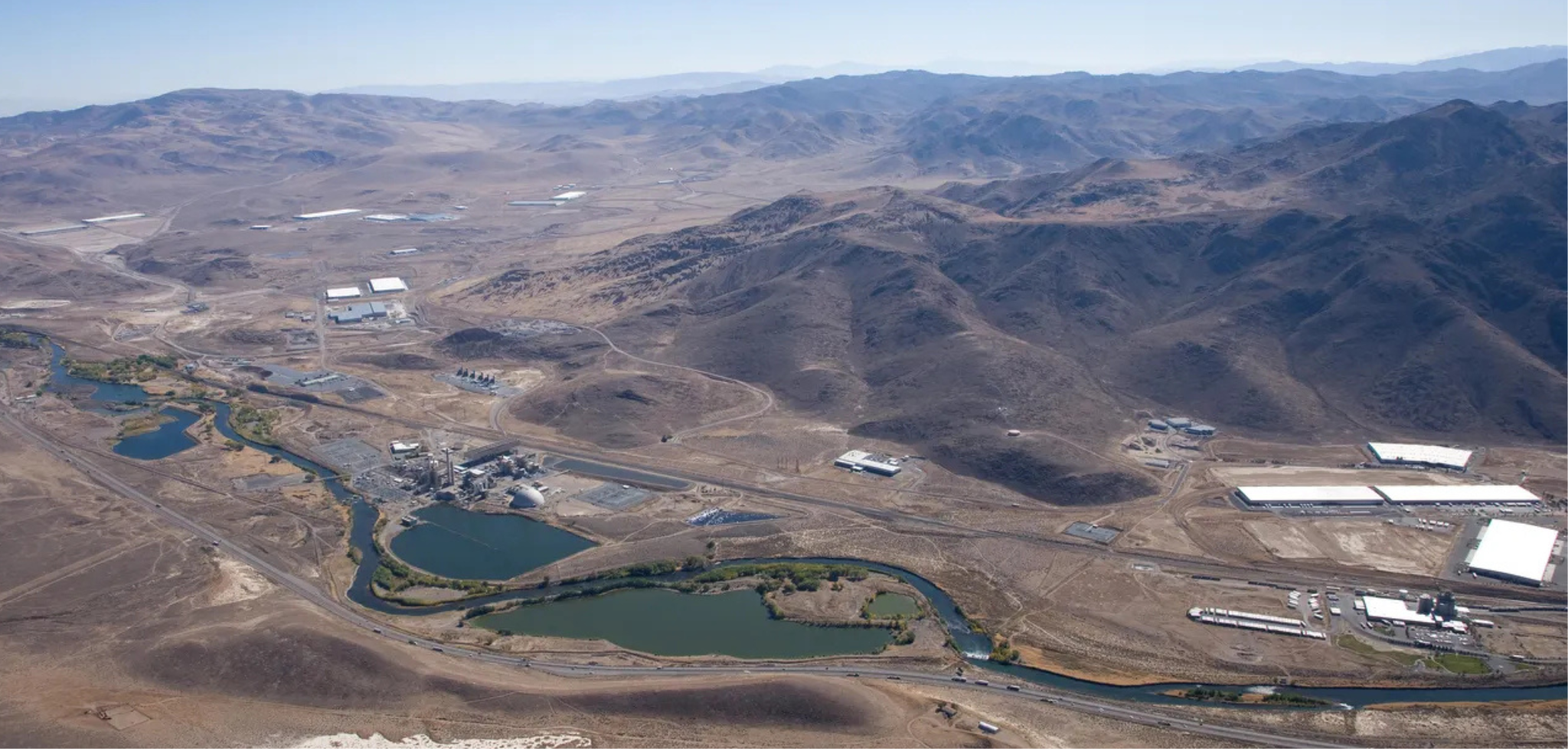
The Desert Research Institute found that 12 data center projects concentrated in the northern part of the state could together drive roughly 5,900 megawatts of new demand by 2033, and Sierra Club expert testimony filed with Nevada regulators put data centers at about three-quarters of the major-project load growth across the system that also feeds Lake Tahoe. A single one of those campuses can ask for more power than the entire Tahoe utility delivers.
The companies behind the build-out are among the largest in the world. Reporting on the cluster around the Tahoe-Reno Industrial Center names Google, Apple, and Microsoft as the hyperscale operators with facilities built or planned there.
To be clear, we are not alleging that these companies caused the Liberty contract to end. Our reporting identifies them as major sources of electricity demand on a grid with limited available capacity. They are included as load drivers contributing to that broader constraint, not as the documented cause of Liberty’s contract ending. Any direct connection would need to be established through a filing or other verified record..
What the record does already support, however, is the direction of the pressure. The biggest customers in the history of the grid are arriving at once, in one corner of one state, and the system is being reorganized around them.
For anyone who has never had to think about how a grid decides who gets power, here is the part that does not make the brochure. Electricity is not kept in a giant tank that everyone dips into as needed. The grid is a queue, and a utility promises its supply through contracts, first come and first signed.
When a customer the size of a small city arrives and signs for the next decade of capacity, the smaller customers already on the line get bumped, and the thing that bumps them is paperwork, a proceeding most of them will never read.
Picture a landlord who has rented the same building to the same families for years, then signs a new tenant who will pay more and tells the families they can stay only until the new tenant needs the space. The families did nothing wrong. They were underhandedly outbid for something they thought they already had.
Who Pays, And Who Pays Twice
The households on the lake were paying for this before they ever heard the phrase data center.
Rates in Liberty's territory have roughly doubled over the last four years, Fortune reported, and the utility carries tens of millions of dollars a year in wildfire insurance inside the total it is allowed to collect from customers.
Its territory is classified as high wildfire risk and is excluded from the state wildfire fund California created in 2018, which leaves that exposure on the utility's books and on its customers' bills. The supply is being pulled away at the same moment the cost of keeping the remaining system safe is climbing.
This is where the abstraction touches you, wherever you live. When a giant new customer needs new transmission, new substations and new generation, the cost of building all of it does not vanish into the company that triggered it.
It is spread, through the rate base, across everyone connected to the same wires, on the theory that a bigger system benefits all. You did not request the data center. You may help pay for its wires, and on a hard day in 2027 you may wait behind it for your own power.
Danielle Hughes, the energy-commission supervisor, expects the replacement power Liberty buys to cost the lake significantly more, and she named the contest plainly.
"We're going to be fighting for that same power that those data centers are fighting for," she recently told The Hill.
The Case For The Build
The honest version of this story includes the argument on the other side, because that argument is real and the people making it are not lying.
Data centers bring genuine money into the places that host them. They arrive with billions in capital investment, they fund road and substation upgrades that can outlast them, they employ construction crews for years, and the energy transmission requirements a project forces a utility to build new lines for, such as Greenlink West, can strengthen a grid that needed reinforcement anyway.
There is also a serious economic case, made by some grid analysts, that very large new customers can spread the fixed costs of the system across more megawatt-hours and, under the right rate design, hold the per-unit price down for everyone. The country has decided it wants the computing these buildings provide, and that demand is not going to be wished away.
The central issue with all of this, however, is that benefits arrive with certainty and the costs arrive with a question mark. The operator gets a signed interconnection commitment and a tax package before the first server is racked, while the ratepayer gets a promise that the cost-sharing will work out and a utility that has just been told its supply is going elsewhere.
A community can welcome the investment and still insist that the company causing the new cost pays for the new cost, and that no existing customer is moved to the back of the line to make room.
In Nevada that insistence is arriving late, after the capacity has already been spoken for.
The Promise Being Re-Priced
Step back and the shape is simple enough to hold in one image. A utility is a promise written into law. In exchange for a monopoly over the wires, the company agrees to serve everyone in its territory on fair terms, so that any household that pays its bill can count on the lights. That promise is what is quietly being re-priced.
The grid that was built as a shared inheritance, paid down over generations by the people connected to it, is being re-pointed toward a small number of enormous private customers who can pay more and wait less.
Nobody has repealed the promise. It is being rewritten in the technical language of interconnection queues and resource plans, where the public rarely reads, and the rewrite puts the newest and largest customer at the front and the oldest and smallest at the back.
None of this happened to the lake by accident. It was decided. NV Energy chose which customers to keep on its system and which to send shopping for power in a market where everyone is short.
The hyperscalers whose appetite set the whole thing in motion will never open a Tahoe power bill, because the cost was engineered to land somewhere else. A grid is a chain of choices with names attached, and those names belong to the people who signed the contracts. The people now waiting behind them were never handed a pen.
The same rewrite is spreading well beyond one lake. A national reporting project led by the environmental advocate Erin Brockovich has collected more than five thousand community submissions across forty-nine states, and in that self-reported data electricity and the grid rank second only to water; the totals are the project's own and run here as attributed claims).
Roughly sixty-nine local moratoriums are now in place across the country, and a federal pause has been introduced in Congress. Lake Tahoe is early, and it is not alone. 49,000 people will learn the price of their power in the months ahead, when Liberty opens the bids on its replacement supply and the new number lands on the bill.
The contract will wind down on whatever schedule the regulators finally bless, the transmission line will either be ready or it will not, and the households on the lake will discover what it costs to be second in line behind Big Tech and the machines the rest of the country has decided it wants.
Danielle Hughes already knows what the waiting feels like from the inside. The rest of the lake is about to find out.
What is arriving at Lake Tahoe is a version of what rural communities across the West have been saying for two years.
Near Broadview, Montana, a town of about a hundred and forty people, a rancher named Kassi Solberg has spent months fighting a five-thousand-acre data center proposed beside her land, and she named the dynamic better than any utility filing could.
"I think they count on us being dumb country people and us not pushing back," she told the New York Times. "But by the time you figure out what these companies are planning to do, they've got the data centers built already."
Next in the Series: Water, Money and the Machinery Behind the Cloud
Part Two of this Series, Water, follows Big Tech’s power build out to the river. The story there opens with a company that already paid hundreds of millions over the contamination of one watershed, and is now being cleared to supply the next wave of data centers with the very chemistry it was punished for.
Part Three, Money and the Enablers, follows the dollar all the way home, to the lawyers, funds, and tax engineers who book the benefit this year and leave the reckoning to towns that never signed a thing. The lights are still on at Lake Tahoe. The open question is who gets to decide how long they stay that way.