
How Did the Civil Rights Act Influence Schools? Examining Landmark cases 61 years later

Civil Rights March On Washington, August 28th, 1963 | Original image by Warren K. Leffler
The Civil Rights Act of 1964 was a watershed in American education. It addressed the entrenched segregation and discrimination in schools head-on, transforming the legal landscape for K‑12 and higher education alike. How Did the Civil Rights Act Influence Schools across the United States?
This comprehensive look examines the Act’s immediate effects, the desegregation policies and court battles that ensued, key statistical outcomes in educational access and achievement and the long-term legacy and ongoing challenges in our school systems.
Ending Legal Segregation: The Civil Rights Act of 1964 and Education
Enacted at the height of the Civil Rights Movement, the Civil Rights Act of 1964 made racial segregation and discrimination unlawful in public facilities, including schools. Title IV of the Act targeted public education and Title VI barred discrimination in any program receiving federal funds.
In sweeping terms, the law prohibited discrimination in public places, provided for the integration of schools and other public facilities. By outlawing segregation in “public places such as ... public schools, the Act gave federal backing to the Supreme Court’s Brown v. Board of Education mandate that “separate but equal” schools were unconstitutional.
In short, the Civil Rights Act made school segregation not just unconstitutional (as Brown declared in 1954) but explicitly illegal under federal statute, with mechanisms to enforce compliance.
How Did the Civil Rights Act Influence Schools Immediately?
The Civil Rights Act empowered the federal government to act: Title IV allowed the U.S. Attorney General to sue school districts to force desegregation, and it authorized federal technical assistance to help local schools integrate.
Just as critically, Title VI gave teeth to desegregation by permitting the cutoff of federal funds to school systems that refused to integrate. This tied the new law to substantial financial consequences for defiant districts. President Johnson’s administration made clear that any school district practicing racial discrimination could lose vital federal education dollars. Within months of the Act’s passage, formerly segregated school districts faced intense pressure to comply or risk federal intervention.
Desegregation and Federal Enforcement
The Civil Rights Act of 1964 jump-started genuine school desegregation after a decade of stall tactics following Brown. For years after 1954, many districts (especially in the South) had ignored court orders or adopted token measures like “freedom-of-choice” plans that left most schools segregated. The new Act changed that dynamic by giving federal agencies and courts robust tools to dismantle dual school systems.
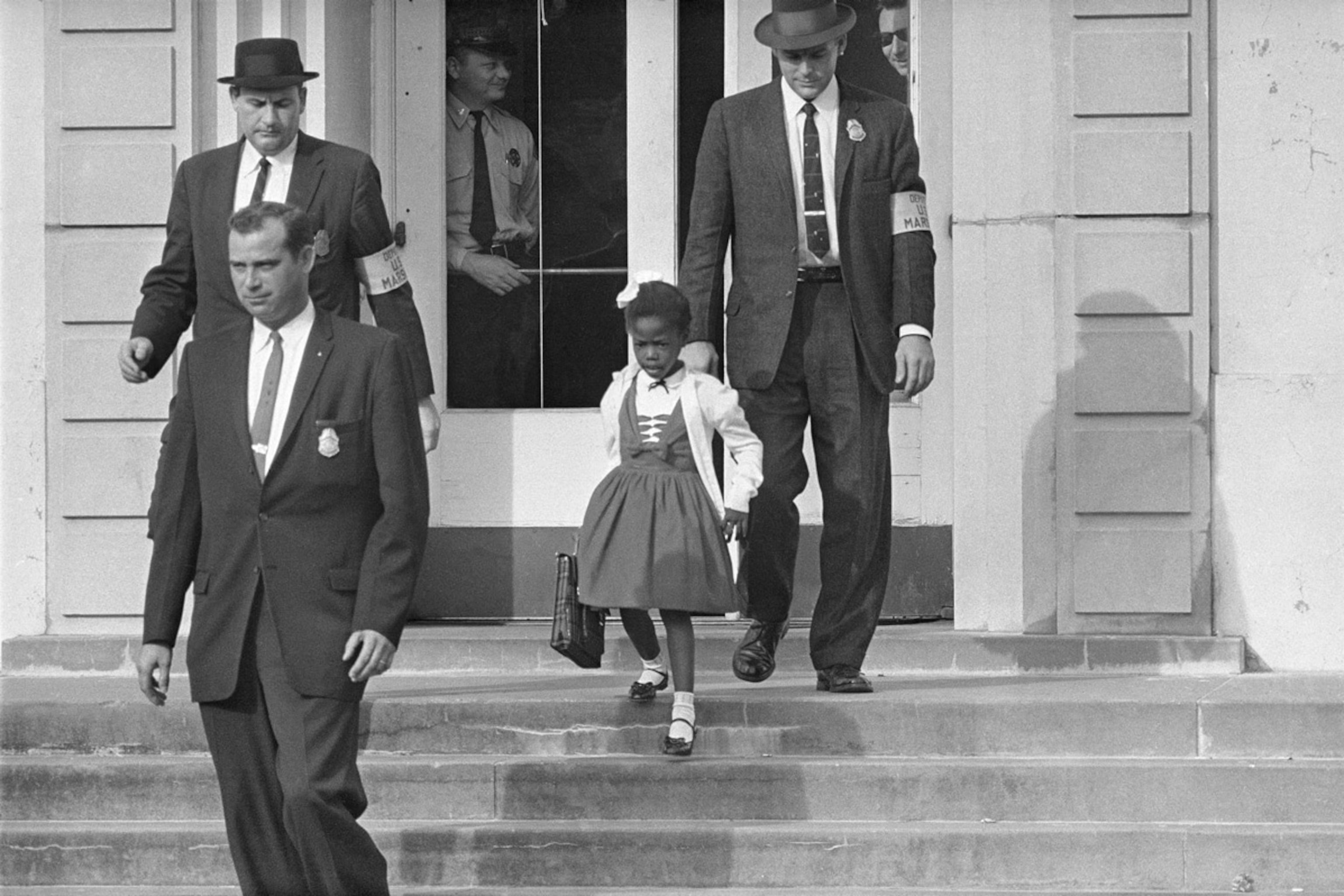
Six-year-old Ruby Bridges ends her school day at the all-white William Frantz Elementary School in New Orleans in November 1960 | Photograph by ASSOCIATED PRESS
Indeed, historians note that while the Supreme Court ruled school segregation unconstitutional in 1954 in Brown, it wasn’t until after the 1964 Civil Rights Act that federal enforcement of the court’s ruling became widespread. Armed with the power to withhold funds from non-compliant districts, the Department of Health, Education and Welfare (HEW)—which would later become the Department of Education—provided the “muscle for integration.”
In practical terms, this meant school districts could no longer delay; they had to submit real desegregation plans or face consequences.
Nationwide, How Did the Civil Rights Act Influence Schools in this period?
Under President Johnson, HEW tied Title VI compliance to money from the new Elementary and Secondary Education Act of 1965, effectively leveraging school integration through funding. Scores of districts that had refused to integrate throughout the late 1950s and early 1960s finally began to do so under the Act’s watch.
In Mississippi, for example, virtually no Black children attended white schools in 1964; by 1970, after vigorous enforcement, over 90% of African American students in the former Confederate states were attending integrated schools.
This astonishing turnaround within a few years illustrates the Act’s impact when coupled with strong federal oversight.
One key enforcement policy was the threat of fund termination. School boards understood that Title VI’s mandates had real bite. In Virginia, Black parents worked with their local NAACP chapter to desegregate New Kent County schools in 1965 by explicitly citing the Civil Rights Act’s fund cutoff provision as leverage in their lawsuits.

Thurgood Marshall outside the Supreme Court in Washington in 1958. | Photo by the Associated Press
In short, federal policy and local civil rights activism worked in tandem: the law empowered officials to enforce desegregation, and civil rights advocates pressed for those tools to be used.
Federal enforcement sometimes met resistance, but by the late 1960s it had the backing of the Supreme Court. After years of massive resistance in some states, the Supreme Court grew impatient with slow compliance, bolstered by the clear requirements of the Civil Rights Act.
As described next, a series of major court decisions in the late 1960s and early 1970s, often invoking the Act or its principles, forced the final demolition of official school segregation.
WhICH Landmark Court Cases Shaped School Desegregation?
Several pivotal court cases both shaped, and were shaped by, the Civil Rights Act’s educational mandates. These cases interpreted the Constitution’s equal protection clause and the Civil Rights Act in ways that profoundly influenced schools.
-
Brown deserves notes as the starting point when the Supreme Court declared segregated public schools “inherently unequal,” but implementation was slow.
The Civil Rights Act of 1964 was in many ways a legislative response to Brown’s call for integration, enforcing what Brown had promised. The Act explicitly authorized the Justice Department to revive Brown’s mandate by suing recalcitrant districts and affirmatively to protect constitutional rights in public education.
Without Brown there would have been no mandate to enforce; without the Civil Rights Act, Brown’s mandate might have remained unenforced. The synergy of the two was crucial to change in the 1960s.
-
This Supreme Court ruling marked a turning point for meaningful integration. In New Kent County, Virginia ran a “freedom-of-choice” plan allowing students to select schools, which led to the slow advancement of integration (few Black students chose all-white schools, and no white students chose Black schools).
After the Civil Rights Act threatened the district’s federal funds, a lawsuit by Black parents (the Green family) challenged the inadequate plan. The Supreme Court unanimously held that such freedom-of-choice plans were insufficient; school boards had an “affirmative duty” to eliminate segregation “root and branch.”
The Court noted that the county’s dual system extended to “every facet of school operations” and that any plan must be judged by its effectiveness in actually achieving a non-racial system.
This decision, often called the most important school desegregation ruling since Brown, was a direct rebuke to years of foot-dragging and was enabled by the enforcement climate created by the Civil Rights Act.
-
If Green demanded speed, Alexander ended all excuses. In October 1969, the Supreme Court issued a brief but powerful per curiam order insisting that the era of “deliberate speed” was over.
The Court held that “it was the obligation of every school district to immediately terminate any and all segregated school systems and to only operate integrated schools.”
This ruling, coming after the Justice Department (now emboldened by Title IV of the Civil Rights Act) pressed for quicker action, meant that by the start of 1970, dual school systems, especially in the South, had to be dissolved at once.
As a result, the 1969–1970 school year saw a massive jump in integration. Southern schools that had been nearly 100% segregated a few years earlier were rapidly moving toward unitary (integrated) status.
-
The Civil Rights Act had explicitly stated that it did not require “busing” students to achieve racial balance beyond what the Constitution required, a clause meant to allay fears of federal overreach.
However, when integration still faced resistance due to segregated housing patterns, courts stepped in with busing as a remedy.
In Swann, the Supreme Court unanimously upheld the use of busing and other techniques to integrate schools.
It ruled that federal courts could require local school districts to reassign students and use busing to overcome segregation, noting this was often necessary “to speed up the racial integration of public schools.”
Charlotte, North Carolina’s schools had remained largely segregated due to neighborhood segregation; Judge James McMillan’s busing plan, later affirmed by the Supreme Court, dramatically integrated the district.Swann thus endorsed robust desegregation remedies (within a single district), signifying that the highest court–in line with the spirit of the Civil Rights Act–would countenance strong measures to fulfill the law’s promise of integrated education. Busing soon became a standard tool in many cities during the 1970s.
It’s worth noting that cross-district busing was later limited by the Milliken v. Bradley (1974) decision, which barred inter-district remedies in the absence of proven inter-district segregation, a setback that curtailed metropolitan-wide integration in places like Detroit.
-
Unlike Southern states, places like Denver, Colorado, had no laws requiring segregation. Yet segregation existed in practice through gerrymandered attendance zones and school site selection (so-called de facto segregation). In Keyes, black and Hispanic parents invoked the Equal Protection Clause to challenge Denver’s segregated schools.
The Supreme Court extended desegregation obligations beyond the South: it held that if plaintiffs prove intentional segregation in part of a district, the burden shifts to the district to show it did not segregate elsewhere. Justice Brennan wrote that evidence showed Denver’s school board “intentionally created and maintained” segregation in core city schools.
As a result, the entire district was ordered to desegregate, marking the first major northern desegregation case. Keyes was influenced by the Civil Rights Act’s principles (it was essentially a private lawsuit analog to what Title IV empowered the DOJ to do) and it acknowledged that the right to integrated schools was national in scope, not just a Southern issue.
After Keyes, many northern and western cities faced similar suits, though proving intent (as required) was often challenging. Still, Keyes underscored that the legacy of the Civil Rights Act–equal educational opportunity–applied everywhere, not only where Jim Crow had been law.
-
The Civil Rights Act also transformed schools in less expected ways. Title VI’s prohibition on national-origin discrimination became the basis for this landmark case on the rights of English language learners.
In San Francisco, Chinese American students with limited English received no supplemental language instruction and struggled in school. They sued under the Civil Rights Act, since the school district received federal funds. The Supreme Court unanimously ruled that failing to provide English language instruction to students who need it effectively denies them equal educational opportunity, violating Title VI.
In other words, a “neutral” policy (teaching only in English) had a disparate impact on non-English-speaking students and thus ran afoul of the Civil Rights Act’s ban on discrimination in federally funded programs.
Lau v. Nichols led to a mandate that schools take affirmative steps (such as bilingual education or ESL programs) to help students with limited English proficiency.
This greatly influenced how schools accommodate immigrant and language-minority students, showing the Act’s broad influence beyond black–white integration. The Lau decision ushered in a new era of bilingual education policies.
-
The Civil Rights Act’s influence extended to higher education admissions and the emerging practice of affirmative action.
Allan Bakke, a white applicant, challenged a special admissions program for minority students at UC Davis Medical School, citing Title VI of the Civil Rights Act (which applies the same standard as the 14th Amendment to any institution receiving federal funds).
In a fragmented decision, the Supreme Court struck down strict racial quotas but upheld consideration of race as one factor in admissions.
The Civil Rights Act was central because Bakke’s claim was that the university, by reserving seats for minorities, was discriminating against him on the basis of race in a federally funded program (thus violating Title VI).
Justice Powell’s controlling opinion concluded that rigid quotas violated Title VI/Equal Protection, but that using race as a “plus” factor to achieve educational diversity could be permissible.
This compromise shaped college admissions policies for decades and was a legacy of the Act’s nondiscrimination principle. Interestingly, the Act intended to protect minorities, but here it was used as a tool by a majority applicant.
The Bakke case and later affirmative action rulings (such as Grutter v. Bollinger in 2003 and Fisher v. Texas in 2013) highlight the continuing debate over what nondiscrimination requires in education.
They underscore that the Civil Rights Act influenced schools not only by outlawing exclusion, but also by prompting questions of how to ensure inclusion and diversity in post-segregation America. (Recent developments, like the 2023 Supreme Court decision ending race-conscious admissions, show this remains a contentious legacy of the Act in higher education.)
Each of these cases, and many others at district and appellate levels, collectively enforced and interpreted the Civil Rights Act in education. They dismantled dual school systems, required proactive integration measures, extended protections to new groups and grappled with the meaning of equal opportunity. Through litigation and enforcement, the promise of the Act gradually became reality in classrooms across America.
The Civil Rights Act’s Impact on K–12 Schools: Integration and Achievement
By the mid-1970s, the legal architecture of school segregation had been demolished. But How Did the Civil Rights Act Influence Schools in measurable outcomes for students?
The changes were profound. Following the vigorous desegregation of the late 1960s, the South, once fully segregated, became the most integrated region of the country. For a time, integrated education led to significant gains for minority students in several areas:
-
Thanks to the Act and subsequent court orders, the percentage of Black students in the South attending majority-white schools skyrocketed from near-zero in 1964 to a peak in the late 1980s.
By 1988, over 43% of Black students in America attended schools that were majority-white—a high point of integration unheard of in prior generations. This represented not just statistical mixing but greater access for Black students to resources that had traditionally been concentrated in white schools, from experienced teachers to advanced courses.
-
Desegregation coincided with rising graduation rates and educational attainment for minorities. In the decades after 1964, the high school completion rate for African Americans climbed steadily, closing much of the gap with whites. In 1964, a far smaller share of Black Americans finished high school compared to whites; by the 1990s that gap had narrowed significantly.
For example, data from the US Department of Education show the Black youth dropout rate (ages 16–24) fell from 20.5% in 1976 to 13.0% in 1996. By 1997, three-quarters of African Americans aged 25+ had completed high school, up from just two-thirds in 1990. Similarly, college enrollment and completion rose: 60% of African American high school graduates in 1997 went straight to college, up from 52% a decade earlier, and the proportion of Black adults with college degrees also grew.
From integrated K–12 schools that raised expectations, to affirmative action and outreach in higher education, these gains reflect improved access to education that the Civil Rights Act helped foster.
-
The integration era saw notable improvements in test scores for minority students and a narrowing of the achievement gap. On the National Assessment of Educational Progress (NAEP), often called the Nation’s Report Card, Black and Latino students made large gains in the 1970s and 1980s, closing portions of the gap with white students. By the late 1980s, the Black–White test score gap in reading and math was the smallest on record, coinciding with the high point of school integration.
Researchers have linked some of these academic gains to the effects of desegregation, such as minority students in integrated schools often having better access to resources, experienced teachers and peer environments that supported achievement. While many factors influence educational outcomes, the Civil Rights Act undeniably opened doors that had previously been closed to students of color, enabling them to learn in higher-quality schools and setting the stage for improved outcomes.es here
-
Through Title VI enforcement, the Civil Rights Act also prompted equity in school resources and funding, though progress was uneven. Integrating schools meant that, at least within the same district, expenditures per pupil and facilities began to equalize.
In some instances, litigation under the Act addressed blatant disparities. For example, the Department of Education’s Office for Civil Rights investigated districts for providing inferior facilities or curriculum to minority schools, pressuring improvements. Additionally, the Act’s principles influenced later reforms: it laid groundwork for subsequent legislation like the Emergency School Aid Act (1972) which provided aid to districts undergoing desegregation, and it set a precedent that “separate is inherently unequal,” underpinning school finance lawsuits in many states.
It’s important to acknowledge that desegregation also came with challenges. One unintended consequence was a steep decline in Black teachers in the South: during integration, many all-Black schools closed and Black teachers/principals lost jobs as districts ostensibly consolidated staff.
Research conducted by the National Bureau of Economic Research found the share of black teachers in Deep South schools fell from 30.6% in 1964 to 24.2% in 1972” as white-run school boards often preferred to keep white teachers.This not only hurt Black educators’ employment but also meant Black students had fewer same-race role models in integrated schools. The loss of the Black teacher workforce is a complex legacy of how integration was implemented, and it reminds us that progress can have costs that need addressing (a challenge still being tackled today through efforts to diversify the teaching workforce).
Overall, however, the immediate decades following the Civil Rights Act saw dramatic improvements in minority educational access. No longer legally excluded, millions of Black and brown children entered previously white-only schools. Many thrived in environments with better funding and opportunity, and the positive trend lines of graduation rates and test scores in the 1970s and 1980s underscore that the Civil Rights Act’s influence on schools was largely beneficial in leveling the playing field.
Higher Education and the Civil Rights Act: Expanding Access
The Civil Rights Act’s influence was not confined to K–12 schools; it also transformed higher education. Title VI’s ban on discrimination in federally assisted programs applied to virtually all colleges and universities, since most receive some form of federal funding (student loans, research grants, etc.).
In 1964, many public universities in the South still restricted black enrollment or maintained token integration, and few predominantly white colleges elsewhere actively recruited minorities. The Act changed incentives in higher ed, just as in elementary and secondary schools.
-
Southern state universities, which had been battlegrounds (recall James Meredith’s integration of Ole Miss in 1962 under federal guard), were now unequivocally required to admit students of all races or forfeit federal money.
Over the latter 1960s, flagship universities like the University of Alabama, University of Georgia, and others fully desegregated under this pressure. The Department of Health, Education, and Welfare pressed 19 states in 1969–1970 to submit plans for desegregating their state university systems, under threat of fund termination. This resulted in increased Black student enrollment at historically white institutions and efforts to improve historically Black colleges.
In one notable case, Adams v. Richardson (1973), a federal court ordered HEW to enforce Title VI more aggressively in higher education, as civil rights groups complained some states were still operating segregated systems. The enforcement of the Act thus spurred reluctant state systems to take action–merging racially duplicate institutions, diversifying faculty, and recruiting minority students.
By the 1970s and 1980s, college access for students of color had expanded significantly. From 1976 to 1996, total minority enrollment in U.S. colleges rose by 61%. Black student college enrollment increased by 20% in the 1990s alone, and the number of degrees earned by minority students climbed sharply (for instance, bachelor’s degrees earned by African Americans in engineering went up 75% from 1981 to 1996).
Many of these gains trace back to pipelines built after the Civil Rights Act, such as recruitment programs and scholarships for minority students, outreach by universities under affirmative action policies and the diminishing of blatant exclusionary practices.
-
The Act’s legacy in higher education also encompasses the rise (and recent fall) of affirmative action in admissions. In the late 1960s, as part of the effort to remedy historical inequities, colleges began implementing affirmative action; i.e. the setting of goals or considering race in admissions to boost minority representation.
Title VI allowed this as long as it wasn’t explicit “discrimination” against individuals, a line the courts would later parse in Bakke (1978) and beyond. Over the decades, affirmative action helped increase Black, Hispanic and Native American student presence in many selective colleges, and produced a generation of minority professionals who benefitted from opportunities previously denied.
However, it also provoked legal challenges (as noted with Bakke) and, unfortunately, remains contentious. In recent years, the Supreme Court’s rulings have curtailed the use of race-based preferences, arguing that the Civil Rights Act and Equal Protection Clause protect all races from differential treatment, thus coming full circle to an interpretation that any racial categorization–even to promote diversity–is suspect.
This ongoing debate underscores that the Civil Rights Act’s influence is dynamic: it reshaped institutions to be more open, yet how to achieve lasting equality in higher education remains an evolving question.
-
Beyond admissions, Title VI has been used to address other forms of discrimination in higher education. It covers not only student access but also campus environments. For example, Title VI has been invoked in cases of racially hostile environments or unequal campus services.
Moreover, the success of Title VI inspired additional protections: Title IX of 1972 (for gender equity in education) was modeled on Title VI, extending the Act’s approach to sex discrimination; likewise Section 504 of the Rehabilitation Act (1973) and the ADA (1990) addressed disability, and the Age Discrimination Act (1975) addressed age—all with similar language of nondiscrimination in federally funded programs.
In that sense, the Civil Rights Act’s influence on schools radiated outward, creating a framework for equity that has broadened over time.
Ongoing Challenges and the Legacy in Education
The Civil Rights Act of 1964 unequivocally changed American schools for the better, but its legacy is complicated by both remarkable progress and stubborn challenges.
More than 60 years since Brown and over half a century since the Act, the question How Did the Civil Rights Act Influence Schools invites reflection on where we stand today:
-
After peaking in the 1980s, school integration has been backsliding. Court supervision of desegregation plans waned (many districts were declared “unitary” and freed from court orders in the 1990s), and subsequent Supreme Court decisions limited what districts could do voluntarily to maintain racial balance (notably Parents Involved in Community Schools v. Seattle, 2007).
The result has been a steady increase in school segregation by race and class. Studies show that since around 1990, the proportion of Black students in majority-white schools declined, and the share of intensely segregated minority schools (those with 90–100% non-white enrollment) has more than tripled.
Today, Black and Latino students are often concentrated in high-poverty schools that are segregated in fact if not by law. This “resegregation” is driven by residential segregation, court rollbacks, and in some cases choices like secession of school districts. It means that many students still attend racially isolated schools, a trend that threatens to undermine some of the Act’s hard-won gains. The legacy of the Civil Rights Act compels us to view this trend with alarm, as it shows that legal equality does not automatically yield substantive equality.
-
While outright barriers to attendance were removed, racial gaps in academic achievement and opportunity persist. On average, Black, Latino and Native American students still have less access to advanced coursework, experienced teachers and high-quality facilities than their white peers.
The disparity in school funding between districts (often along racial lines) remains a major issue–something the federal Civil Rights Act didn’t directly address, since school funding is largely state/local. This inequity contributes to ongoing achievement gaps.Notably, after narrowing through the 1980s, test score gaps stopped closing and even widened in some cases after schools resegregated and inequality in resources grew in the 1990s and 2000s. The Civil Rights Act’s promise is only partly fulfilled until these gaps are eliminated. Efforts like funding reforms, accountability systems and educational equity initiatives today are all, in a sense, part of the Act’s long legacy–the work of guaranteeing truly equal educational opportunity continues.
-
The legacy of Lau v. Nichols lives on in how schools serve English Language Learner (ELL) students. Public schools now routinely provide ESL programs or bilingual education to ensure students with limited English proficiency can participate meaningfully–a direct outgrowth of Title VI enforcement.
Similarly, Title VI has been used to protect students from harassment due to religion or ethnicity (for instance, anti-Semitic or anti-Muslim harassment can be addressed as ethnic origin discrimination). The Civil Rights Act’s influence thus adapts to new contexts, reinforcing that schools must be safe and inclusive for all backgrounds.
-
Perhaps one of the Act’s most enduring legacies is the idea that diversity is a value in education. The experience of generations learning side by side has produced well-documented benefits, such as higher academic achievement, improved cross-cultural understanding, reduced prejudice and promotion of civic participation in a diverse society.
These benefits echo the arguments civil rights leaders made in the 1960s about why integration matters. However, achieving diversity requires conscious effort in an era when the legal tools for integration are fewer.
In sum, How Did the Civil Rights Act Influence Schools? It revolutionized them.
It struck down lawful segregation, compelled integration of millions of students and opened educational institutions to people of all races, fundamentally changing the face of American education. The Act’s enforcement mechanisms—lawsuits, fund termination and oversight—proved critical in translating moral principle into actual practice in classrooms. Over time, its influence helped narrow educational disparities and produced a more diverse educated populace.
Yet, it also became the foundation for new debates (such as how to handle affirmative action or address de facto segregation) that continue to the present day. The Civil Rights Act did not solve every problem in education, many inequities linger, but it provided the necessary conditions to begin solving them by ensuring that de jure discrimination could no longer block the path.
Its legacy in schools is seen every day in the diverse halls of our public schools and universities, in the expectations of fairness we hold, and in the continuing struggle to fulfill its promise. The task now is to carry that legacy forward. In doing so, we honor the Act’s transformative impact on America’s schools and its enduring vision of equal educational opportunity for all.


Vivamus pellentesque vitae neque at vestibulum. Donec efficitur mollis dui vel pharetra.