What Tulsi Gabbard’s Resignation Reveals About the Bargain of Borrowed Power
Tulsi Gabbard Worked to Dismantle the Covert Forever War Machine. Then She Watched Trump Launch Overt Wars Without Her
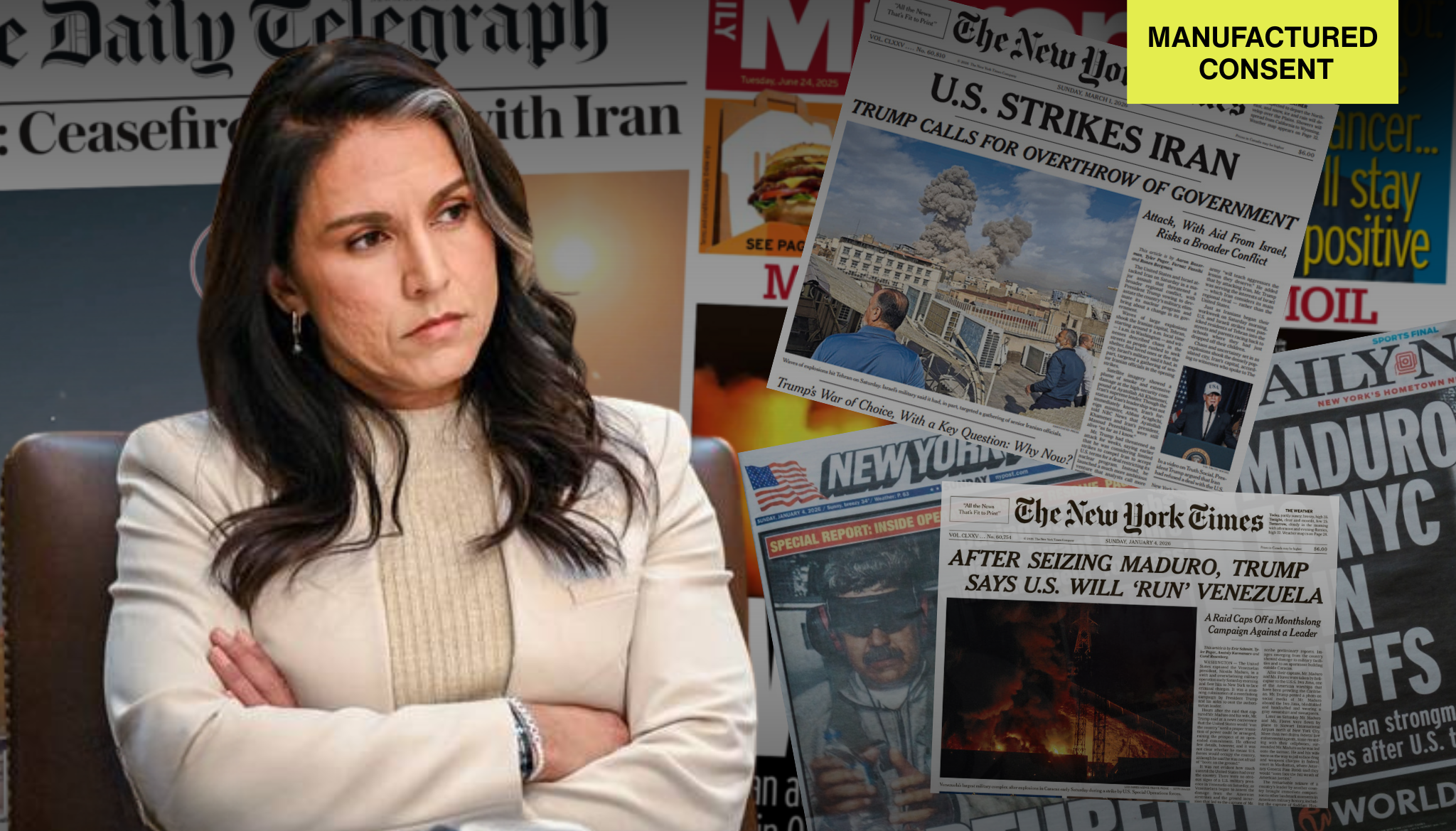
Tulsi Gabbard’s resignation as director of national intelligence was officially explained as a family decision. On May 22, 2026, she announced she would leave the post effective June 30, citing her husband’s diagnosis with a rare form of bone cancer.
Publicly, President Trump praised her service, but reporting around her departure told a harder story: a rocky tenure, mounting isolation and a top intelligence official increasingly cut out of the national-security decisions that mattered most.
That is where the story begins. Not with Gabbard’s appointment, or her break with the Democratic Party, or even the years of accusations that she had become too sympathetic to America’s adversaries. It begins with the bargain exposed by her exit.
Gabbard entered Trump’s second administration as one of the strangest figures ever placed at the top of the U.S. intelligence community: a former Democratic congresswoman, a combat veteran, an Iraq War critic, a presidential candidate and a politician whose public identity had been built around opposition to regime change.
Trump gave her the title, the reform mandate and the chance to confront the intelligence bureaucracy she had spent years condemning. For a while, it looked like power. Then came the wars.
January 3, 2026. Mar-a-Lago. The director of national intelligence was not in the room.
Trump sat surrounded by advisers as Operation Absolute Resolve unfolded on screens: the invasion of Caracas, the capture of Nicolás Maduro, U.S. military strikes across Venezuela. Marco Rubio was there. Pete Hegseth was there. John Ratcliffe was there. Stephen Miller was there.
Gabbard, who had been placed above 18 intelligence agencies and made the president’s principal intelligence adviser, was in Hawaii.
The image was almost too neat: the woman appointed to dismantle the covert war machine watching, from a distance, as Trump used overt force.
According to later reporting, her absence from key Venezuela and Iran decisions became emblematic of her diminished role inside the administration. White House aides reportedly joked that DNI stood for “Do Not Invite.”
That joke reduced her to an internal punchline, but the larger story is less simple.
Gabbard did not arrive in Trump’s administration as a conventional loyalist or a decorative appointment. She came in with a specific grievance against the foreign-policy establishment and a specific theory of how American intervention worked. She believed the machinery of regime change could be named, exposed and dismantled from the inside.
To understand why Gabbard made the bargain, it helps to understand what she believed she was fighting.
Gabbard was a combat veteran with more than two decades of military service and multiple deployments to Iraq, Kuwait and Africa. She served eight years in Congress, including on the Armed Services, Foreign Affairs and Homeland Security committees. Her politics were shaped by proximity to the machinery of war rather than by abstraction.
Her break with the Democratic establishment began in earnest in January 2017, when she traveled to Syria, met with Bashar al-Assad and spoke with Syrian civilians.
When she returned, she said the thing Washington was least prepared to tolerate from a Democrat with military credentials: “I will not support a policy of allying with Al-Qaeda to overthrow a sovereign government.”
The comment cut through years of euphemism around Syria. U.S. policy had relied on a shifting universe of rebels, opposition groups and armed factions, some of them entangled with extremist networks. Gabbard’s formulation was blunt, morally loaded and politically radioactive. It made her impossible for the party’s foreign-policy class to absorb.
Hillary Clinton later called her a “Russian asset.” Bernie Sanders defended her, saying Gabbard had “put her life on the line to defend this country.”
“People can disagree on issues, but it is outrageous for anyone to suggest that Tulsi is a foreign asset, Sanders tweeted.
Former Rep. Beto O'Rourke of Texas also defended Gabbard, saying she "is not being groomed by anyone" and that the focus of the campaign should be on the economy, climate change and other issues affecting Americans.
Pete Buttigieg also dismissed the claim, saying that "there is no basis for that" and "statements like that ought to be backed by evidence."
The party chose Clinton’s suspicion over Sanders, O’Rourke and Buttigieg’s defense.
On October 11, 2022, Gabbard left the Democratic Party, denouncing what she called “an elitist cabal of warmongers.” Two years later, Trump made the offer.
Her confirmation hearing revealed the terms of entry. Gabbard opened with a warning that senators would hear “lies and smears” challenging her loyalty and love of country.
Mark Warner said she had “repeatedly excused our adversaries’ worst actions” and blamed the United States instead. Michael Bennet pressed her over Edward Snowden. So did others, from both parties.
“Is Edward Snowden a traitor?”
Gabbard’s answer remained fixed: “He broke the law.”
She would not call him a traitor. Snowden had exposed illegal mass surveillance programs later challenged in court. He had also leaked classified information and fled to Russia. Gabbard’s refusal to use the approved word became the hearing’s central issue. The question was less about Snowden than obedience.
Mitch McConnell, the establishment’s establishment Republican, voted against her confirmation. He was the only Republican to do so. The final vote was 52-48, almost identical to the vote that confirmed Robert F. Kennedy Jr. as Health and Human Services secretary the day before.
On January 24, 2025, just 12 days after confirmation, Trump issued a stop-work order to the U.S. Agency for International Development, known as USAID.
The agency had worked across many of the world’s most food-insecure and climate-besieged regions, funding thousands of humanitarian, healthcare, food assistance and disaster relief programs. It was also part of a larger foreign-policy architecture.
Less than six months later, the agency was gone. By July 1, 63 years of operations had been erased, 83 percent of programs had been terminated and every overseas staff position had been cut.
Editor’s Note: The human cost of that decision to cut USAID is not to be minimized. We recognize that USAID was one of the central ways the United States delivered food, medicine, emergency response and public-health support to communities facing war, famine, disease and climate disaster.
On February 13, 2025, Trump suspended funding for the National Endowment for Democracy, a congressionally funded nonprofit created during the Cold War to support democratic institutions, political parties, labor groups, civil society organizations and independent media abroad.
By August, Gabbard had announced a 40 percent reduction in the Office of the Director of National Intelligence, a move projected to generate $700 million in savings. She also dismantled the Foreign Malign Influence Center.
Taken together, these moves cut into the infrastructure through which the United States had long projected influence abroad, sometimes through humanitarian assistance, sometimes through intelligence and sometimes through democracy-promotion programs that blurred the line between civic support and geopolitical strategy.
For decades, USAID and NED occupied that uneasy space. Both supported programs that could be genuinely valuable to people on the ground. Both also operated within a U.S. foreign-policy system that used aid, civil society funding and media support to shape political outcomes in countries where Washington had strategic interests.
NED co-founder Allen Weinstein acknowledged that continuity in 1991 when he told The Washington Post: “A lot of what we do today was done covertly 25 years ago by the CIA.”
Ukraine in 2014 offered a vivid example of that machinery in motion.
On February 6, 2014, a leaked call between Victoria Nuland, then assistant secretary of state for European and Eurasian affairs, and Geoffrey Pyatt, the U.S. ambassador to Ukraine, appeared online.
The call, reportedly intercepted and released by Russian sources, captured two senior U.S. officials discussing the shape of a future Ukrainian government while the country was still in political crisis.
Nuland was reportedly explicit about her preferred outcome. “I think Yats is the guy,” she said, referring to opposition leader Arseniy Yatsenyuk. “He’s got the economic experience.” At another point, frustrated with European diplomacy, she added: “Fuck the EU.”
On February 21, Viktor Yanukovych, Ukraine’s elected president, signed an agreement with opposition leaders meant to end the crisis. Within days, he had fled Kyiv and was removed from office. On February 27, Yatsenyuk became prime minister. The man Nuland had described as “the guy” was now leading the government.
A month later, Jeffrey Sachs arrived in Kyiv.
Jeffrey Sachs was one of the most prominent development economists in the world: a principal contributor to the U.N. Sustainable Development Goals and a longtime adviser on post-Soviet economic transitions in Russia, Poland, Slovenia and Ukraine.
His career had placed him close to some of the most consequential economic restructurings of the post-Cold War era.
In February 2025, Sachs testified before the European Parliament that, when he arrived in Kyiv in March 2014, he was told by U.S.-backed organizations that American money had helped finance the networks around Maidan.
“I was told how the U.S. paid the money for all the people around the Maidan,” Sachs said. He pointed to media outlets, buses and organizational infrastructure as evidence that the uprising was not as spontaneous as Western audiences were often told.
“This is an organized effort. And it's not a secret, except perhaps to citizens of Europe and the United States," he stated.
Libya in 2011. Syria in 2011. Ukraine in 2014. The details differed, as they always do, but the machinery was recognizable: fund the opposition, narrate the instability, then present intervention as rescue. Gabbard appeared to believe she had dismantled the mechanism.
Six months after USAID was shuttered, Trump invaded Venezuela without telling her.
On January 3, 2026, U.S. forces carried out Operation Absolute Resolve, a direct military operation in Caracas that resulted in the capture of Venezuelan President Nicolás Maduro.
The mission included thirty-two military strikes and killed one hundred and fifteen people. It was overt force, ordered by the president and executed through the military chain of command.
As director of national intelligence, Gabbard oversaw the intelligence community and served as a principal intelligence adviser to the president, the National Security Council and the Homeland Security Council. Her office could shape intelligence priorities, oversee national intelligence programs and coordinate among agencies. It did not give her command over the military.
Trump did not need the infrastructure she had tried to dismantle if he was willing to bypass the softer instruments of influence and move directly to force. Iran followed the same pattern.
In June 2025, Trump publicly broke with Gabbard’s intelligence assessment that Iran was not actively building a nuclear weapon, telling reporters she was “wrong” after she had testified that the intelligence community continued to assess Iran had not reauthorized its suspended nuclear weapons program.
Days later, the U.S. struck Iranian nuclear sites.
By February 2026, the conflict had widened into a direct U.S.-Iran war. The bombing campaign that preceded the April 8 ceasefire had drawn in U.S. and Israeli forces, left the Strait of Hormuz at the center of a global energy crisis and produced a fragile diplomatic effort to keep the ceasefire from collapsing.
Iran responded with strikes of its own against U.S. military assets in the region and continued to use the Strait of Hormuz as leverage. Since the April ceasefire, the U.S. has remained entangled in naval operations around the strait, with negotiations now focused on reopening the waterway, lifting aspects of the blockade and preventing the war from reigniting.
Once again, Gabbard was not the central actor. The Guardian reported that CIA Director John Ratcliffe had taken a more prominent advisory role after Trump’s decision to attack Iran, while the Wall Street Journal described Gabbard’s tenure as defined by exclusion from key decisions and public conflict with the president over Iran intelligence.
Trump did not need covert scaffolding if he was willing to use overt force. He did not need a democracy-promotion pipeline if he was willing to send missiles. He did not need Gabbard’s intelligence consensus if he had already decided the answer.
Gabbard appeared to believe that dismantling pieces of the covert infrastructure would force foreign policy back into public view, where war would have to be debated, authorized and owned.
Trump took a cruder route. He skipped the covert phase, ignored the intelligence warning signs and used the military directly.
That is the bitter turn in the story. The covert Forever War mechanism may have been weakened but the appetite for war remained intact.
For decades, liberal institutions have insisted that representation matters. Women should be in power, women should be in the room, women can be trusted with the machinery of state.
On February 12, 2025, Tulsi Gabbard entered one of the most powerful rooms in Washington. As director of national intelligence, she was placed at the top of an 18-agency intelligence community and made the president’s principal intelligence adviser. But the celebration never came.
Gabbard had the résumé liberal politics often claims to honor: a woman, a combat veteran, a former Democratic congresswoman and a former presidential candidate. Her elevation should have complicated the easy slogans about women in power. ‘
Instead, it exposed the condition attached to those slogans. Power is celebrated when it serves the right institutions. It becomes suspect when it threatens them.
That does not make Gabbard above scrutiny. Her record gave critics plenty to challenge, from her foreign-policy positions to her political realignment with Trump.
The point is narrower and more revealing: the same political culture that turns representation into a moral credential had little interest in defending the most powerful woman inside the intelligence state once she became inconvenient to its assumptions.
Robert F. Kennedy Jr. followed a similar path through a different wing of the same establishment. Trump offered him the Department of Health and Human Services, placing him inside the very regulatory structure he had spent years attacking.
A longtime critic of glyphosate, the herbicide used in Roundup, Kennedy said he had been given advance notice of Trump’s February 2026 executive order to boost domestic production of glyphosate-based herbicides and had made his disagreement known to the White House.
The order moved forward anyway, invoking national security and food-supply concerns to protect and expand production of a chemical Kennedy had spent years warning against.
Gabbard received a similar lesson in a different arena. She was given the title and the reform mandate but not the power to stop overt war once Trump chose to use the military directly.
Kennedy got authority over public health until public health collided with agribusiness.
Gabbard got authority over intelligence reform until intelligence reform collided with war-making.
That pattern runs across party and ideology. Join the coalition, lend it your credibility and believe, for a moment, that the office might give you the power to change things.
The bargain holds only until it threatens the wrong industries. Challenge the war machine, the pharmaceutical machine, the food system, the intelligence bureaucracy or the donor architecture beneath them, and the language of democracy suddenly becomes very flexible
Gabbard made the deal. She appeared to believe that dismantling parts of the covert infrastructure could weaken the Forever War state. She was wrong about Trump. She was not wrong about the establishment.
That is the lesson. When the enemy of your enemy offers you power, the power may be real, but the terms are rarely yours.